

Retatrutide Phase 3 Results for Sleep Apnea and Osteoarthritis: How Researchers Should Select Disease-Specific Endpoints
A drug that cuts dangerous breathing pauses by more than 60 percent and slashes knee pain scores by nearly three-quarters, those are not typical weight-loss numbers. They are disease-specific signals, and they only appear when researchers choose the right endpoint from the start. The retatrutide Phase 3 results for sleep apnea and osteoarthritis: how researchers should select disease-specific endpoints is exactly the question that the TRIUMPH program answers in 2026, offering a practical blueprint for endpoint strategy across multi-system obesity-related conditions.
Key Takeaways
- Retatrutide's TRIUMPH Phase 3 program met primary endpoints across obesity, obstructive sleep apnea (OSA), and knee osteoarthritis (OA) at approximately 80 weeks.
- The Apnea-Hypopnea Index (AHI) and the WOMAC pain subscale were chosen as disease-specific primary endpoints for OSA and knee OA, respectively, capturing benefits that go beyond weight loss alone.
- In knee OA, retatrutide reduced WOMAC pain scores by 73.1%; in OSA, AHI fell by 60.6%, roughly 36 fewer breathing pauses per hour.
- Co-primary endpoint designs (pairing a disease-specific measure with percent body weight change) are now a model strategy for obesity-linked comorbidities.
- Full peer-reviewed publications are still pending; most detailed data currently come from company releases and congress presentations.
Why Endpoint Choice Defines What a Trial Can Prove
Clinical trials answer only the questions their endpoints ask. In obesity research, percent change in body weight is a well-validated primary measure, but it cannot tell a regulator whether a patient's knee hurts less or whether their airway stays open at night. That gap is exactly why the retatrutide Phase 3 results for sleep apnea and osteoarthritis demand a closer look at endpoint selection methodology.
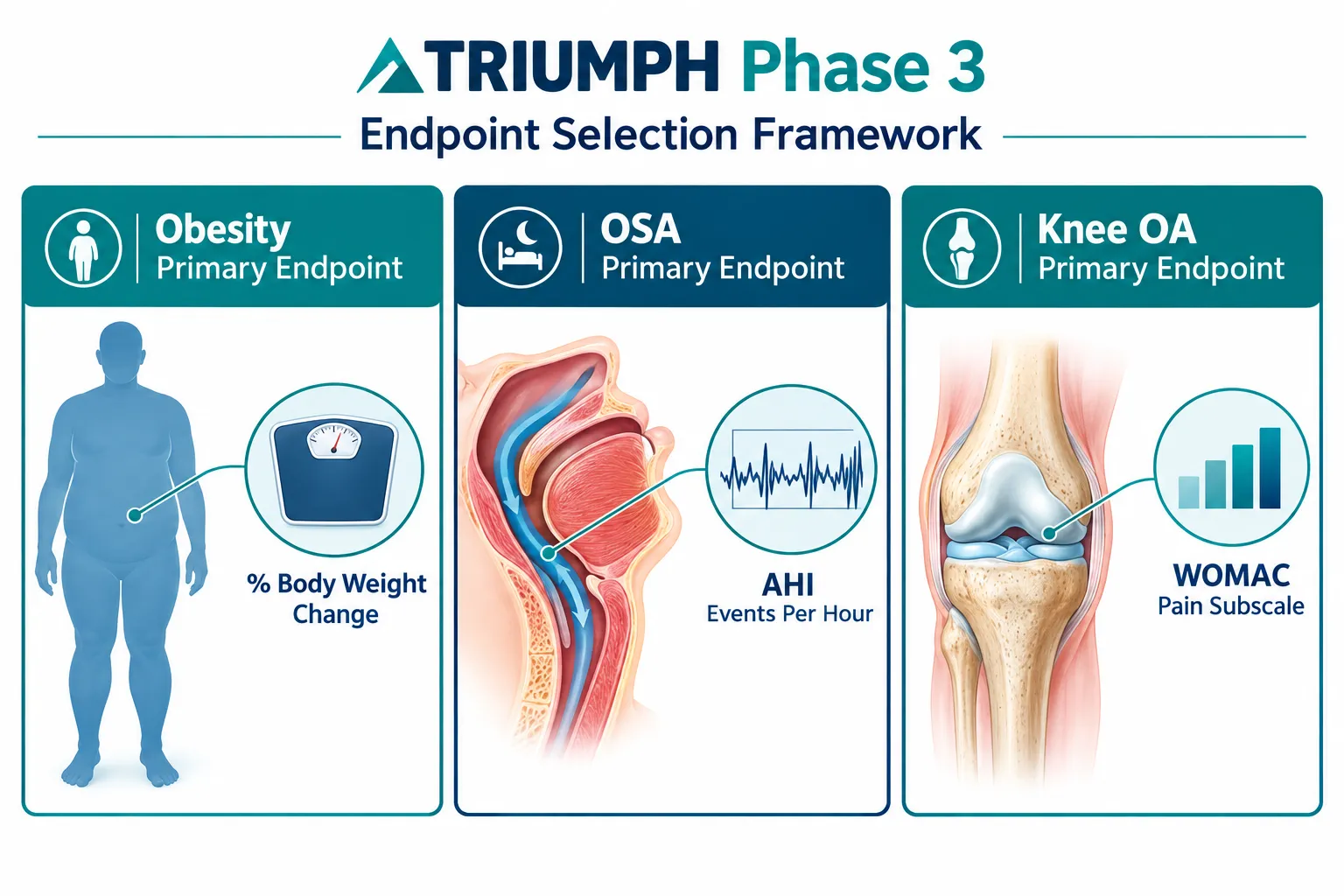
The TRIUMPH program enrolled 2,339 adults in its flagship obesity trial (TRIUMPH-1), with predefined subsets for knee OA and OSA. Mean weight loss reached 25.9% at the 9 mg dose and 28.3% at 12 mg over 80 weeks. Those figures are powerful, but they served as the platform from which disease-specific endpoints could be evaluated, not as a substitute for them.
Researchers working with GLP-3 Reta peptide materials in preclinical settings face a comparable decision: a biomarker of metabolic activity alone will not capture tissue-level or airway-level outcomes without a purpose-built measurement tool.
Retatrutide Phase 3 Results for Sleep Apnea: The AHI as a Precision Tool
The AHI counts how many times per hour breathing stops or becomes dangerously shallow during sleep. It is the gold-standard disease-specific endpoint for OSA trials because it directly quantifies the pathology, not just a correlate of it.
In participants with moderate-to-severe OSA and obesity, retatrutide reduced AHI by approximately 36.1 events per hour, a 60.6% drop from a baseline of 58.6 events per hour. Clinical commentary from 2026 notes that this reduction appears larger than what weight loss alone would predict, suggesting the AHI was sensitive enough to detect both respiratory and weight-mediated mechanisms simultaneously.
Why AHI worked here:
- It is continuous, allowing detection of graded improvement.
- It has established regulatory precedent as a primary endpoint in sleep apnea device and drug trials.
- It separates responders from non-responders in a way that subjective sleepiness scores cannot.
Secondary measures that strengthen AHI data:
| Endpoint Category | Example Measure | What It Adds |
|---|---|---|
| Subjective sleep quality | Epworth Sleepiness Scale | Patient-reported burden |
| Cardiometabolic safety | Blood pressure, HbA1c | Systemic risk context |
| Body composition | Percent fat mass | Weight-mediated pathway |
| Daytime function | Patient global impression | Functional relevance |

Researchers evaluating retatrutide through the GLP1-Reta research overview will recognize that the triple agonist mechanism, targeting GIP, GLP-1, and glucagon receptors, creates multiple physiological pathways, each of which may need its own measurement instrument.
Retatrutide Phase 3 Results for Osteoarthritis: Applying the WOMAC Subscale Correctly
Knee osteoarthritis endpoints present a different challenge: pain is subjective, functional limitation varies by patient, and structural changes on imaging may not correlate with symptoms in the short term. The TRIUMPH-4 trial addressed this by selecting the WOMAC pain subscale as one co-primary endpoint alongside percent body weight change.
Results showed a mean reduction of 4.3 points (73.1%) from a baseline WOMAC pain score of 6.0. That magnitude is clinically meaningful by any established threshold for minimal clinically important difference (MCID) in knee OA research.
What makes the WOMAC pain subscale the right choice:
- Disease specificity: It targets pain in the knee joint, not global pain or mood.
- Regulatory familiarity: Accepted by the FDA and EMA in prior OA drug approvals.
- Sensitivity to change: Its five-item format detects graded improvement across activities.
- Patient relevance: Items map directly to daily-life tasks like stair climbing and walking.
The co-primary design, requiring both the WOMAC pain subscale and percent body weight change to meet significance, is particularly important. It forces the trial to demonstrate that symptom relief is not simply a product of patients moving more because they weigh less. It separates the mechanical unloading benefit from any direct anti-inflammatory or analgesic effect.
Researchers interested in complementary tissue-level mechanisms can review related work on SS-31 mitochondrial research themes and SS-31 10mg research peptide considerations as examples of how endpoint granularity differs across biological pathways.
Building a Dual-Endpoint Strategy: A Practical Framework for Researchers
The TRIUMPH program's most transferable contribution may be its endpoint architecture. Across all four trials, Lilly paired a disease-specific primary measure with percent body weight change, then added cardiometabolic and functional secondary endpoints.
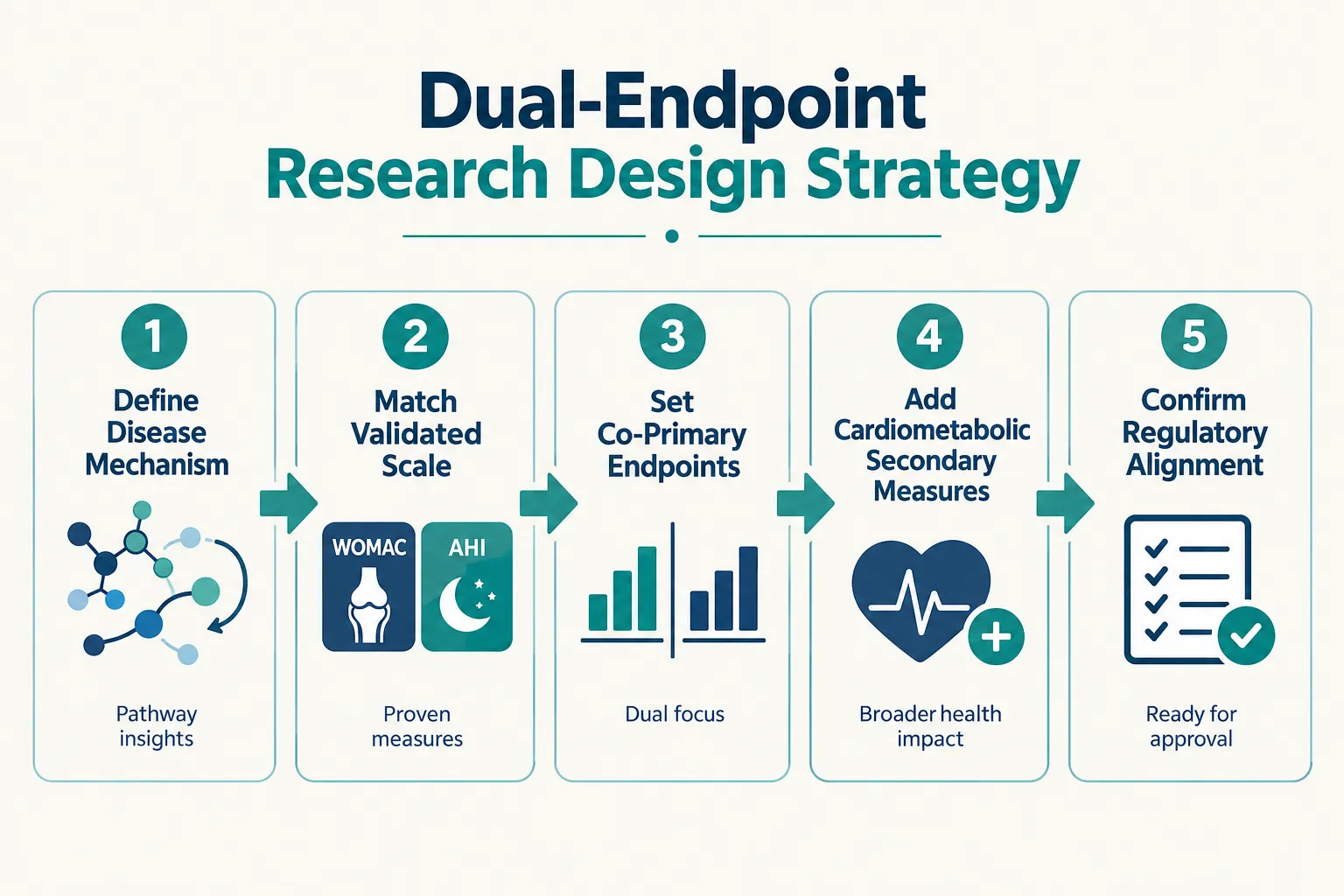
Researchers designing their own studies can apply this logic in five steps:
- Identify the dominant disease mechanism, airway collapse, joint degradation, glycemic dysregulation, or another target.
- Select a validated, regulatory-precedented instrument, AHI for OSA, WOMAC for OA, HbA1c for diabetes.
- Pair it with a weight-change measure when obesity is a contributing factor, creating a co-primary structure.
- Add functional and patient-reported secondary outcomes to capture daily-life impact.
- Include cardiometabolic safety endpoints to satisfy regulatory risk-benefit expectations.
This framework is relevant not only for large Phase 3 programs but for any investigator planning endpoint-driven preclinical or early-phase research. Resources on how to buy Reta and where to buy Reta for research-grade supply are available for investigators setting up controlled studies.
A key principle drawn from the TRIUMPH data: if the chosen endpoint is not sensitive enough to detect the full mechanism of action, a genuinely effective intervention can appear weaker than it is. The 60.6% AHI reduction likely would have been invisible if the trial had used body weight alone as its primary measure.
Conclusion
The retatrutide Phase 3 results for sleep apnea and osteoarthritis: how researchers should select disease-specific endpoints is not an abstract methodological question, it has direct consequences for what regulators see, what clinicians can act on, and what patients ultimately receive. The TRIUMPH program demonstrates that a triple agonist targeting metabolic pathways can produce profound, measurable improvements in OSA and knee OA, but only because the trials were designed to look for those improvements with the right tools.
Actionable next steps for researchers:
- Use AHI as the primary endpoint for any OSA-adjacent intervention study; pair it with at least one cardiometabolic secondary measure.
- Apply the WOMAC pain subscale as a co-primary alongside body weight change when studying obesity-related joint disease.
- Review the TRIUMPH co-primary design structure before finalizing any protocol that addresses an obesity comorbidity.
- Monitor peer-reviewed publications from the TRIUMPH program as they become available, since full datasets will refine secondary endpoint interpretations.
- Consult the Reta 30mg research tag and GLP-3 Reta 20mg product page for research-grade material specifications relevant to dose-ranging studies.
Disease-specific endpoints do not just measure outcomes, they define what a drug is allowed to become.


Leave a Reply
Want to join the discussion?Feel free to contribute!