

Best Research-Use Nasal Spray Peptides: A Buyer’s Checklist for Semax, Selank, Klow, and PT-141 Documentation
Only about one in three research-use peptide suppliers consistently provides complete batch-level documentation, yet documentation quality is the single most reliable proxy for product integrity. For anyone sourcing research-use nasal spray peptides, that gap matters enormously. This guide to the Best Research-Use Nasal Spray Peptides: A Buyer's Checklist for Semax, Selank, Klow, and PT-141 Documentation is not an efficacy ranking. It is a commercial-grade checklist focused entirely on the paperwork, labeling, and physical specifications that separate credible research suppliers from unreliable ones.
Key Takeaways
- A Certificate of Analysis (COA) with HPLC purity data, lot number, and third-party testing is the minimum acceptable standard for any research-use nasal spray peptide.
- Excipient and preservative disclosure is as important as peptide concentration when evaluating supplier transparency.
- Pump delivery specifications, sterility claims, and stability data are frequently omitted by lower-quality vendors, their absence is a red flag.
- Semax, Selank, Klow (multi-peptide blend), and PT-141 each have distinct documentation profiles; buyers must know what to request for each.
- Research-use labeling must explicitly state the product is not for human use, any supplier omitting this disclaimer introduces regulatory and liability risk.
Why Documentation Is the Real Differentiator
Before exploring individual peptides, it helps to understand the foundational structure and mechanisms of research-use peptides. Research-grade compounds occupy a specific regulatory lane: they are sold strictly for in-vitro and laboratory research, not for human administration. That distinction must appear on every label, every invoice, and every marketing page.
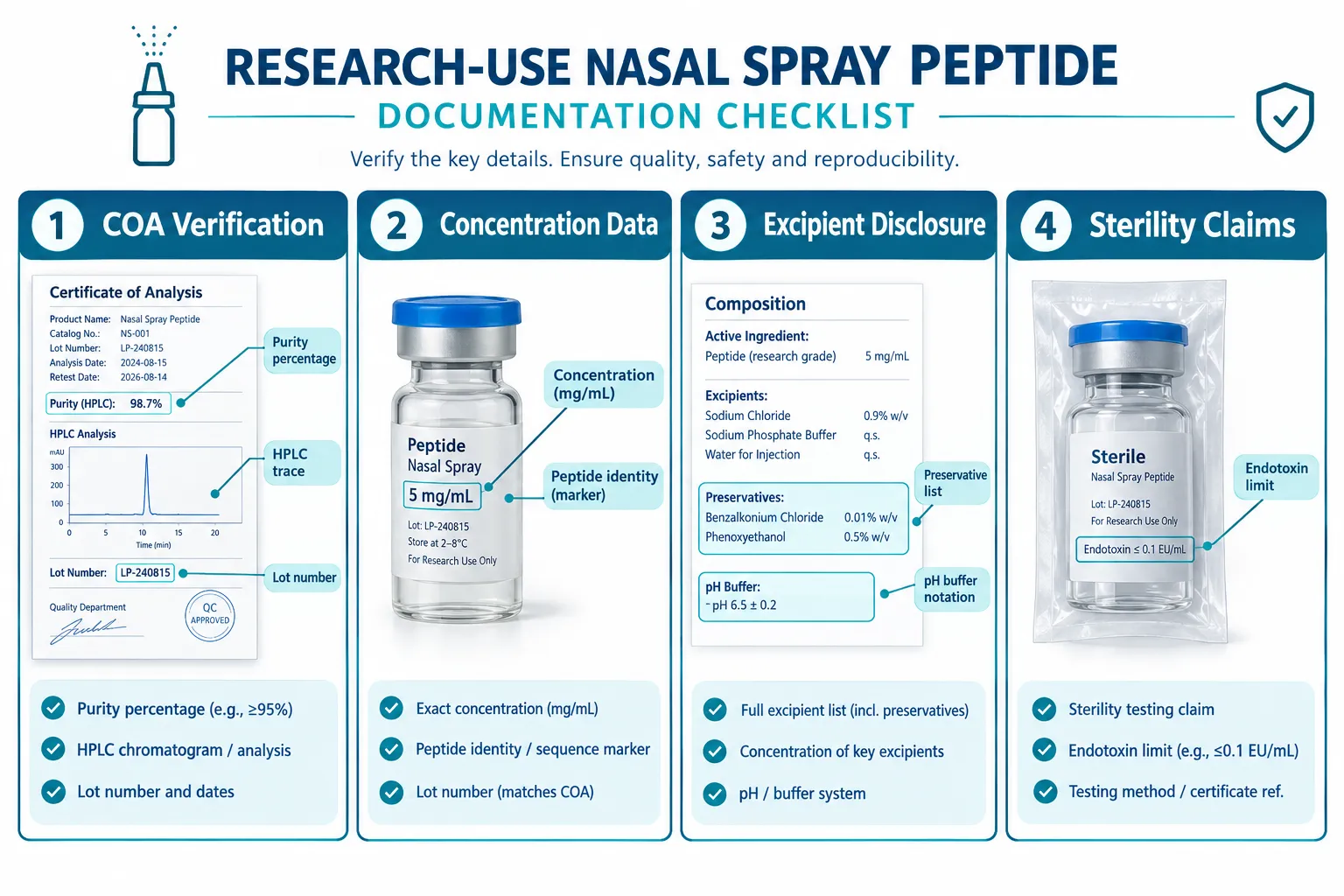
The documentation a supplier provides reveals more about product quality than any marketing claim. Below is the core checklist applicable to all research-use nasal spray peptides:
Core Documentation Checklist
| Document | What to Verify |
|---|---|
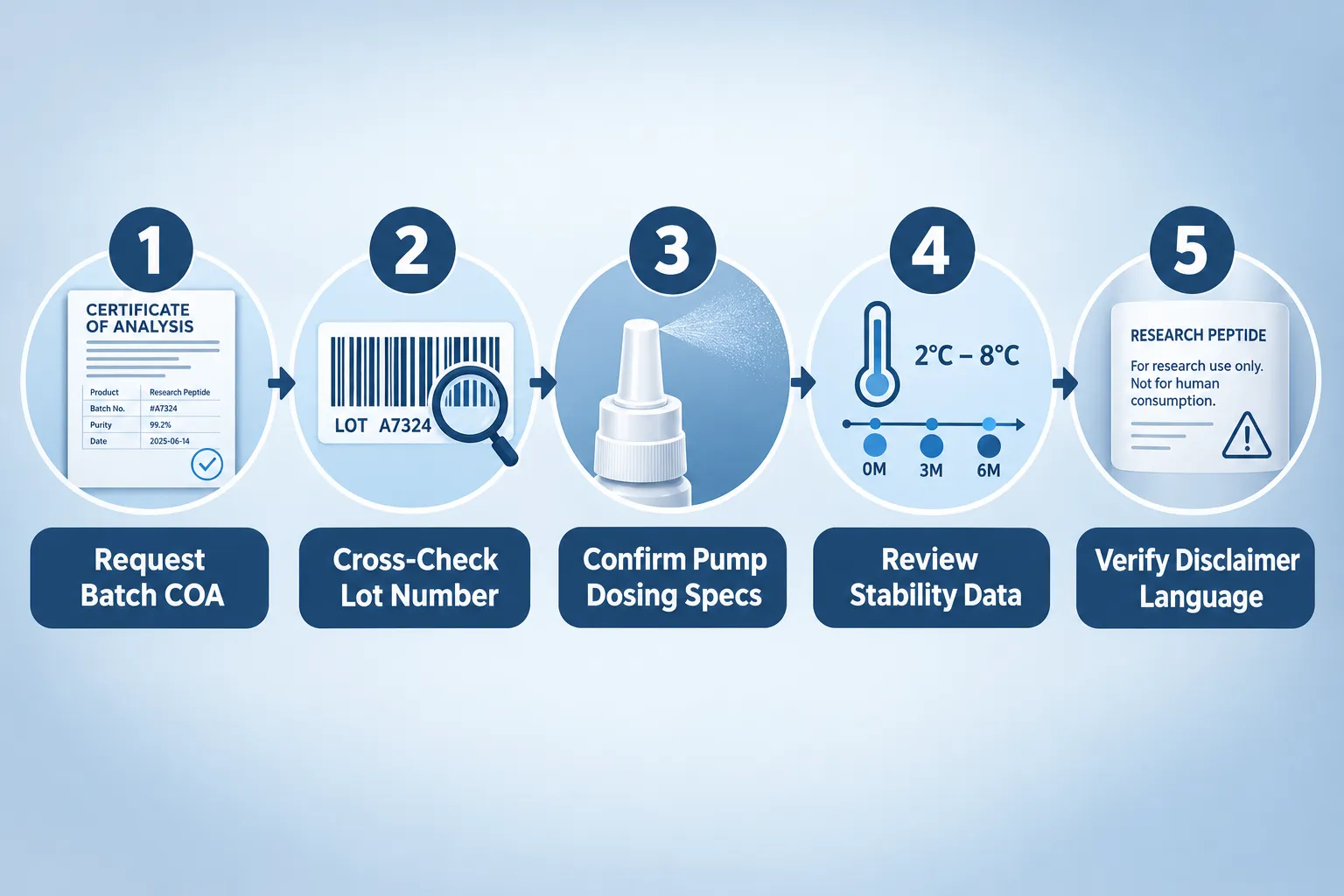
| Certificate of Analysis (COA) | Purity (%), HPLC trace, lot number, test date |
| Third-Party Lab Identity | Independent lab name, not in-house only |
| Concentration Statement | mg/mL per actuation and total volume |
| Excipient Disclosure | Preservatives, buffers, pH range |
| Sterility and Endotoxin | Sterility test method, endotoxin limits (EU/mL) |
| Stability Data | Storage temperature, expiration window |
| Pump Delivery Spec | Actuation volume (microliters), dose variance |
| Research-Use Disclaimer | "Not for human use" language, clearly visible |
| Batch Traceability | Lot-to-COA matching, reorder consistency |
For lab-tested peptides, every row in this table should be answerable before purchase.
Checklist Applied: Semax and Selank Nasal Sprays
Semax is a synthetic heptapeptide analog of ACTH(4-7). Selank is a synthetic analog of tuftsin with proposed anxiolytic and immune-modulating properties. Both are widely studied in CNS research models and are frequently sold as standalone or combo nasal sprays.
Semax Documentation Expectations
- Purity should be 98% or higher by HPLC
- Concentration is typically 0.1% or 1% (1 mg/mL or 10 mg/mL)
- Preservative used (commonly benzalkonium chloride) must be disclosed with concentration
- Stability data: most formulations require 2-8°C storage; confirm shelf life post-reconstitution
Selank Documentation Expectations
- Standard research concentration: 0.15% (1.5 mg/mL)
- Selank combo sprays (Semax/Selank blends) require a COA entry for each peptide separately
- Lot numbers must match across the COA and the physical vial label
- Where to buy Selank nasal spray resources should always direct buyers toward vendors who publish full COAs on request
"A COA without a named third-party laboratory is not a COA, it is a marketing document."
Combo sprays are gaining traction because they offer multi-target CNS research utility in a single delivery format. However, they raise a documentation complexity: both peptide identities, both purities, and the combined excipient profile must all be disclosed. Buyers should reject any combo spray COA that lists only a single compound.
Checklist Applied: Klow Multi-Peptide Nasal Spray
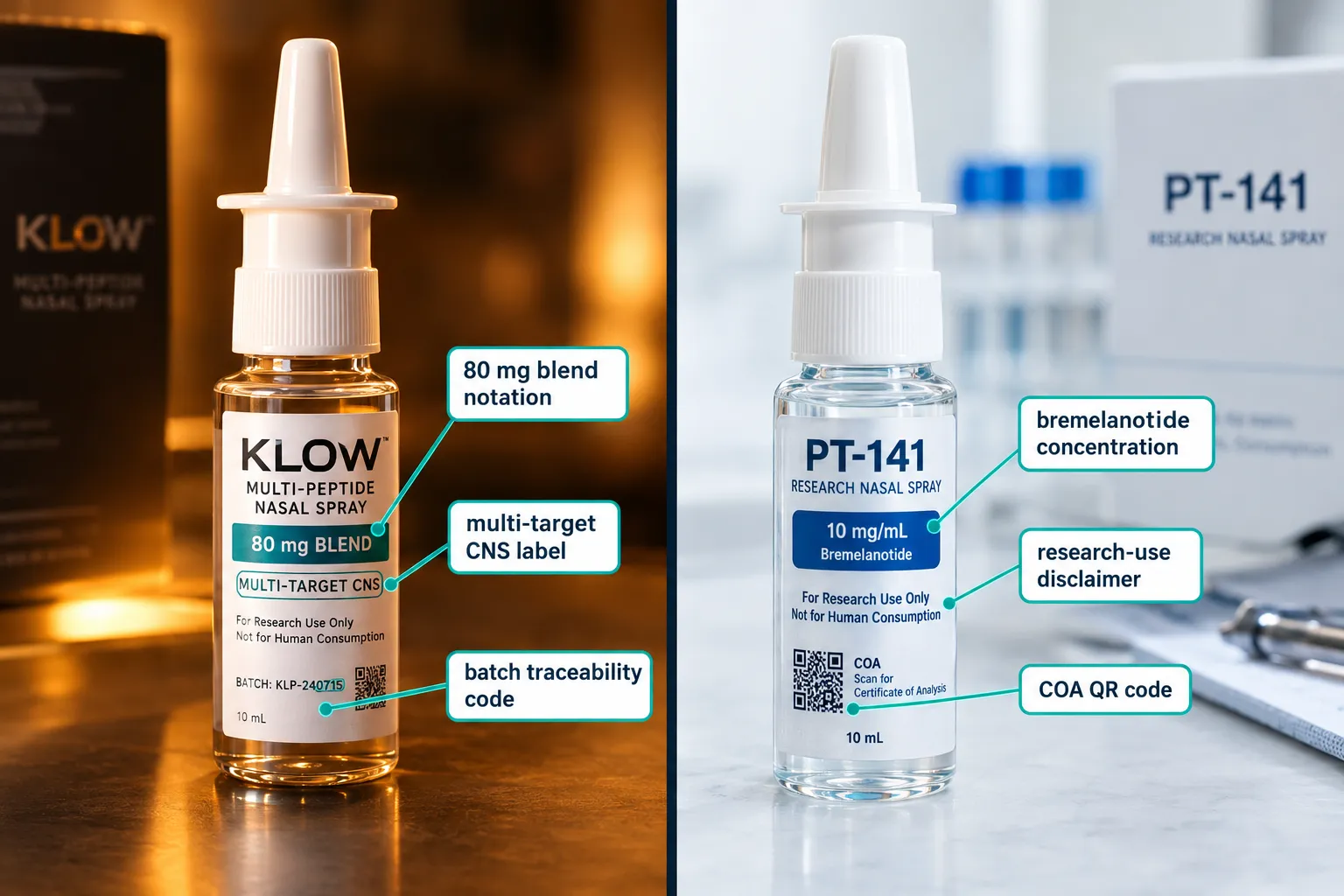
The Klow nasal spray represents a newer category, a multi-peptide research blend formulated at an 80 mg combined concentration. Its growing presence in 2026 research catalogs reflects a broader shift toward combination nasal sprays as multi-target tools. The documentation requirements are correspondingly more complex.
Klow-Specific Documentation Points
- An 80 mg blend requires individual peptide identification for each component, not a single aggregate purity figure
- Excipient compatibility must account for multiple peptide sequences, ask specifically whether any component degrades in the presence of the preservative system used
- Pump actuation volume is critical: verify microliters per spray and total spray count per vial
- Stability data for multi-peptide blends is more sensitive than for single-peptide formulations; request data showing stability at both refrigerated and room-temperature conditions
The Glow Blend peptide evaluation framework offers a useful parallel for how to approach purity assessment in complex research blends, the same principles of component-level verification apply to Klow.
Checklist Applied: PT-141 (Bremelanotide) Nasal Sprays
PT-141 occupies a unique regulatory position. Bremelanotide received FDA approval as an injectable for clinical use, but research-use nasal spray formulations remain strictly in the laboratory-grade category and must be labeled accordingly. This distinction is non-negotiable in supplier documentation.
PT-141 Documentation Expectations
- Concentration range in research sprays: typically 10-15 mg/mL
- COA must include mass spectrometry or HPLC confirmation of the bremelanotide sequence
- Endotoxin testing is especially important given the compound's mechanism profile, request a result in EU/mL, not a pass/fail notation only
- Labeling must not reference any clinical indication or imply therapeutic use
- Batch traceability is critical: regional suppliers (including those operating in markets such as Thailand with clinical-grade production infrastructure) may issue COAs in formats unfamiliar to North American buyers, verify the testing method standard used
Regional sourcing variability makes PT-141 one of the highest-risk peptides for documentation gaps. Always cross-reference the named testing laboratory against publicly verifiable third-party labs.
Pump Performance and Sterility: The Overlooked Columns
Most buyers focus on peptide purity and neglect two specifications that directly affect research validity: pump delivery accuracy and sterility assurance.
Pump Performance Checklist
- Actuation volume: should be stated in microliters (typical range: 50-100 mcL per spray)
- Dose variance: reputable suppliers publish an acceptable variance range (typically ±5%)
- Priming requirements: number of primes before first use affects early-dose accuracy
- Material compatibility: pump components must be confirmed compatible with the peptide and preservative system
Sterility and Endotoxin Checklist
- Sterility test method: USP <71> or equivalent
- Endotoxin limit: 0.5 EU/mL is a common benchmark for research sprays
- Filtration documentation: 0.22-micron sterile filtration should be confirmed
Suppliers who publish IPA peptide and wholesale peptide catalogs at scale are more likely to maintain standardized sterility documentation than small-batch producers, but volume alone is not a substitute for documented testing.
2026-2027 Outlook for Research-Use Nasal Spray Peptides
The trend toward multi-peptide nasal spray formats, Semax/Selank combos, Klow, and similar blends, is expected to accelerate through 2027. With that growth comes increasing documentation complexity. Buyers should anticipate:
- Greater demand for component-level COAs in combo formulations
- Increased regulatory scrutiny of labeling language in North American and European markets
- Broader adoption of QR-code-linked COAs for real-time batch verification
Staying current with research-use peptide documentation standards and sourcing from vendors who invest in third-party verification will remain the most defensible procurement strategy.
Conclusion
The Best Research-Use Nasal Spray Peptides: A Buyer's Checklist for Semax, Selank, Klow, and PT-141 Documentation ultimately comes down to one principle: documentation is product. A vial without a complete, verifiable COA, clear concentration data, excipient disclosure, sterility results, pump specifications, and an explicit research-use disclaimer is not a research-grade product, regardless of the peptide name on the label.
Actionable next steps:
- Request a full COA and sterility report before any purchase, not after
- For combo sprays (Semax/Selank, Klow), require individual peptide purity entries
- Confirm the third-party laboratory name is independently verifiable
- Verify pump actuation volume and dose variance in writing
- Reject any product whose label does not clearly state "not for human use"
Applying this checklist consistently removes the majority of documentation risk from research-use nasal spray peptide procurement in 2026 and beyond.


Leave a Reply
Want to join the discussion?Feel free to contribute!