Call or Text 727-513-9780
  • Shopping Cart Shopping Cart
    0Shopping Cart
Pure Tested Peptides | America's most trusted Peptides for sale online
  • Peptides for sale
    • Oral Peptides for sale
      • Peptide Capsules for sale
      • BPC 157 Capsules 1000mcg
      • SLU-PP-332 Capsules | 1000 mcg
      • 5-Amino-1MQ 50mg Capsules
      • Tesofensine 500mcg
    • All Peptides for sale
    • Peptide Sprays
      • BPC 157 Nasal Spray Kit
      • BPC-157 TB500 Nasal Spray Kit
      • Semax Nasal Spray 10mg
      • Selank – Nasal Spray Kit – 10mg
      • Epithalon 50MG Nasal Spray Kit
      • Ipamorelin 10mg Nasal Spray
      • Klow Nasal Spray (BPC-157 + TB-500 + GHK-Cu + KPV) | 80mg
      • Hulk Nasal Spray Tesa / Ipa Blend 6/3 MG
      • Klow Nasal Spray
      • NAD + 500 mg Nasal Spray
      • PT-141 Nasal Spray Kit
    • GHRH Peptides
      • Ipa Peptides
      • CJC-1295 Peptides
        • CJC-1295 with DAC 5 mg
        • CJC-1295 without DAC 5 mg
        • CJC-1295 Ipa 10mg
      • Tesa Peptides
        • Tesa Peptide
        • Tesa 20 mg
    • GHK-Cu Peptides
      • All GHK-Cu Peptides
      • GHK-Cu 100mg
      • KLOW Peptide Blend – Buy KLOW blend online
    • BPC Peptides
      • All BPC Peptides
      • BPC-157
      • BPC-157 TB-500
      • BPC 157 capsules 1000mcg
    • SLU-PP-332 Peptides
      • All SLU-PP-332 Peptides
      • SLU-PP-332 5mg
    • GLP3 Peptides
    • PT-141 Peptides
      • PT-141 Peptides for sale
      • PT-141 10mg
      • PT-141 Nasal Spray
    • CAG Peptides
      • Lipo-C Peptide Blend
      • CAG 5mg
      • CAG 10mg
    • MOTS-C Peptides
      • MOTS-C Peptides for sale
      • MOTS-c peptide
      • MOTS-c 10mg *6 pack*
    • 5 Amino 1MQ Peptides
      • 5 Amino 1MQ Peptides for sale
      • 5-Amino-1MQ 50mg Capsules
      • 5-Amino-1MQ 5mg
    • Epithalon Peptides
      • Epithalon Peptides for sale
      • Epithalon 10mg
      • Epithalon 50mg
  • Shop
    • GLPs
      • 5-Amino-1MQ 50mg Capsules
      • 5-Amino-1MQ 5mg
      • L-Carnitine 500mg/ml
      • Tesofensine 500mcg
      • SLU-PP-332 5mg
      • MOTS-c 10mg *6 pack*
    • Epithalon & BPC Peptides
      • Epithalon 10mg
      • Epithalon 50mg
      • BPC-157
      • BPC 157 capsules 1000mcg
      • BPC-157 TB-500
      • BPC-157 TB500 Nasal Spray Kit
      • BPC 157 Nasal Spray Kit
    • BPC TB-500 & NAD+ Peptides
      • NAD+ 500 mg
      • KLOW Peptide Blend – Buy KLOW blend online
      • GLOW Peptide Blend
      • TB 500 5mg
      • BPC 157 capsules 1000mcg – Supplement
      • BPC 157 Nasal Spray Kit
      • BPC-157
      • BPC-157 TB500 Nasal Spray Kit
      • BPC-157 TB-500
      • BPC 157 capsules 1000mcg
    • LL-37 Peptide
      • LL-37 10 mg
    • MOTS-C & Selank
      • MOTS-c peptide
      • Selank 10mg
    • GHK Peptides
      • GHK-Cu 100mg
      • GLOW Peptide Blend
      • KLOW Peptide Blend – Buy KLOW blend online
  • COAs
  • Wholesale
    • Wholesale Peptides for sale
  • PTP FAQ
  • Affiliates
    • Selank Peptide: Advanced Pharmacological Mechanisms Underlying Its Anxiolytic and Nootropic Effects in Research
      • 5-Amino-1MQ Peptide: Detailed Mechanisms of NNMT Inhibition and Its Impact on Cellular Metabolism Research
        • MOTS-C Peptide: Unraveling Its Role in Mitochondrial Dynamics and Energy Metabolism Research
          • Epithalon Peptide and Telomerase Regulation: Investigating Its Impact on Cellular Senescence and Lifespan Research Models
            • GLP2-T vs GLP2 Tirz Peptide: Understanding the Naming, Mechanistic Nuances, and Research Implications for Gut Health
      • Peptides and Polypeptides in Modern Pharmacology: What Research on Metoprolol, Prednisone, and Amlodipine Reveals
        • Polypeptide Peptides vs NSAIDs: What Naproxen and Diclofenac Teach Tissue-Repair Researchers About BPC‑157 and TB‑500
          • Peptides and Polypeptides in Endocrine Pharmacology: How GLP-1, GLP-2, and GLP-3 Retatrutide Differ From Classic Drugs Like Prednisone and Amlodipine
          • 5‑Amino‑1MQ Peptide and NNMT Inhibition: How It Compares With Statins Like Atorvastatin in Adipose and Lipid Metabolism Research
      • Enclomiphene, Estrogen Receptor Signaling, and Luteinizing Phase Biology: What Hormone Researchers Should Measure
        • Mesenchymal Stem Cells, BPC‑157, and GHK‑Cu: How Tissue Repair Peptides Compare With Classic NSAIDs Like Naproxen in Injury Models
          • Peptide Calculator Use Cases Beyond Growth Hormone: Working Through GLP‑3 Retatrutide, MOTS‑c, and BPC‑157 Research Dosing
        • Polypeptide Peptides in Endocrine and Metabolic Pharmacology: Lessons From Amlodipine, Prednisone, and Metoprolol
        • Peptides Calculator for Advanced Blends: Worked Examples for Tesamorelin, CJC‑1295, and Ipamorelin Stacks
          • Peptides and Polypeptides in Human Physiology: How Molecular Size Shapes Research Applications
            • Selank Peptide: Advanced Pharmacological Mechanisms Underlying Its Anxiolytic and Nootropic Effects in Research
          • 5-Amino-1MQ Peptide: Detailed Mechanisms of NNMT Inhibition and Its Impact on Cellular Metabolism Research
            • MOTS-C Peptide: Unraveling Its Role in Mitochondrial Dynamics and Energy Metabolism Research
              • Epithalon Peptide and Telomerase Regulation: Investigating Its Impact on Cellular Senescence and Lifespan Research Models
                • GLP2-T vs GLP2 Tirz Peptide: Understanding the Naming, Mechanistic Nuances, and Research Implications for Gut Health
                  • Peptides and Polypeptides in Endocrine Pharmacology: How GLP-1, GLP-2, and GLP-3 Retatrutide Differ From Classic Drugs Like Prednisone and Amlodipine
                    • Polypeptide Peptides vs NSAIDs: What Naproxen and Diclofenac Teach Tissue-Repair Researchers About BPC‑157 and TB‑500
                      • Peptides and Polypeptides in Modern Pharmacology: What Research on Metoprolol, Prednisone, and Amlodipine Reveals
                        • 5‑Amino‑1MQ Peptide and NNMT Inhibition: How It Compares With Statins Like Atorvastatin in Adipose and Lipid Metabolism Research
                        • Enclomiphene, Estrogen Receptor Signaling, and Luteinizing Phase Biology: What Hormone Researchers Should Measure
                        • Mesenchymal Stem Cells, BPC‑157, and GHK‑Cu: How Tissue Repair Peptides Compare With Classic NSAIDs Like Naproxen in Injury Models
                        • Peptide Calculator Use Cases Beyond Growth Hormone: Working Through GLP‑3 Retatrutide, MOTS‑c, and BPC‑157 Research Dosing
                        • Polypeptide Peptides in Endocrine and Metabolic Pharmacology: Lessons From Amlodipine, Prednisone, and Metoprolol
                        • Peptides Calculator for Advanced Blends: Worked Examples for Tesamorelin, CJC‑1295, and Ipamorelin Stacks
                        • Peptides and Polypeptides in Human Physiology: How Molecular Size Shapes Research Applications
                        • Selank Peptide: Advanced Pharmacological Mechanisms Underlying Its Anxiolytic and Nootropic Effects in Research
                        • MOTS-C Peptide: Unraveling Its Role in Mitochondrial Dynamics and Energy Metabolism Research
                        • Peptides and Polypeptides in Modern Pharmacology: What Research on Metoprolol, Prednisone, and Amlodipine Reveals
                        • Peptides and Polypeptides in Endocrine Pharmacology: How GLP-1, GLP-2, and GLP-3 Retatrutide Differ From Classic Drugs Like Prednisone and Amlodipine
                        • 5-Amino-1MQ Peptide: Detailed Mechanisms of NNMT Inhibition and Its Impact on Cellular Metabolism Research
                        • Mesenchymal Stem Cells, BPC‑157, and GHK‑Cu: How Tissue Repair Peptides Compare With Classic NSAIDs Like Naproxen in Injury Models
                        • Peptide Calculator Use Cases Beyond Growth Hormone: Working Through GLP‑3 Retatrutide, MOTS‑c, and BPC‑157 Research Dosing
                        • GLP2-T vs GLP2 Tirz Peptide: Understanding the Naming, Mechanistic Nuances, and Research Implications for Gut Health
                        • Polypeptide Peptides in Endocrine and Metabolic Pharmacology: Lessons From Amlodipine, Prednisone, and Metoprolol
                        • Polypeptide Peptides vs NSAIDs: What Naproxen and Diclofenac Teach Tissue-Repair Researchers About BPC‑157 and TB‑500
                        • Peptides and Polypeptides in Human Physiology: How Molecular Size Shapes Research Applications
                        • Peptides Calculator for Advanced Blends: Worked Examples for Tesamorelin, CJC‑1295, and Ipamorelin Stacks
                        • 5‑Amino‑1MQ Peptide and NNMT Inhibition: How It Compares With Statins Like Atorvastatin in Adipose and Lipid Metabolism Research
                        • Enclomiphene, Estrogen Receptor Signaling, and Luteinizing Phase Biology: What Hormone Researchers Should Measure
                        • Epithalon Peptide and Telomerase Regulation: Investigating Its Impact on Cellular Senescence and Lifespan Research Models
                        • Best research protocol Klow blend
                        • best time to take BPC-157
                        • best time to take DSIP (Delta Sleep Inducing Peptide)
                        • best time to take CJC-1295
                        • best time to take AOD-9604
                        • best time to take Follistatin 344
                        • best time to take Ipamorelin
                        • best time to take MK-677 (Ibutamoren)
                        • best time to take Ligandrol (LGD-4033) — research compound
                        • best time to take Ostarine (MK-2866) — research compound
                        • best time to take GHK-CU
                        • best time to take TB-500
                        • best time to take MOTS-c
                        • best time to take Semax
                        • best time to take RAD-140 (Testolone) — research compound
                        • best time to take Thymosin Alpha-1
                        • best time to take PEG-MGF
                        • Biolife Plasma, Octapharma Plasma, and Research Peptides: How Plasma Donation Labs Differ From Peptide Suppliers
                        • best time to take YK-11 — research compound
                        • best time to take PT-141 (Bremelanotide)
                        • Best research protocol Klow blend
                        • 5-Amino-1MQ and MOTS-C Synergy: Metabolic Signaling, Mitochondria, and Research Design
                        • BPC-157 and TB-500: Investigating Their Combined Effects on Angiogenesis and Cellular Migration in Tissue Repair Models
                        • BPC-157 Peptide: Gut Barrier Function, Inflammation, and Tissue-Recovery Research
                        • 5‑Amino‑1MQ and MOTS‑c Synergy in Metabolic Research: Designing NNMT and Mitochondrial Biogenesis Stacks
                        • CJC-1295 with DAC vs. Without DAC: Half-Life, Release Kinetics, and Research Implications
                        • CJC‑1295 with DAC vs. Without DAC: Expanding on Half‑Life Differences Using Tesamorelin and Ipamorelin Blend Case Studies
                        • Collagen Biology and Copper‑Binding Peptides: How GHK‑Cu, Glow Blend, and Klow Blend Interact with Skin and Connective Tissue
                        • Collagen Biology and Regenerative Peptides: How GHK‑Cu, Glow Blend, and Klow Blend Affect Extracellular Matrix Research
                    • DNA, Telomeres, and Longevity Peptides: Positioning Epithalon and MOTS‑c in Genetic Aging Research
                      • Enclomiphene Citrate: serm Mechanism, Testosterone Research, and Stack Compatibility
                        • Enclomiphene vs Enclomiphene Citrate: Formulation, Bioavailability, and Research Distinctions
                        • Epithalon Peptide Research: Telomerase Activation, Aging, and Pineal Gland Function
                        • Estrogen Receptor Signaling and Enclomiphene: How Selective Modulators Compare with Classic Polypeptide Hormones
                        • GHK-Cu Peptide: Advanced Mechanisms in Extracellular Matrix Remodeling and Wound Healing Research
                        • GHK-Cu Peptide: Collagen Synthesis, Wound Repair, and Skin-Barrier Research Models
                        • GLP-1 vs GLP-3 vs GLP-2: Peptide Classification and Research Applications
                        • GLP-2 Peptide Research Guide: Gut Barrier Function, Nutrient Absorption, and Intestinal Recovery Models
                        • GLP-3 Retatrutide vs. GLP-1 Drugs: What Triple-Agonist Biology Changes in Research Models
                        • Ipamorelin and Tesamorelin Combination: Synergistic GH Secretagogue Research and Dosing Protocols
                        • GLP2 Tirz Peptide: What It Is, Why the Name Exists, and How Researchers Should Interpret It
                        • Klow Blend Peptide Nasal Spray: What the Formulation Is Trying to Do in Cognitive Research
                        • Mitochondria, NNMT Inhibition, and Peptide Modulators: Where MOTS‑c and 5‑Amino‑1MQ Fit in Cellular Energy Research
                        • MOTS-c Peptide: Mitochondrial Function, Energy Metabolism, and What Researchers Measure
                        • MOTS-c vs. 5-Amino-1MQ: Which Metabolic Research Questions Each Compound Actually Answers
                        • Nasal Spray Peptides: Bioavailability, Administration, and Semax/Selank Research Applications
                        • PT-141 Peptide Research: Mechanism of Action and Melanocortin Receptor Signaling
                        • Retatrutide for Research: Mechanism, Structure, and GLP-1/GLP-3 Dual Action
                        • Retatrutide for Obesity and Type 2 Diabetes: What the Latest Trial Data Suggest
                        • Tesofensine Peptide Research: Mechanism, Appetite Suppression, and Neuropeptide Y Pathways
  • Contact
    • Contact Customer Service
    • Text Customer Support
  • About US
  • Shop all peptides
  • Affiliate Program
    • Affiliate Signup
  • Login / Register Login / Register Page Link Login / Register Page Link
  • Click to open the search input field Click to open the search input field Search
  • Menu Menu
GLP-3 Retatrutide and GLP-1 Pills: Oral Stability, Gastric Exposure, and Receptor-Selective Research Design

GLP-3 Retatrutide and GLP-1 Pills: Oral Stability, Gastric Exposure, and Receptor-Selective Research Design

October 24, 2026/0 Comments/in Uncategorized/by

Oral delivery of GLP-1 class compounds fails roughly 99% of an administered peptide dose before it ever reaches systemic circulation, a biochemical obstacle that fundamentally separates how researchers design injectable triple agonists from how they engineer small-molecule pills. Understanding that gap is central to appreciating the diverging paths of GLP-3 Retatrutide and GLP-1 Pills: Oral Stability, Gastric Exposure, and Receptor-Selective Research Design as a unified field of metabolic science.

Key Takeaways

  • Retatrutide is a triple receptor agonist targeting GLP-1, GIP, and glucagon receptors simultaneously, unlike single-target GLP-1 pills.
  • Oral GLP-1 compounds face severe gastric degradation; small-molecule designs like orforglipron bypass this limitation but sacrifice receptor breadth.
  • The TRIUMPH Phase 3 program is testing retatrutide across obesity, type 2 diabetes, and cardiovascular cohorts.
  • Receptor selectivity is a deliberate design variable, broader agonism drives greater weight loss but adds complexity.
  • In 2026, the convergence of oral convenience and multi-receptor potency remains an unsolved challenge in metabolic drug research.

Receptor Architecture: Why Triple Agonism Changes the Design Equation
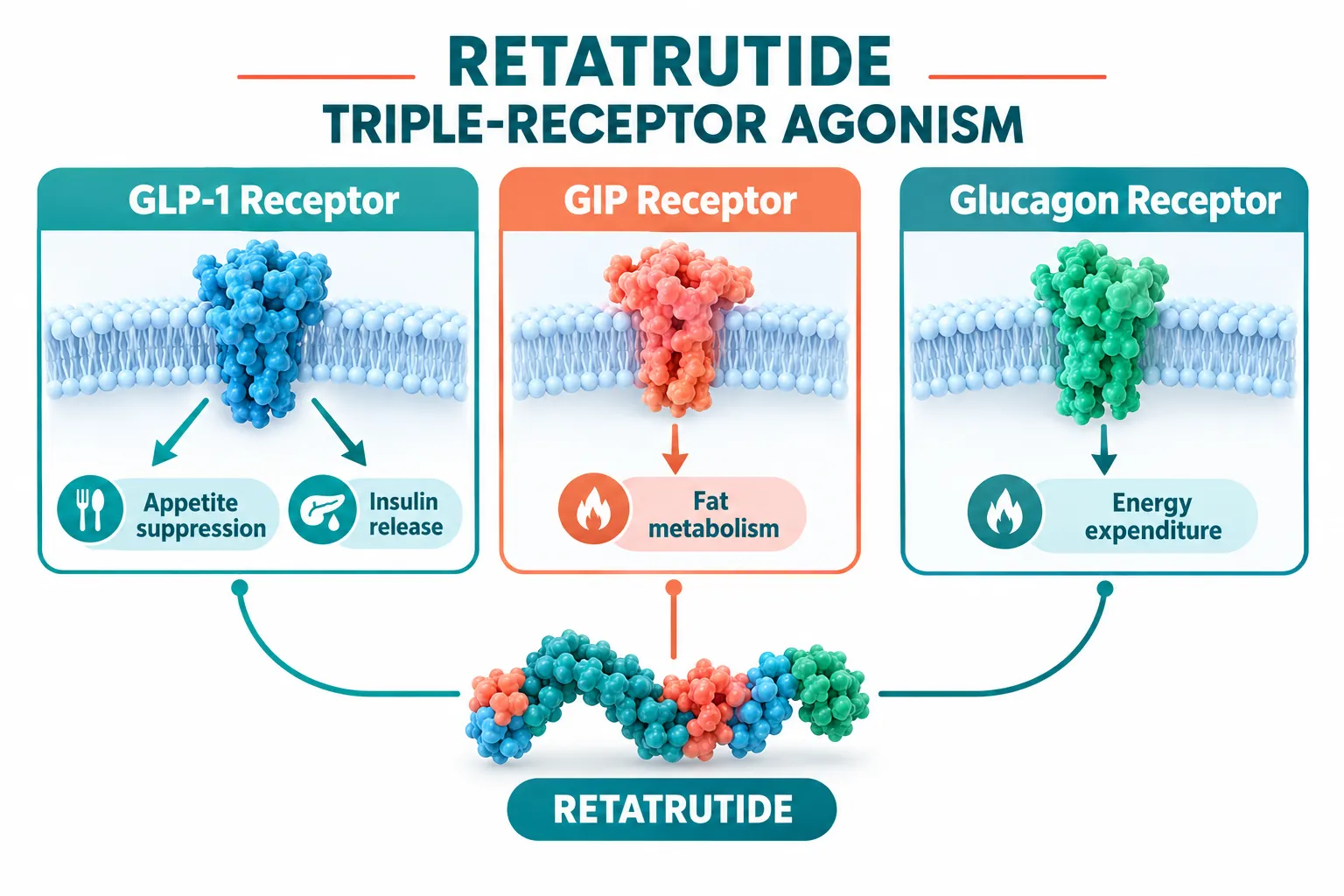
Receptor Architecture: Why Triple Agonism Changes the Design Equation

Retatrutide is engineered to activate three distinct G-protein coupled receptors: the glucagon-like peptide-1 receptor (GLP-1R), the glucose-dependent insulinotropic polypeptide receptor (GIPR), and the glucagon receptor (GCGR). Each receptor contributes a different metabolic effect. GLP-1R activation suppresses appetite and stimulates insulin release. GIPR engagement supports fat metabolism and may amplify GLP-1R sensitivity. GCGR activation increases energy expenditure, a mechanism largely absent in single-agonist GLP-1 therapies.

This "triple G" strategy is what separates retatrutide from earlier generations. Tirzepatide, for example, hits only GLP-1R and GIPR. That dual approach produced significant results, but early Phase 2 data for retatrutide suggested even larger reductions in body weight over comparable timeframes. Researchers working in GLP-1 and retatrutide receptor pharmacology have tracked this design evolution closely, noting that adding glucagon receptor engagement comes with its own tolerability considerations, particularly around blood glucose management.

The receptor-selective design also directly determines whether oral delivery is even feasible. Retatrutide is a large peptide molecule. Large peptides are cleaved rapidly by gastric proteases, oxidized by gastric acid, and poorly absorbed across intestinal epithelium. This is not a solubility problem, it is a structural incompatibility with oral pharmacokinetics.

"Receptor breadth and oral bioavailability currently exist in inverse proportion, the more receptors a peptide targets, the harder it is to deliver through the gut."


Oral Stability, Gastric Exposure, and Small-Molecule GLP-1 Pills
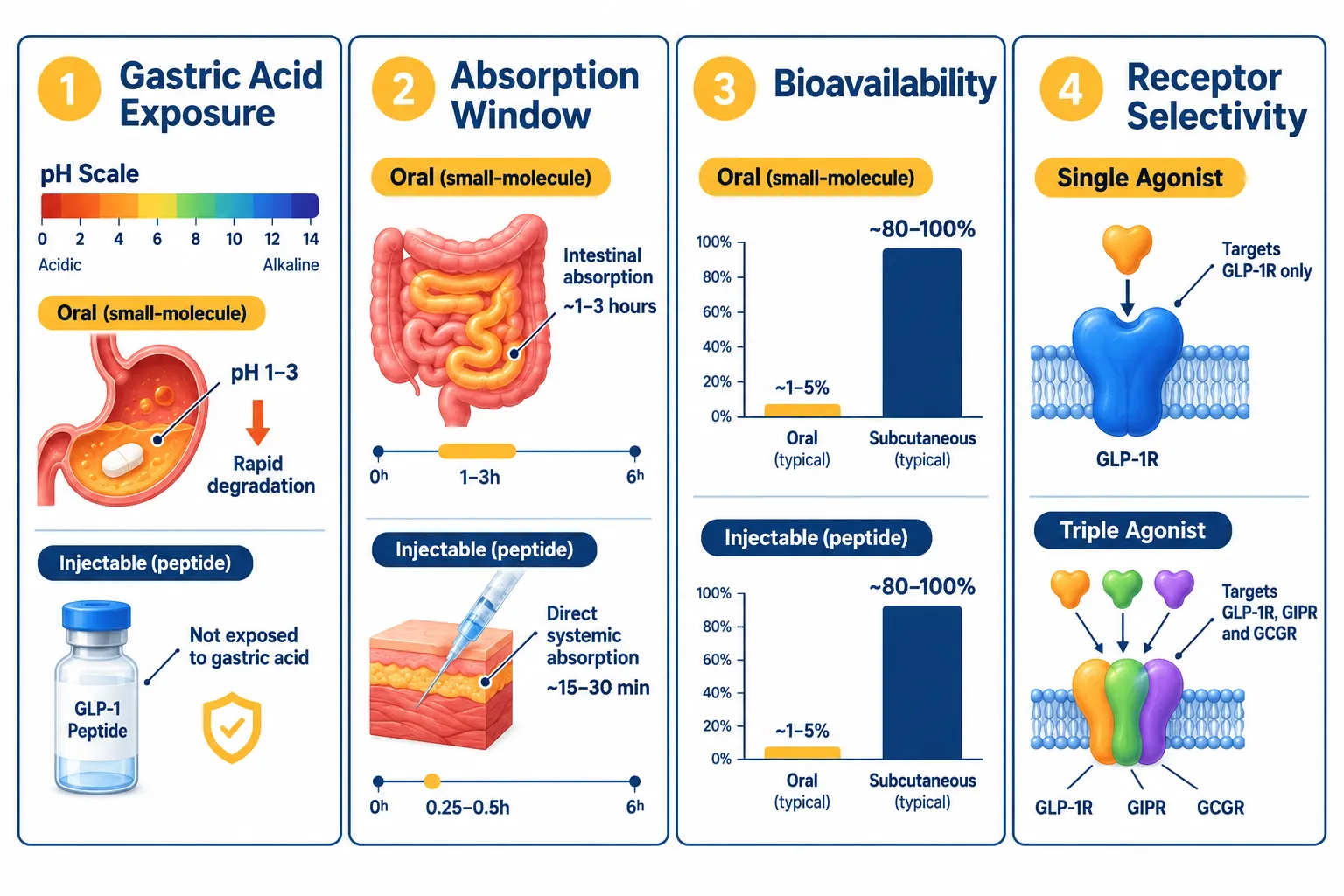
Oral Stability, Gastric Exposure, and Small-Molecule GLP-1 Pills

The approval of orforglipron (brand name Foundayo) by the FDA in 2025 marked a genuine milestone: the first orally bioavailable non-peptide GLP-1 receptor agonist for obesity. Unlike semaglutide tablets, which require a large oral dose with strict fasting protocols to achieve modest absorption, orforglipron is a small molecule. It does not rely on peptide bonds that gastric proteases can break.

What makes small-molecule oral GLP-1 design different:

  • No peptide backbone susceptible to protease cleavage
  • Passive absorption across intestinal epithelium without a carrier mechanism
  • Consistent oral bioavailability without fasting requirements
  • Narrower receptor binding profile, GLP-1R only

The tradeoff is specificity. Orforglipron activates only GLP-1R. Researchers studying visceral fat reduction mechanisms have noted that single-receptor engagement produces meaningful but potentially ceiling-limited metabolic outcomes compared to multi-agonist approaches.

Gastric exposure remains the core engineering problem. Peptide GLP-1 drugs administered orally face an absorption window of only a few minutes in the upper small intestine before degradation overtakes absorption. Sodium N-[8-(2-hydroxybenzoyl)amino]caprylate (SNAC), the absorption enhancer used with oral semaglutide, works by transiently raising local gastric pH near the tablet and facilitating transcellular transport, but this mechanism still requires strict fasting and delivers low, variable systemic exposure.

Small molecules sidestep this entirely. The exposure window is broader, the dose required is lower relative to bioavailability, and food does not dramatically impair absorption. For GLP-3 Retatrutide and GLP-1 Pills: Oral Stability, Gastric Exposure, and Receptor-Selective Research Design, this distinction represents the most practically significant divide in current metabolic drug development.


TRIUMPH Program: Phase 3 Evidence and Long-Term Exposure Strategy
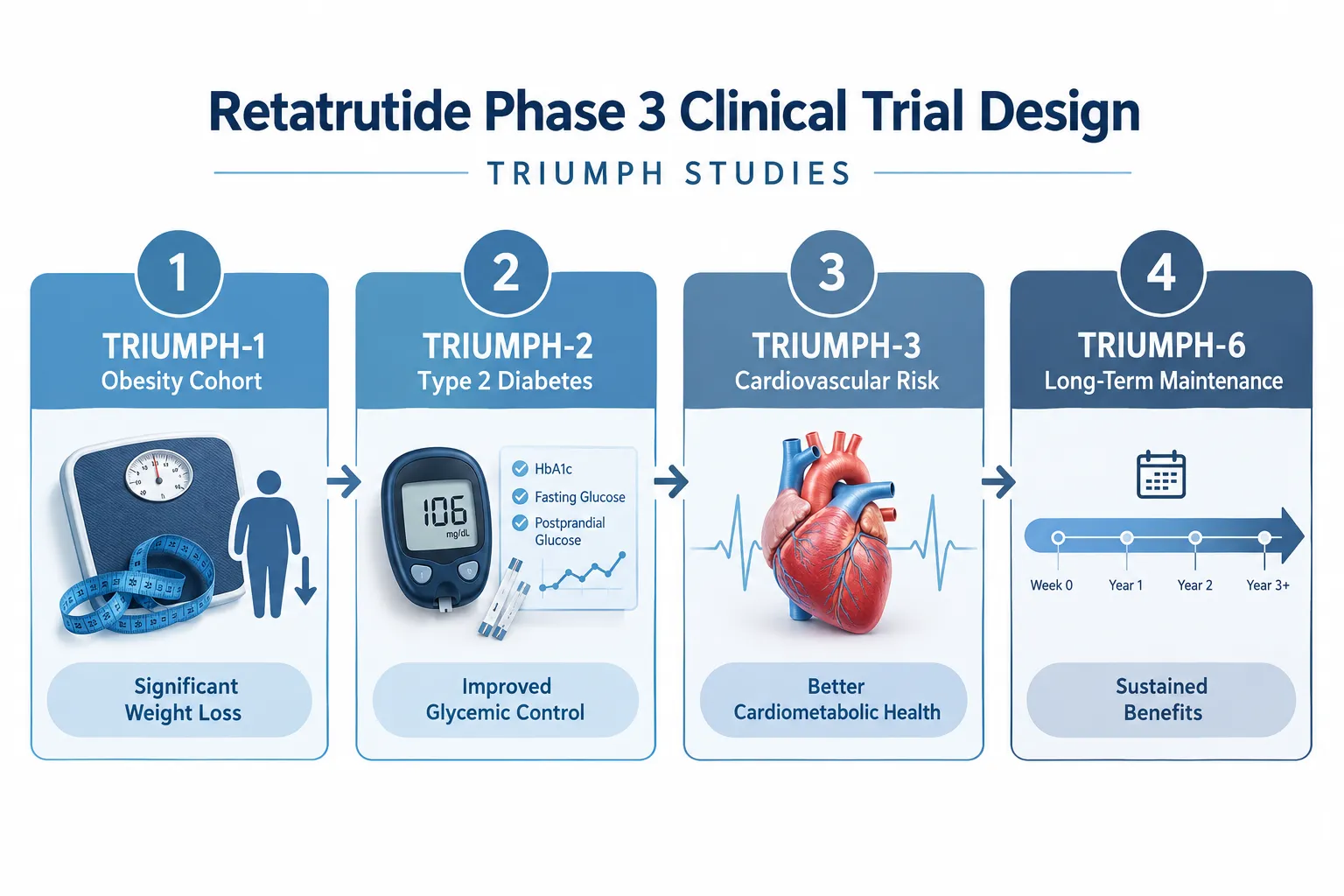
TRIUMPH Program: Phase 3 Evidence and Long-Term Exposure Strategy

Eli Lilly's TRIUMPH Phase 3 program encompasses several distinct trials, each probing a different population and exposure duration.

Trial Population Primary Focus
TRIUMPH-1 Adults with obesity Weight reduction magnitude
TRIUMPH-2 Type 2 diabetes Glycemic control plus weight loss
TRIUMPH-3 High cardiovascular risk Safety and cardiac outcomes
TRIUMPH-6 Post-treatment maintenance Long-term weight maintenance

TRIUMPH-1 data set an early benchmark, with participants achieving weight reductions that exceeded those seen in comparable semaglutide and tirzepatide trials. Media and clinical commentators labeled early results a "new benchmark" for injectable obesity pharmacotherapy. TRIUMPH-2 extended findings to type 2 diabetes populations, where retatrutide's glucagon receptor component required careful management to avoid fasting hypoglycemia.

TRIUMPH-6 addressed a known vulnerability of all GLP-1 class therapies: weight regain after treatment cessation. Long-term exposure strategy, meaning continuous administration at maintenance doses, appears necessary to sustain outcomes, a finding consistent across the class.

For researchers sourcing retatrutide for preclinical study, understanding this dosing architecture matters for experimental design. Whether sourcing RETA 10mg or RETA 30mg formats, dose-escalation protocols mirror the clinical program's gradual titration approach to minimize gastrointestinal side effects, nausea and vomiting being the most commonly reported adverse events across the class.

Tolerability considerations in receptor-selective design:

  • GLP-1R agonism drives most GI side effects; triple agonism amplifies this risk at higher doses
  • Slow dose escalation over weeks reduces discontinuation rates
  • Glucagon receptor activation requires monitoring of fasting glucose, particularly in non-diabetic populations

Speculative Outlook: Toward Oral Triple Agonism

Note: The following represents forward-looking analysis, not established fact.

The logical next frontier in GLP-3 Retatrutide and GLP-1 Pills: Oral Stability, Gastric Exposure, and Receptor-Selective Research Design is whether small-molecule chemistry can eventually encode multi-receptor selectivity. Current small-molecule GLP-1R agonists achieve potency at a single receptor; extending that to GIPR and GCGR through a single oral compound would require identifying allosteric binding geometries compatible with all three receptors in a molecule small enough for passive absorption.

Some researchers involved in GLP-3 reta 30mg preclinical formats speculate that bifunctional small molecules could emerge within the next decade, but no clinical candidate has entered Phase 1 trials as of 2026. The more near-term scenario is combination oral regimens, a GLP-1R small molecule paired with adjunct agents targeting GIPR or GCGR through separate mechanisms.


Conclusion

The science of GLP-3 Retatrutide and GLP-1 Pills: Oral Stability, Gastric Exposure, and Receptor-Selective Research Design reveals a field navigating a fundamental tradeoff: receptor breadth versus delivery practicality. Retatrutide's triple agonism delivers outsized metabolic effects but demands injectable administration. Oral small molecules like orforglipron offer daily pill convenience but trade receptor scope for gastrointestinal stability.

Actionable next steps for researchers and informed readers:

  1. Follow TRIUMPH Phase 3 completion data expected in 2026 for head-to-head weight loss and cardiovascular outcome benchmarks.
  2. Evaluate oral GLP-1 candidates on bioavailability, not just receptor target, exposure consistency matters as much as mechanism.
  3. Review preclinical retatrutide study protocols to understand dose-escalation requirements before designing receptor-selective experiments.
  4. Track small-molecule multi-agonist pipeline developments as the next structural challenge in oral metabolic pharmacology.

The convergence of oral convenience and multi-receptor potency remains the defining unsolved problem of GLP class drug design in 2026.

Tags: glp-1 pills, glp-3 research, oral glp-1, orforglipron, receptor-selective design, retatrutide, triumph trials, visceral fat research
https://www.puretestedpeptides.com/wp-content/uploads/2026/10/glp-3-retatrutide-and-glp-1-pills-oral-stability-gastric-exposure-and-receptor-s.webp 1024 1536 https://www.puretestedpeptides.com/wp-content/uploads/2026/01/buy-peptides-online.jpg 2026-10-24 13:04:542026-10-24 13:04:54GLP-3 Retatrutide and GLP-1 Pills: Oral Stability, Gastric Exposure, and Receptor-Selective Research Design
You might also like
GLP-3 Retatrutide vs. GLP2-T in Research: Metabolic Signaling Compared With Intestinal Epithelial Models GLP-3 Retatrutide vs. GLP2-T in Research: Metabolic Signaling Compared With Intestinal Epithelial Models
Retatrutide Phase 3 Cardiometabolic Monitoring: Designing Research Panels for Triglycerides, Blood Pressure, hsCRP, and A1C Retatrutide Phase 3 Cardiometabolic Monitoring: Designing Research Panels for Triglycerides, Blood Pressure, hsCRP, and A1C
Tesofensine vs GLP‑3 Retatrutide vs Classic Appetite Drugs: Which Pathways Researchers Model for Weight‑Related Studies Tesofensine vs GLP‑3 Retatrutide vs Classic Appetite Drugs: Which Pathways Researchers Model for Weight‑Related Studies
Retatrutide 2026 Trial Data: Interpreting Triple-Agonist Results Across Obesity, Diabetes, and Cardiovascular-Risk Populations Retatrutide 2026 Trial Data: Interpreting Triple-Agonist Results Across Obesity, Diabetes, and Cardiovascular-Risk Populations
Retatrutide Phase 3 Results: How Weight Loss, A1C, and Cardiovascular Findings Change Research Interpretation Retatrutide Phase 3 Results: How Weight Loss, A1C, and Cardiovascular Findings Change Research Interpretation
Retatrutide 2026 Phase 3 Results: What the Latest Trial Data Means for GLP-3 Research Retatrutide 2026 Phase 3 Results: What the Latest Trial Data Means for GLP-3 Research
GLP-3 Retatrutide and Triple-Agonist Peptides: How Phase 3 Obesity Data Are Shaping Next-Generation Metabolic Research GLP-3 Retatrutide and Triple-Agonist Peptides: How Phase 3 Obesity Data Are Shaping Next-Generation Metabolic Research
GLP-3 Retatrutide and Oral GLP-1 Concepts: How Researchers Should Compare Exposure, Gastric Emptying, and Bioavailability GLP-3 Retatrutide and Oral GLP-1 Concepts: How Researchers Should Compare Exposure, Gastric Emptying, and Bioavailability
0 replies

Leave a Reply

Want to join the discussion?
Feel free to contribute!

Leave a Reply Cancel reply

Your email address will not be published. Required fields are marked *

×

Helpful Links

  • My account
  • Cart
  • Checkout
  • Refund and Returns Policy
  • Privacy Policy
  • SMS Privacy Policy
  • Login
  • My Account
  • Logout

USA Made Lab Tested Peptides

All products are sold for research, laboratory, or analytical purposes only, and are not for human consumption


Pure Tested Peptides is a chemical supplier. Pure Tested Peptides is not a compounding / chemical compounding facility as defined under 503A of the Federal Food, Drug, and Cosmetic act. Pure Tested Peptides is not an outsourcing facility as defined under 503B of the Federal Food, Drug, and Cosmetic act.

The statements made within this website have not been evaluated by the US Food and Drug Administration. The products we offer are not intended to diagnose, treat, cure or prevent any disease.

Human/Animal Consumption Prohibited. Laboratory/In-Vitro Experimental Use Only

Link to: GLP-1 Receptor Agonists vs Traditional Weight-Loss Medications: What Researchers Should Measure Beyond the Drug Name Link to: GLP-1 Receptor Agonists vs Traditional Weight-Loss Medications: What Researchers Should Measure Beyond the Drug Name GLP-1 Receptor Agonists vs Traditional Weight-Loss Medications: What Researchers...GLP-1 Receptor Agonists vs Traditional Weight-Loss Medications: What Researchers Should Measure Beyond the Drug Name Link to: MOTS-c Peptide in 2026: How to Build Energy, Metabolic-Flexibility, and Exercise-Mimetic Research Models Link to: MOTS-c Peptide in 2026: How to Build Energy, Metabolic-Flexibility, and Exercise-Mimetic Research Models MOTS-c Peptide in 2026: How to Build Energy, Metabolic-Flexibility, and Exercise-Mimetic Research ModelsMOTS-c Peptide in 2026: How to Build Energy, Metabolic-Flexibility, and Exercise-Mimetic...
Scroll to top Scroll to top Scroll to top