Call or Text 727-513-9780
  • Shopping Cart Shopping Cart
    0Shopping Cart
Pure Tested Peptides | America's most trusted Peptides for sale online
  • Peptides for sale
    • Oral Peptides for sale
      • Peptide Capsules for sale
      • BPC 157 Capsules 1000mcg
      • SLU-PP-332 Capsules | 1000 mcg
      • 5-Amino-1MQ 50mg Capsules
      • Tesofensine 500mcg
    • All Peptides for sale
    • Peptide Sprays
      • BPC 157 Nasal Spray Kit
      • BPC-157 TB500 Nasal Spray Kit
      • Semax Nasal Spray 10mg
      • Selank – Nasal Spray Kit – 10mg
      • Epithalon 50MG Nasal Spray Kit
      • Ipamorelin 10mg Nasal Spray
      • Klow Nasal Spray (BPC-157 + TB-500 + GHK-Cu + KPV) | 80mg
      • Hulk Nasal Spray Tesa / Ipa Blend 6/3 MG
      • Klow Nasal Spray
      • NAD + 500 mg Nasal Spray
      • PT-141 Nasal Spray Kit
    • GHRH Peptides
      • Ipa Peptides
      • CJC-1295 Peptides
        • CJC-1295 with DAC 5 mg
        • CJC-1295 without DAC 5 mg
        • CJC-1295 Ipa 10mg
      • Tesa Peptides
        • Tesa Peptide
        • Tesa 20 mg
    • GHK-Cu Peptides
      • All GHK-Cu Peptides
      • GHK-Cu 100mg
      • KLOW Peptide Blend – Buy KLOW blend online
    • BPC Peptides
      • All BPC Peptides
      • BPC-157
      • BPC-157 TB-500
      • BPC 157 capsules 1000mcg
    • SLU-PP-332 Peptides
      • All SLU-PP-332 Peptides
      • SLU-PP-332 5mg
    • GLP3 Peptides
      • GLP3-R
      • GLP3-R CAG 10mg
      • GLP3-R 20mg
    • PT-141 Peptides
      • PT-141 Peptides for sale
      • PT-141 10mg
      • PT-141 Nasal Spray
    • CAG Peptides
      • Lipo-C Peptide Blend
      • CAG 5mg
      • CAG 10mg
    • MOTS-C Peptides
      • MOTS-C Peptides for sale
      • MOTS-c peptide
      • MOTS-c 10mg *6 pack*
    • 5 Amino 1MQ Peptides
      • 5 Amino 1MQ Peptides for sale
      • 5-Amino-1MQ 50mg Capsules
      • 5-Amino-1MQ 5mg
    • Epithalon Peptides
      • Epithalon Peptides for sale
      • Epithalon 10mg
      • Epithalon 50mg
  • Shop
    • GLPs
      • 5-Amino-1MQ 50mg Capsules
      • 5-Amino-1MQ 5mg
      • GLP3-Reta
      • L-Carnitine 500mg/ml
      • Tesofensine 500mcg
      • SLU-PP-332 5mg
      • MOTS-c 10mg *6 pack*
    • Epithalon & BPC Peptides
      • Epithalon 10mg
      • Epithalon 50mg
      • BPC-157
      • BPC 157 capsules 1000mcg
      • BPC-157 TB-500
      • BPC-157 TB500 Nasal Spray Kit
      • BPC 157 Nasal Spray Kit
    • BPC TB-500 & NAD+ Peptides
      • NAD+ 500 mg
      • KLOW Peptide Blend – Buy KLOW blend online
      • GLOW Peptide Blend
      • TB 500 5mg
      • BPC 157 capsules 1000mcg – Supplement
      • BPC 157 Nasal Spray Kit
      • BPC-157
      • BPC-157 TB500 Nasal Spray Kit
      • BPC-157 TB-500
      • BPC 157 capsules 1000mcg
    • LL-37 Peptide
      • LL-37 10 mg
    • MOTS-C & Selank
      • MOTS-c peptide
      • Selank 10mg
    • GHK Peptides
      • GHK-Cu 100mg
      • GLOW Peptide Blend
      • KLOW Peptide Blend – Buy KLOW blend online
  • COAs
  • Wholesale
    • Wholesale Peptides for sale
  • PTP FAQ
  • Affiliates
    • Selank Peptide: Advanced Pharmacological Mechanisms Underlying Its Anxiolytic and Nootropic Effects in Research
      • 5-Amino-1MQ Peptide: Detailed Mechanisms of NNMT Inhibition and Its Impact on Cellular Metabolism Research
        • MOTS-C Peptide: Unraveling Its Role in Mitochondrial Dynamics and Energy Metabolism Research
          • Epithalon Peptide and Telomerase Regulation: Investigating Its Impact on Cellular Senescence and Lifespan Research Models
            • GLP2-T vs GLP2 Tirz Peptide: Understanding the Naming, Mechanistic Nuances, and Research Implications for Gut Health
      • Peptides and Polypeptides in Modern Pharmacology: What Research on Metoprolol, Prednisone, and Amlodipine Reveals
        • Polypeptide Peptides vs NSAIDs: What Naproxen and Diclofenac Teach Tissue-Repair Researchers About BPC‑157 and TB‑500
          • Peptides and Polypeptides in Endocrine Pharmacology: How GLP-1, GLP-2, and GLP-3 Retatrutide Differ From Classic Drugs Like Prednisone and Amlodipine
          • 5‑Amino‑1MQ Peptide and NNMT Inhibition: How It Compares With Statins Like Atorvastatin in Adipose and Lipid Metabolism Research
      • Enclomiphene, Estrogen Receptor Signaling, and Luteinizing Phase Biology: What Hormone Researchers Should Measure
        • Mesenchymal Stem Cells, BPC‑157, and GHK‑Cu: How Tissue Repair Peptides Compare With Classic NSAIDs Like Naproxen in Injury Models
          • Peptide Calculator Use Cases Beyond Growth Hormone: Working Through GLP‑3 Retatrutide, MOTS‑c, and BPC‑157 Research Dosing
        • Polypeptide Peptides in Endocrine and Metabolic Pharmacology: Lessons From Amlodipine, Prednisone, and Metoprolol
        • Peptides Calculator for Advanced Blends: Worked Examples for Tesamorelin, CJC‑1295, and Ipamorelin Stacks
          • Peptides and Polypeptides in Human Physiology: How Molecular Size Shapes Research Applications
            • Selank Peptide: Advanced Pharmacological Mechanisms Underlying Its Anxiolytic and Nootropic Effects in Research
          • 5-Amino-1MQ Peptide: Detailed Mechanisms of NNMT Inhibition and Its Impact on Cellular Metabolism Research
            • MOTS-C Peptide: Unraveling Its Role in Mitochondrial Dynamics and Energy Metabolism Research
              • Epithalon Peptide and Telomerase Regulation: Investigating Its Impact on Cellular Senescence and Lifespan Research Models
                • GLP2-T vs GLP2 Tirz Peptide: Understanding the Naming, Mechanistic Nuances, and Research Implications for Gut Health
                  • Peptides and Polypeptides in Endocrine Pharmacology: How GLP-1, GLP-2, and GLP-3 Retatrutide Differ From Classic Drugs Like Prednisone and Amlodipine
                    • Polypeptide Peptides vs NSAIDs: What Naproxen and Diclofenac Teach Tissue-Repair Researchers About BPC‑157 and TB‑500
                      • Peptides and Polypeptides in Modern Pharmacology: What Research on Metoprolol, Prednisone, and Amlodipine Reveals
                        • 5‑Amino‑1MQ Peptide and NNMT Inhibition: How It Compares With Statins Like Atorvastatin in Adipose and Lipid Metabolism Research
                        • Enclomiphene, Estrogen Receptor Signaling, and Luteinizing Phase Biology: What Hormone Researchers Should Measure
                        • Mesenchymal Stem Cells, BPC‑157, and GHK‑Cu: How Tissue Repair Peptides Compare With Classic NSAIDs Like Naproxen in Injury Models
                        • Peptide Calculator Use Cases Beyond Growth Hormone: Working Through GLP‑3 Retatrutide, MOTS‑c, and BPC‑157 Research Dosing
                        • Polypeptide Peptides in Endocrine and Metabolic Pharmacology: Lessons From Amlodipine, Prednisone, and Metoprolol
                        • Peptides Calculator for Advanced Blends: Worked Examples for Tesamorelin, CJC‑1295, and Ipamorelin Stacks
                        • Peptides and Polypeptides in Human Physiology: How Molecular Size Shapes Research Applications
                        • Selank Peptide: Advanced Pharmacological Mechanisms Underlying Its Anxiolytic and Nootropic Effects in Research
                        • MOTS-C Peptide: Unraveling Its Role in Mitochondrial Dynamics and Energy Metabolism Research
                        • Peptides and Polypeptides in Modern Pharmacology: What Research on Metoprolol, Prednisone, and Amlodipine Reveals
                        • Peptides and Polypeptides in Endocrine Pharmacology: How GLP-1, GLP-2, and GLP-3 Retatrutide Differ From Classic Drugs Like Prednisone and Amlodipine
                        • 5-Amino-1MQ Peptide: Detailed Mechanisms of NNMT Inhibition and Its Impact on Cellular Metabolism Research
                        • Mesenchymal Stem Cells, BPC‑157, and GHK‑Cu: How Tissue Repair Peptides Compare With Classic NSAIDs Like Naproxen in Injury Models
                        • Peptide Calculator Use Cases Beyond Growth Hormone: Working Through GLP‑3 Retatrutide, MOTS‑c, and BPC‑157 Research Dosing
                        • GLP2-T vs GLP2 Tirz Peptide: Understanding the Naming, Mechanistic Nuances, and Research Implications for Gut Health
                        • Polypeptide Peptides in Endocrine and Metabolic Pharmacology: Lessons From Amlodipine, Prednisone, and Metoprolol
                        • Polypeptide Peptides vs NSAIDs: What Naproxen and Diclofenac Teach Tissue-Repair Researchers About BPC‑157 and TB‑500
                        • Peptides and Polypeptides in Human Physiology: How Molecular Size Shapes Research Applications
                        • Peptides Calculator for Advanced Blends: Worked Examples for Tesamorelin, CJC‑1295, and Ipamorelin Stacks
                        • 5‑Amino‑1MQ Peptide and NNMT Inhibition: How It Compares With Statins Like Atorvastatin in Adipose and Lipid Metabolism Research
                        • Enclomiphene, Estrogen Receptor Signaling, and Luteinizing Phase Biology: What Hormone Researchers Should Measure
                        • Epithalon Peptide and Telomerase Regulation: Investigating Its Impact on Cellular Senescence and Lifespan Research Models
                        • Best research protocol Klow blend
                        • best time to take BPC-157
                        • best time to take DSIP (Delta Sleep Inducing Peptide)
                        • best time to take CJC-1295
                        • best time to take AOD-9604
                        • best time to take Follistatin 344
                        • best time to take Ipamorelin
                        • best time to take MK-677 (Ibutamoren)
                        • best time to take Ligandrol (LGD-4033) — research compound
                        • best time to take Ostarine (MK-2866) — research compound
                        • best time to take GHK-CU
                        • best time to take TB-500
                        • best time to take MOTS-c
                        • best time to take Semax
                        • best time to take RAD-140 (Testolone) — research compound
                        • best time to take Thymosin Alpha-1
                        • best time to take PEG-MGF
                        • Biolife Plasma, Octapharma Plasma, and Research Peptides: How Plasma Donation Labs Differ From Peptide Suppliers
                        • best time to take YK-11 — research compound
                        • best time to take PT-141 (Bremelanotide)
                        • Best research protocol Klow blend
                        • 5-Amino-1MQ and MOTS-C Synergy: Metabolic Signaling, Mitochondria, and Research Design
                        • BPC-157 and TB-500: Investigating Their Combined Effects on Angiogenesis and Cellular Migration in Tissue Repair Models
                        • BPC-157 Peptide: Gut Barrier Function, Inflammation, and Tissue-Recovery Research
                        • 5‑Amino‑1MQ and MOTS‑c Synergy in Metabolic Research: Designing NNMT and Mitochondrial Biogenesis Stacks
                        • CJC-1295 with DAC vs. Without DAC: Half-Life, Release Kinetics, and Research Implications
                        • CJC‑1295 with DAC vs. Without DAC: Expanding on Half‑Life Differences Using Tesamorelin and Ipamorelin Blend Case Studies
                        • Collagen Biology and Copper‑Binding Peptides: How GHK‑Cu, Glow Blend, and Klow Blend Interact with Skin and Connective Tissue
                        • Collagen Biology and Regenerative Peptides: How GHK‑Cu, Glow Blend, and Klow Blend Affect Extracellular Matrix Research
                    • DNA, Telomeres, and Longevity Peptides: Positioning Epithalon and MOTS‑c in Genetic Aging Research
                      • Enclomiphene Citrate: serm Mechanism, Testosterone Research, and Stack Compatibility
                        • Enclomiphene vs Enclomiphene Citrate: Formulation, Bioavailability, and Research Distinctions
                        • Epithalon Peptide Research: Telomerase Activation, Aging, and Pineal Gland Function
                        • Estrogen Receptor Signaling and Enclomiphene: How Selective Modulators Compare with Classic Polypeptide Hormones
                        • GHK-Cu Peptide: Advanced Mechanisms in Extracellular Matrix Remodeling and Wound Healing Research
                        • GHK-Cu Peptide: Collagen Synthesis, Wound Repair, and Skin-Barrier Research Models
                        • GLP-1 vs GLP-3 vs GLP-2: Peptide Classification and Research Applications
                        • GLP-2 Peptide Research Guide: Gut Barrier Function, Nutrient Absorption, and Intestinal Recovery Models
                        • GLP-3 Retatrutide vs. GLP-1 Drugs: What Triple-Agonist Biology Changes in Research Models
                        • Ipamorelin and Tesamorelin Combination: Synergistic GH Secretagogue Research and Dosing Protocols
                        • GLP2 Tirz Peptide: What It Is, Why the Name Exists, and How Researchers Should Interpret It
                        • Klow Blend Peptide Nasal Spray: What the Formulation Is Trying to Do in Cognitive Research
                        • Mitochondria, NNMT Inhibition, and Peptide Modulators: Where MOTS‑c and 5‑Amino‑1MQ Fit in Cellular Energy Research
                        • MOTS-c Peptide: Mitochondrial Function, Energy Metabolism, and What Researchers Measure
                        • MOTS-c vs. 5-Amino-1MQ: Which Metabolic Research Questions Each Compound Actually Answers
                        • Nasal Spray Peptides: Bioavailability, Administration, and Semax/Selank Research Applications
                        • PT-141 Peptide Research: Mechanism of Action and Melanocortin Receptor Signaling
                        • Retatrutide for Research: Mechanism, Structure, and GLP-1/GLP-3 Dual Action
                        • Retatrutide for Obesity and Type 2 Diabetes: What the Latest Trial Data Suggest
                        • Tesofensine Peptide Research: Mechanism, Appetite Suppression, and Neuropeptide Y Pathways
  • Contact
    • Contact Customer Service
    • Text Customer Support
  • About US
  • Shop all peptides
  • Affiliate Program
    • Affiliate Signup
  • Login / Register Login / Register Page Link Login / Register Page Link
  • Click to open the search input field Click to open the search input field Search
  • Menu Menu
Retatrutide in 2026: Why Phase 3 Trial Updates Are Shifting GLP-3 Search Demand

Retatrutide in 2026: Why Phase 3 Trial Updates Are Shifting GLP-3 Search Demand

August 13, 2026/0 Comments/in Uncategorized/by

By August 2026, all four core TRIUMPH obesity Phase 3 trials for retatrutide have completed enrollment and reported topline data, a milestone that has sent search volume for terms like "GLP-3," "triple agonist," and "retatrutide weight loss" to levels that rival early semaglutide coverage. Retatrutide in 2026: Why Phase 3 Trial Updates Are Shifting GLP-3 Search Demand is not just a headline; it reflects a measurable shift in how researchers, clinicians, and science-literate readers are framing the next generation of metabolic therapeutics.

Key Takeaways

  • All four TRIUMPH Phase 3 trials are complete as of August 2026, with TRIUMPH-1 showing up to approximately 30% body weight reduction over two years.
  • Retatrutide is a triple agonist targeting GLP-1, GIP, and glucagon receptors, a mechanism that distinguishes it from current approved GLP-1 therapies.
  • TRANSCEND-T2D-1 reported late-stage glycemic and weight-loss data in March 2026, expanding the drug's potential beyond obesity.
  • Retatrutide remains investigational in 2026; a Biologics License Application (BLA) is planned for Q1 2027.
  • The surge in "GLP-3" search terminology is driven by media framing and trial readout cadence, making terminology accuracy critical for researchers designing studies.

What Retatrutide Is and Why the Triple-Agonist Mechanism Matters

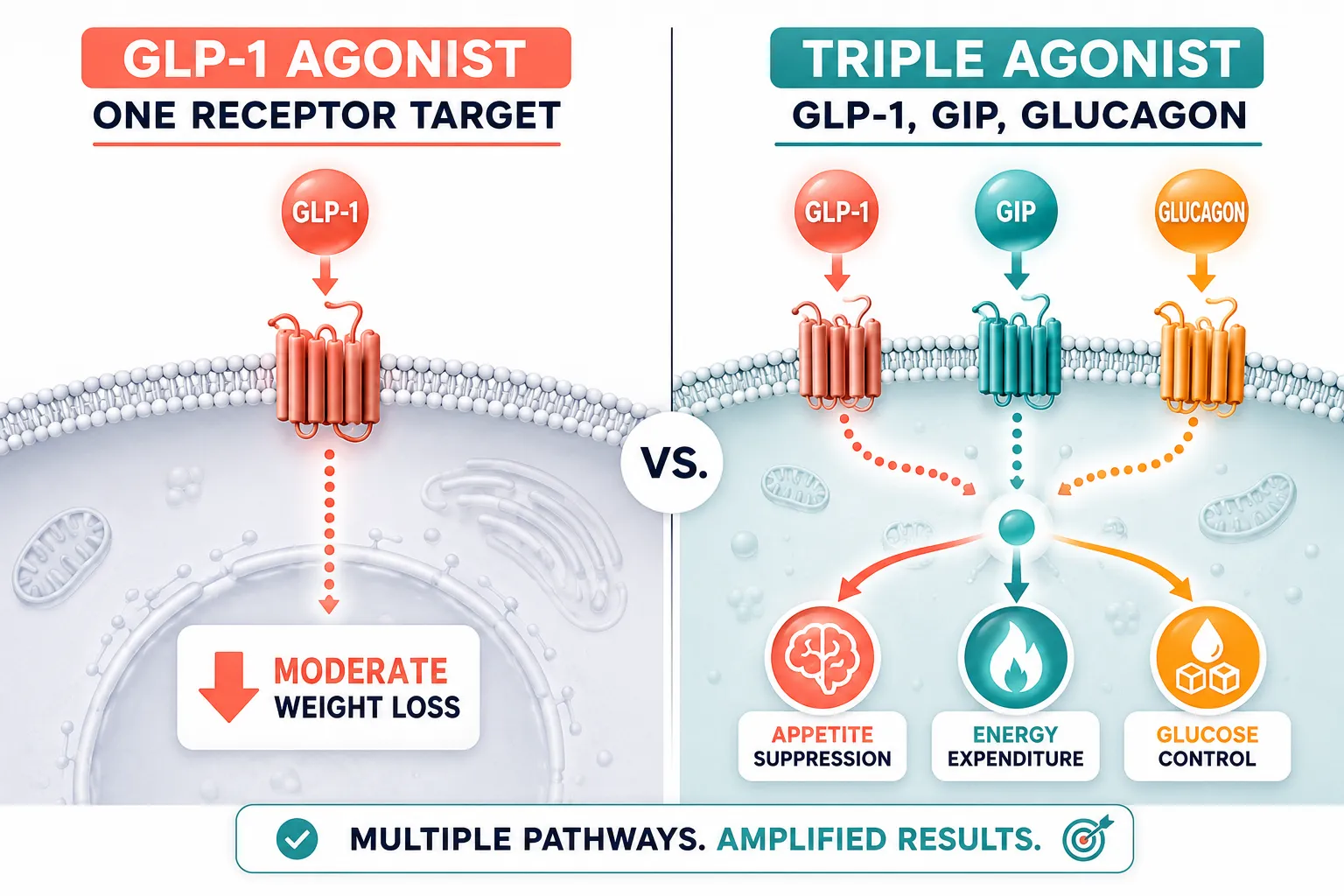
Retatrutide is an investigational peptide developed by Eli Lilly that simultaneously activates three receptor pathways: glucagon-like peptide-1 (GLP-1), glucose-dependent insulinotropic polypeptide (GIP), and glucagon. This triple-agonist profile separates it from approved GLP-1 receptor agonists like semaglutide and tirzepatide, which target one or two receptor classes respectively.
What Retatrutide Is and Why the Triple-Agonist Mechanism Matters

Understanding the mechanism is essential before interpreting trial data. The GLP-1 component suppresses appetite and slows gastric emptying. The GIP component enhances insulin secretion and may improve the tolerability of GLP-1 stimulation. The glucagon component increases energy expenditure, a metabolic lever that single-agonist drugs do not pull. For a deeper look at how these receptor pathways compare at the cellular level, the resource on peptides mechanism from GLP-3 retatrutide to CJC-1295 and MOTS-c provides useful foundational context.

The term "GLP-3" has entered popular science media as shorthand for this next-generation class, though it is technically imprecise. GLP-3 is a distinct peptide fragment; the accurate descriptor is "triple agonist" or "GLP-1/GIP/glucagon receptor agonist." Researchers tracking this space should note the terminology gap, as it affects literature search accuracy and study design framing.

The TRIUMPH and TRANSCEND Trial Readouts Driving 2026 Coverage

The Phase 3 program for retatrutide in obesity and metabolic disease has generated more clinical data in 2026 than any comparable investigational compound in recent memory.
The TRIUMPH and TRANSCEND Trial Readouts Driving 2026 Coverage

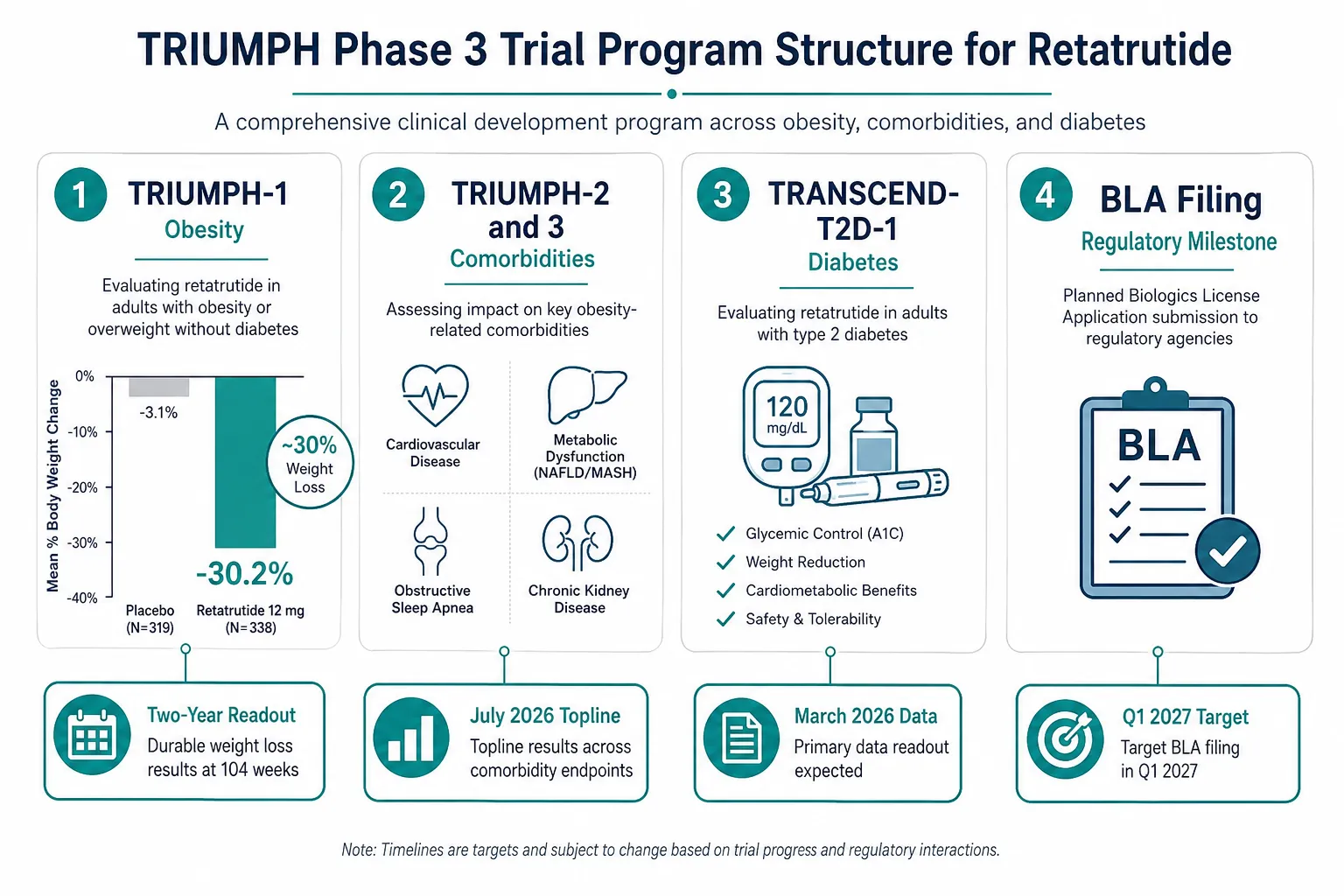
TRIUMPH-1 enrolled adults with obesity but without type 2 diabetes. Over a two-year period, participants receiving the highest dose achieved up to approximately 30% mean body weight reduction, a figure that has been described by researchers as unprecedented in a pharmacological trial without surgical intervention. This result significantly exceeds the roughly 15-21% weight loss seen with approved GLP-1 agents.

TRIUMPH-2 and TRIUMPH-3 enrolled participants with obesity plus major comorbidities, including cardiovascular risk factors and metabolic syndrome. Topline results from both trials were released on July 23, 2026, showing consistent efficacy signals across a more complex patient population.

TRANSCEND-T2D-1 reported late-stage data in March 2026, covering adults with type 2 diabetes. The trial demonstrated meaningful glycemic control alongside substantial weight reduction, positioning retatrutide as a potential dual-indication therapy.

For a broader view of what these obesity trial results mean for research design, the article on retatrutide Phase 3 and beyond in ongoing obesity trials offers structured analysis of the program's implications.

Key trial data at a glance:

Trial Population Notable Signal Readout Timing
TRIUMPH-1 Obesity, no T2D ~30% weight loss Two-year completion
TRIUMPH-2 Obesity + comorbidities Consistent efficacy July 23, 2026
TRIUMPH-3 Obesity + comorbidities Consistent efficacy July 23, 2026
TRANSCEND-T2D-1 Type 2 diabetes Glycemic + weight data March 2026

Researchers studying cardiometabolic peptides should also review how retatrutide compares to other polypeptide agents in metabolic models, the piece on polypeptide peptides in cardiometabolic models including GLP-3 retatrutide addresses this directly.

Retatrutide in 2026: Why Phase 3 Trial Updates Are Shifting GLP-3 Search Demand and What It Means for Researchers

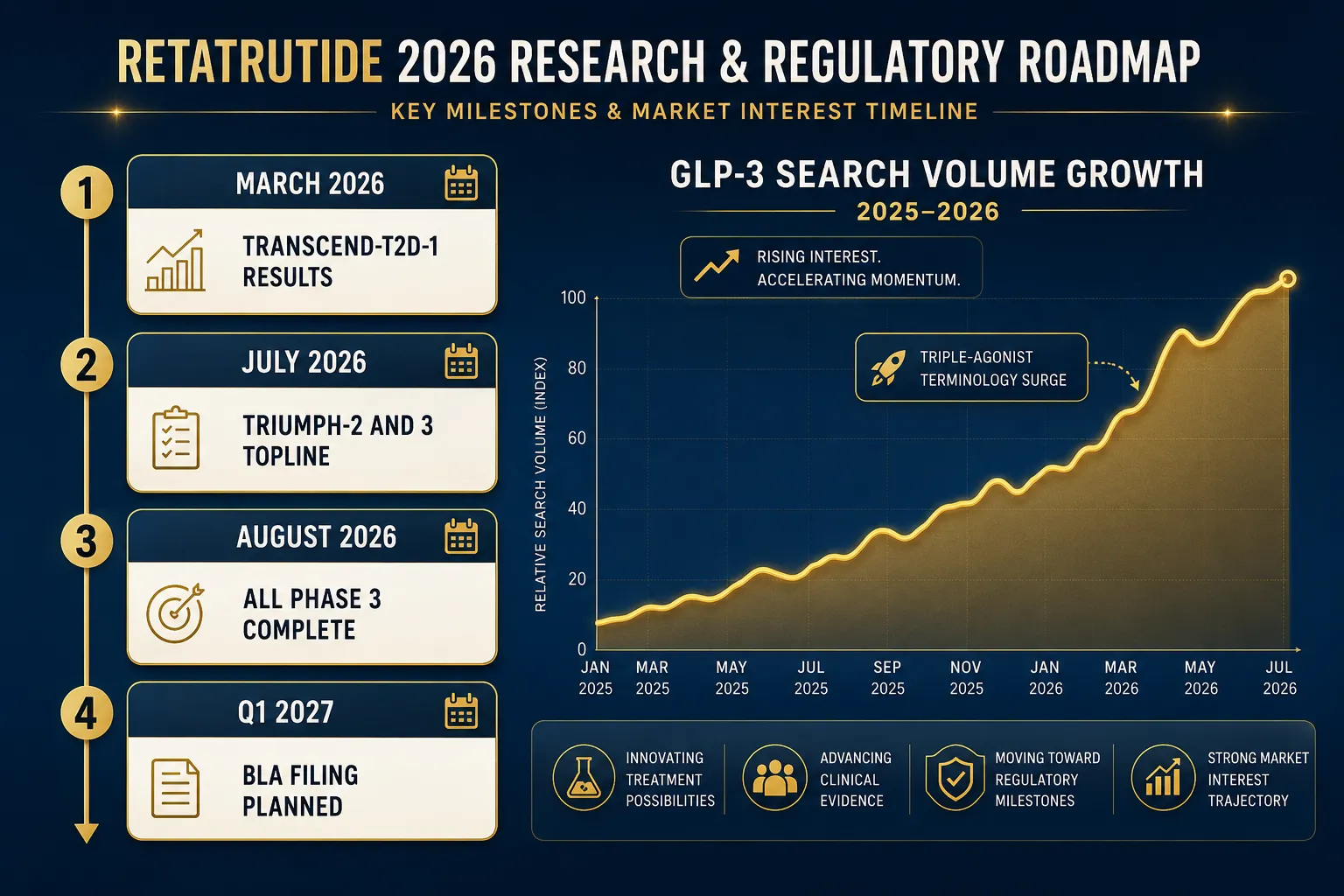
The search behavior shift around retatrutide in 2026 is not accidental. It follows a predictable pattern: high-volume trial readouts generate media coverage, media coverage introduces imprecise terminology, and that terminology drives search queries that researchers then need to interpret carefully.
Retatrutide in 2026: Why Phase 3 Trial Updates Are Shifting GLP-3 Search Demand and What It Means for Researchers

Three factors are compounding this trend in 2026:

  1. Trial readout cadence, Four major trials reporting within a single calendar year creates sustained media attention rather than a single news cycle.
  2. Magnitude of efficacy data, A 30% weight loss figure is inherently shareable and generates lay-audience curiosity that spills into research-adjacent search behavior.
  3. Regulatory anticipation, With a BLA filing planned for Q1 2027, retatrutide is moving from "experimental" to "imminent," which accelerates interest across clinical, investor, and research communities.

For researchers, this environment creates both opportunity and risk. The opportunity lies in the volume of new primary data available for secondary analysis and study design reference. The risk is that popular framing, particularly the "GLP-3" label, can introduce terminological noise into literature searches and grant applications.

"The precision of receptor-class terminology matters as much as the efficacy data itself when designing metabolic research protocols."

Researchers exploring the liver-related implications of retatrutide data will find the analysis of retatrutide and MASLD liver-fat reductions from emerging GLP-3 data particularly relevant, especially given that MASLD (metabolic dysfunction-associated steatotic liver disease) is an emerging secondary endpoint in several retatrutide sub-studies.

For those building broader metabolic research frameworks, the top 5 research peptides for metabolic health updated buyer's guide provides useful comparative context across the current peptide landscape.

Practical guidance for researchers tracking this space:

  • Use "GLP-1/GIP/glucagon receptor agonist" or "triple agonist" in literature searches rather than "GLP-3" to avoid missing or misclassifying relevant studies.
  • Distinguish between obesity-only trials (TRIUMPH-1) and comorbidity-inclusive trials (TRIUMPH-2 and TRIUMPH-3) when referencing efficacy benchmarks.
  • Note that retatrutide remains investigational as of 2026; no regulatory approval exists, and all efficacy data should be treated as pre-approval clinical trial results.
  • Monitor the BLA timeline closely, Q1 2027 submission would trigger a formal FDA review period, likely generating another wave of search and media activity.

Conclusion

The convergence of four completed Phase 3 trials, a 30% weight-loss efficacy signal, and a Q1 2027 BLA filing target makes 2026 a defining year for retatrutide and for the broader triple-agonist category. For researchers, the actionable priority is clear: build terminological precision into study design now, before the regulatory approval cycle introduces further popular-language drift.

Next steps for researchers and science-literate readers:

  • Review the TRIUMPH and TRANSCEND-T2D-1 topline publications directly rather than relying on media summaries.
  • Cross-reference retatrutide efficacy data against current approved GLP-1 benchmarks to contextualize the magnitude of the Phase 3 signals.
  • Use the peptides 101 for research-use only buyers covering GLP-3 and related mechanisms as a structural reference when onboarding new team members to this research area.
  • Set alerts for the BLA submission announcement and the FDA's formal acceptance or review timeline, as these will mark the next major inflection point in retatrutide search demand and clinical discourse.

The data is in. The regulatory clock is running. Researchers who engage with the primary trial literature now will be better positioned to interpret the approval-era evidence base when it arrives.

Tags: glp-1 receptor agonist, glp-3, investigational obesity therapy, metabolic research, obesity drug development, phase 3 trials, retatrutide, retatrutide 2026, transcend-t2d-1, triple agonist, triumph trials, weight loss peptides
https://www.puretestedpeptides.com/wp-content/uploads/2026/08/retatrutide-in-2026-why-phase-3-trial-updates-are-shifting-glp-3-search-demand.webp 1024 1536 https://www.puretestedpeptides.com/wp-content/uploads/2026/01/buy-peptides-online.jpg 2026-08-13 13:05:452026-08-13 13:05:45Retatrutide in 2026: Why Phase 3 Trial Updates Are Shifting GLP-3 Search Demand
You might also like
Retatrutide and MASLD: How Triple-Agonist Research Is Reframing Liver-Fat Endpoints Retatrutide and MASLD: How Triple-Agonist Research Is Reframing Liver-Fat Endpoints
Retatrutide Phase 3 and Beyond: What Ongoing Obesity Trials Mean for Research Readers Retatrutide Phase 3 and Beyond: What Ongoing Obesity Trials Mean for Research Readers
Tesofensine and Metabolic Research: How a Noradrenergic Appetite Modulator Compares With GLP‑3 Peptides in Study Design Tesofensine and Metabolic Research: How a Noradrenergic Appetite Modulator Compares With GLP‑3 Peptides in Study Design
Retatrutide Phase 3 Data and the Future of GLP‑3: What TRIUMPH and TRANSCEND Trials Mean for Research-Use Peptide Design Retatrutide Phase 3 Data and the Future of GLP‑3: What TRIUMPH and TRANSCEND Trials Mean for Research-Use Peptide Design
MOTS-c Peptide: Mitochondrial Signaling, Metabolic Research, and Why Researchers Study It MOTS-c Peptide: Mitochondrial Signaling, Metabolic Research, and Why Researchers Study It
Current Research Questions Around GLP-3 Peptides: What Makes Retatrutide Different From Other Incretin Analogs Current Research Questions Around GLP-3 Peptides: What Makes Retatrutide Different From Other Incretin Analogs
Adenosine Triphosphate, Cellular Energy, and Metabolic Peptides: How MOTS‑c and 5‑Amino‑1MQ Influence ATP-Linked Pathways Adenosine Triphosphate, Cellular Energy, and Metabolic Peptides: How MOTS‑c and 5‑Amino‑1MQ Influence ATP-Linked Pathways
Retatrutide (GLP-3) Peptide: Triple GLP Receptor Agonist Mechanism and Research Applications Retatrutide (GLP-3) Peptide: Triple GLP Receptor Agonist Mechanism and Research Applications
0 replies

Leave a Reply

Want to join the discussion?
Feel free to contribute!

Leave a Reply Cancel reply

Your email address will not be published. Required fields are marked *

×

Helpful Links

  • My account
  • Cart
  • Checkout
  • Refund and Returns Policy
  • Privacy Policy
  • SMS Privacy Policy
  • Login
  • My Account
  • Logout

USA Made Lab Tested Peptides

All products are sold for research, laboratory, or analytical purposes only, and are not for human consumption


Pure Tested Peptides is a chemical supplier. Pure Tested Peptides is not a compounding / chemical compounding facility as defined under 503A of the Federal Food, Drug, and Cosmetic act. Pure Tested Peptides is not an outsourcing facility as defined under 503B of the Federal Food, Drug, and Cosmetic act.

The statements made within this website have not been evaluated by the US Food and Drug Administration. The products we offer are not intended to diagnose, treat, cure or prevent any disease.

Human/Animal Consumption Prohibited. Laboratory/In-Vitro Experimental Use Only

Link to: Research-Use Only BPC-157: What It Is, What It Is Not, and Where It Fits in Tissue-Repair Models Link to: Research-Use Only BPC-157: What It Is, What It Is Not, and Where It Fits in Tissue-Repair Models Research-Use Only BPC-157: What It Is, What It Is Not, and Where It Fits in...Research-Use Only BPC-157: What It Is, What It Is Not, and Where It Fits in Tissue-Repair Models Link to: 5-Amino-1MQ Peptide: How Researchers Frame NAD+ and Metabolic Pathway Questions Link to: 5-Amino-1MQ Peptide: How Researchers Frame NAD+ and Metabolic Pathway Questions 5-Amino-1MQ Peptide: How Researchers Frame NAD+ and Metabolic Pathway Questions5-Amino-1MQ Peptide: How Researchers Frame NAD+ and Metabolic Pathway Quest...
Scroll to top Scroll to top Scroll to top