

Klow Blend vs Glow Blend in Skin and Hair Research: How GHK‑Cu, BPC‑157, and Other Components Are Combined in Lab Formulations
Fibroblast cultures treated with copper peptide complexes show measurable collagen upregulation within 48 hours, yet the specific ratio of co-factors in a blend can either amplify or blunt that response entirely. This precision detail is exactly what separates the Klow Blend vs Glow Blend in Skin and Hair Research: How GHK-Cu, BPC-157, and Other Components Are Combined in Lab Formulations discussion from general peptide overviews. Researchers designing skin and hair follicle models need to understand not just which peptides are present, but how their concentrations, sequencing, and supporting molecules interact at the cellular level.
Key Takeaways
- Klow Blend and Glow Blend are distinct multi-peptide research formulations targeting different aspects of skin and hair biology.
- GHK-Cu drives collagen synthesis and antioxidant signaling, while BPC-157 supports tissue repair and angiogenesis in fibroblast models.
- Ratio differences between blends, not just ingredient lists, determine experimental outcomes in keratinocyte and hair follicle assays.
- Co-factors such as hyaluronic acid, biotin peptides, and growth factors are added to modulate peptide stability and receptor engagement.
- Strict purity standards and documented sourcing are essential for reproducible lab results with any multi-peptide blend.
Defining the Two Formulations: Ingredients and Rationale
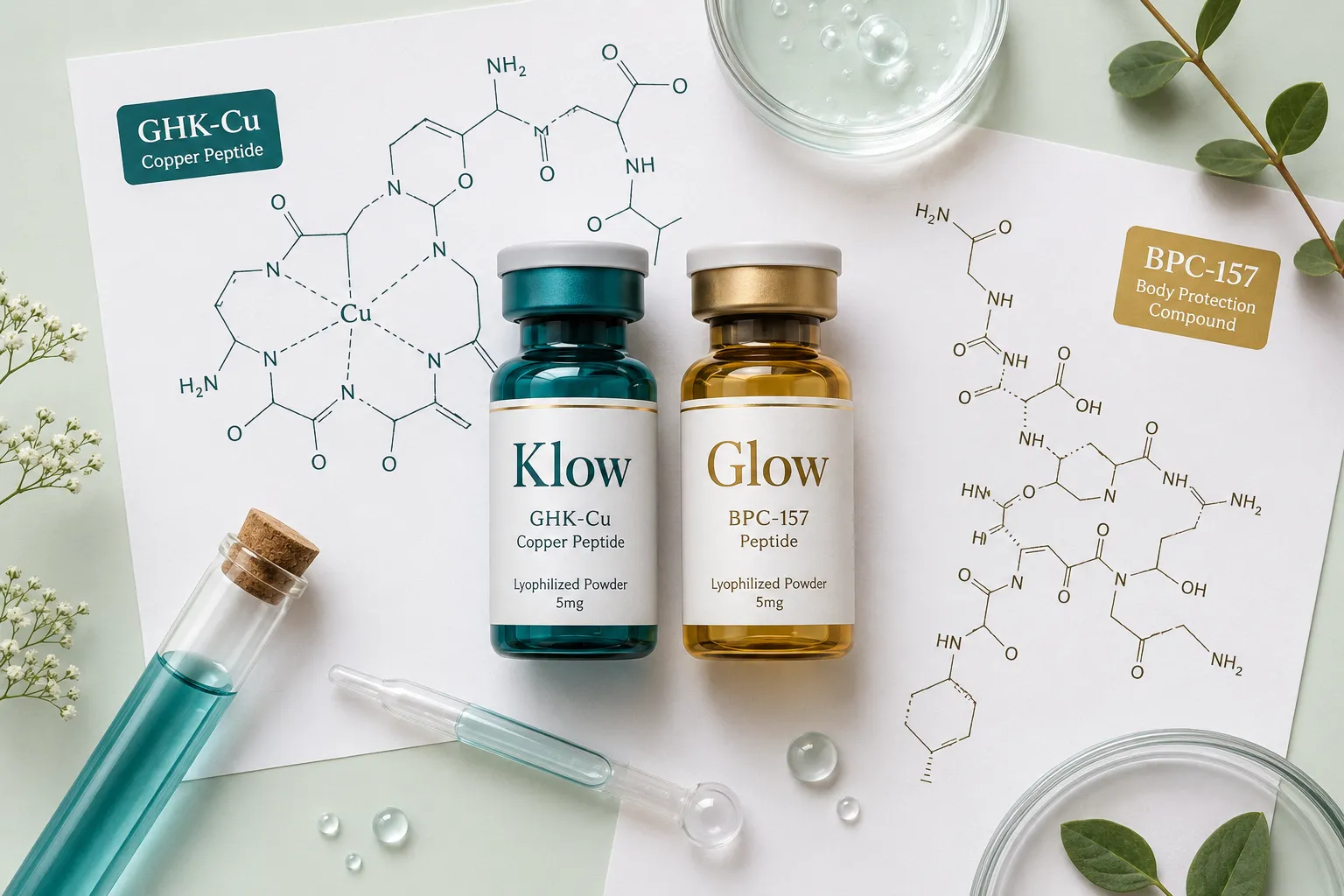
The Glow Blend is formulated primarily around skin luminosity and extracellular matrix support. Its core components typically include GHK-Cu (copper tripeptide-1), a low-molecular-weight peptide known for stimulating fibroblast proliferation and upregulating matrix metalloproteinase inhibitors. Alongside GHK-Cu, Glow Blend formulations often incorporate epidermal growth factor (EGF) analogs and hyaluronic acid precursors to support keratinocyte hydration and barrier integrity.
The Klow Blend, by contrast, is oriented toward hair follicle cycling and scalp tissue repair. Its formulation typically features:
- BPC-157, a 15-amino-acid peptide derived from gastric juice protein, studied for its role in angiogenesis and tendon-to-bone healing models
- GHK-Cu at a lower molar ratio than in Glow Blend
- KGF (keratinocyte growth factor) analogs to stimulate dermal papilla cells
- Thymosin Beta-4 fragments (similar to TB-500 peptide) for cytoskeletal remodeling
For researchers consulting the BPC-157 core documentation and research guide, BPC-157's inclusion in Klow Blend is supported by its documented ability to promote VEGF expression, a key driver of the vascular supply to hair follicle bulbs.
Key distinction: Glow Blend prioritizes dermal matrix density and surface keratinocyte turnover. Klow Blend prioritizes follicular vascularization and papilla cell activation.
How GHK-Cu, BPC-157, and Other Components Are Combined in Lab Formulations
The phrase "combined in lab formulations" is more technically demanding than it sounds. Peptide blends are not simply mixed in equal parts. Researchers consider molar ratios, pH stability windows, and receptor competition before finalizing a protocol.
GHK-Cu Concentration Thresholds
GHK-Cu demonstrates a well-documented biphasic dose response. At concentrations between 1-10 nM, it upregulates collagen I and III synthesis. Above 1 µM, some fibroblast models show inhibitory feedback. This means Glow Blend formulations that prioritize collagen output are typically prepared at the lower end of this range, while Klow Blend uses GHK-Cu as a supporting rather than primary agent.
BPC-157 and Angiogenic Synergy
BPC-157 does not compete with GHK-Cu for the same receptor pathways, which makes co-formulation feasible. In hair follicle explant models, BPC-157 has been shown to increase dermal microvascular density, creating a more nutrient-rich environment for follicle bulb cells that GHK-Cu then acts upon. This sequential signaling logic is why Klow Blend ratios typically run BPC-157 at 2-3x the molar concentration of GHK-Cu.
Supporting Co-Factors
Both blends use co-factors to extend peptide half-life and improve receptor engagement:
| Co-Factor | Role in Glow Blend | Role in Klow Blend |
|---|---|---|
| Hyaluronic acid | Hydration scaffold for keratinocytes | Minimal inclusion |
| Biotin peptide conjugates | Barrier repair support | Follicle cycling support |
| Thymosin Beta-4 fragments | Secondary antioxidant | Primary cytoskeletal agent |
| Zinc gluconate | Copper chelation balance | Enzyme cofactor for KGF |
Researchers exploring related multi-peptide combinations may also find value in reviewing BPC-157 and TB-500 combined research protocols to understand how overlapping repair pathways are managed in blended formats.
Experimental Outcomes in Fibroblast, Keratinocyte, and Hair Follicle Models
Understanding the Klow Blend vs Glow Blend in Skin and Hair Research: How GHK-Cu, BPC-157, and Other Components Are Combined in Lab Formulations question ultimately comes down to what the data shows in specific cell models.
Fibroblast Assays
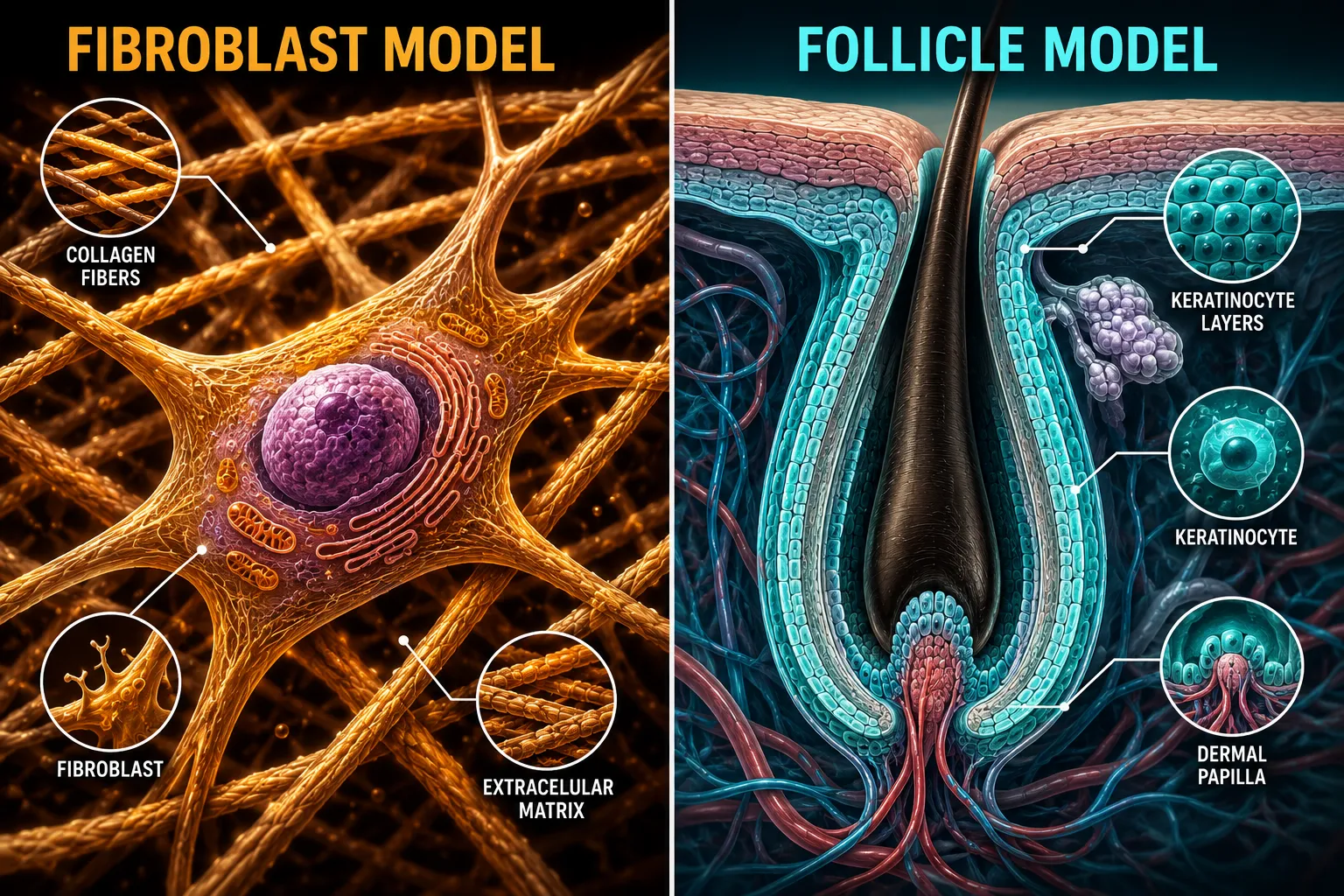
In 2D fibroblast cultures, Glow Blend consistently outperforms Klow Blend on collagen synthesis markers (pro-collagen I C-peptide assays). The higher GHK-Cu concentration drives TGF-beta1 signaling more aggressively. Klow Blend, however, shows superior results in scratch-wound assays, where BPC-157's pro-migratory effects accelerate fibroblast closure rates by approximately 20-30% in published in vitro models.
Keratinocyte Proliferation
Glow Blend's EGF analog component is the dominant driver in keratinocyte proliferation assays. Klow Blend produces modest keratinocyte stimulation, primarily through indirect pathways linked to improved vascular simulation in co-culture systems.
Hair Follicle Organ Culture
This is where Klow Blend demonstrates its clearest advantage. In hair follicle organ culture (HFOC) models, the BPC-157 and KGF analog combination extends the anagen (growth) phase duration by stimulating dermal papilla cell survival. Researchers using TB-500 in related hair and tissue research have noted comparable cytoskeletal effects, reinforcing the mechanistic logic behind Klow Blend's thymosin fragment inclusion.
For labs sourcing reference-grade peptides, Bachem and reference standard benchmarking resources provide critical purity documentation that ensures experimental reproducibility across both blend types.

Practical Considerations for Lab Use in 2026
Researchers working with either blend in 2026 should account for several practical variables:
- Lyophilization stability: BPC-157 degrades faster in aqueous solution than GHK-Cu. Klow Blend formulations require careful reconstitution protocols and cold-chain storage.
- Purity documentation: Both blends should carry HPLC purity certificates above 98% for reliable cell-based assays.
- Solvent compatibility: GHK-Cu is water-soluble; some KGF analogs require dilute acetic acid for initial reconstitution before blending.
Labs sourcing multi-peptide research compounds should also review available peptide research supply options to confirm lot-specific documentation before designing assay protocols.
Conclusion
The Klow Blend vs Glow Blend in Skin and Hair Research: How GHK-Cu, BPC-157, and Other Components Are Combined in Lab Formulations comparison reveals that ingredient overlap is far less important than ratio design and cellular target specificity. Glow Blend is the stronger candidate for fibroblast collagen studies and keratinocyte barrier research. Klow Blend is better positioned for hair follicle vascularization and anagen-phase extension models.
Actionable next steps for researchers:
- Define the primary cell model (fibroblast, keratinocyte, or follicle organ culture) before selecting a blend.
- Request HPLC and mass spectrometry certificates for all peptide components.
- Pilot both blends at half the standard concentration to establish dose-response baselines.
- Cross-reference BPC-157 and GHK-Cu literature to anticipate receptor interaction effects.
- Document reconstitution conditions precisely to ensure inter-assay reproducibility.
Selecting the right formulation is not a matter of preference, it is a matter of matching molecular mechanism to experimental question.


Leave a Reply
Want to join the discussion?Feel free to contribute!