Call or Text 727-513-9780
  • Shopping Cart Shopping Cart
    0Shopping Cart
Pure Tested Peptides | America's most trusted Peptides for sale online
  • Peptides for sale
    • Oral Peptides for sale
      • Peptide Capsules for sale
      • BPC 157 Capsules 1000mcg
      • SLU-PP-332 Capsules | 1000 mcg
      • 5-Amino-1MQ 50mg Capsules
      • Tesofensine 500mcg
    • All Peptides for sale
    • Peptide Sprays
      • BPC 157 Nasal Spray Kit
      • BPC-157 TB500 Nasal Spray Kit
      • Semax Nasal Spray 10mg
      • Selank – Nasal Spray Kit – 10mg
      • Epithalon 50MG Nasal Spray Kit
      • Ipamorelin 10mg Nasal Spray
      • Klow Nasal Spray (BPC-157 + TB-500 + GHK-Cu + KPV) | 80mg
      • Hulk Nasal Spray Tesa / Ipa Blend 6/3 MG
      • Klow Nasal Spray
      • NAD + 500 mg Nasal Spray
      • PT-141 Nasal Spray Kit
    • GHRH Peptides
      • Ipa Peptides
      • CJC-1295 Peptides
        • CJC-1295 with DAC 5 mg
        • CJC-1295 without DAC 5 mg
        • CJC-1295 Ipa 10mg
      • Tesa Peptides
        • Tesa Peptide
        • Tesa 20 mg
    • GHK-Cu Peptides
      • All GHK-Cu Peptides
      • GHK-Cu 100mg
      • KLOW Peptide Blend – Buy KLOW blend online
    • BPC Peptides
      • All BPC Peptides
      • BPC-157
      • BPC-157 TB-500
      • BPC 157 capsules 1000mcg
    • SLU-PP-332 Peptides
      • All SLU-PP-332 Peptides
      • SLU-PP-332 5mg
    • GLP3 Peptides
    • PT-141 Peptides
      • PT-141 Peptides for sale
      • PT-141 10mg
      • PT-141 Nasal Spray
    • CAG Peptides
      • Lipo-C Peptide Blend
      • CAG 5mg
      • CAG 10mg
    • MOTS-C Peptides
      • MOTS-C Peptides for sale
      • MOTS-c peptide
      • MOTS-c 10mg *6 pack*
    • 5 Amino 1MQ Peptides
      • 5 Amino 1MQ Peptides for sale
      • 5-Amino-1MQ 50mg Capsules
      • 5-Amino-1MQ 5mg
    • Epithalon Peptides
      • Epithalon Peptides for sale
      • Epithalon 10mg
      • Epithalon 50mg
  • Shop
    • GLPs
      • 5-Amino-1MQ 50mg Capsules
      • 5-Amino-1MQ 5mg
      • L-Carnitine 500mg/ml
      • Tesofensine 500mcg
      • SLU-PP-332 5mg
      • MOTS-c 10mg *6 pack*
    • Epithalon & BPC Peptides
      • Epithalon 10mg
      • Epithalon 50mg
      • BPC-157
      • BPC 157 capsules 1000mcg
      • BPC-157 TB-500
      • BPC-157 TB500 Nasal Spray Kit
      • BPC 157 Nasal Spray Kit
    • BPC TB-500 & NAD+ Peptides
      • NAD+ 500 mg
      • KLOW Peptide Blend – Buy KLOW blend online
      • GLOW Peptide Blend
      • TB 500 5mg
      • BPC 157 capsules 1000mcg – Supplement
      • BPC 157 Nasal Spray Kit
      • BPC-157
      • BPC-157 TB500 Nasal Spray Kit
      • BPC-157 TB-500
      • BPC 157 capsules 1000mcg
    • LL-37 Peptide
      • LL-37 10 mg
    • MOTS-C & Selank
      • MOTS-c peptide
      • Selank 10mg
    • GHK Peptides
      • GHK-Cu 100mg
      • GLOW Peptide Blend
      • KLOW Peptide Blend – Buy KLOW blend online
  • COAs
  • Wholesale
    • Wholesale Peptides for sale
  • PTP FAQ
  • Affiliates
    • Selank Peptide: Advanced Pharmacological Mechanisms Underlying Its Anxiolytic and Nootropic Effects in Research
      • 5-Amino-1MQ Peptide: Detailed Mechanisms of NNMT Inhibition and Its Impact on Cellular Metabolism Research
        • MOTS-C Peptide: Unraveling Its Role in Mitochondrial Dynamics and Energy Metabolism Research
          • Epithalon Peptide and Telomerase Regulation: Investigating Its Impact on Cellular Senescence and Lifespan Research Models
            • GLP2-T vs GLP2 Tirz Peptide: Understanding the Naming, Mechanistic Nuances, and Research Implications for Gut Health
      • Peptides and Polypeptides in Modern Pharmacology: What Research on Metoprolol, Prednisone, and Amlodipine Reveals
        • Polypeptide Peptides vs NSAIDs: What Naproxen and Diclofenac Teach Tissue-Repair Researchers About BPC‑157 and TB‑500
          • Peptides and Polypeptides in Endocrine Pharmacology: How GLP-1, GLP-2, and GLP-3 Retatrutide Differ From Classic Drugs Like Prednisone and Amlodipine
          • 5‑Amino‑1MQ Peptide and NNMT Inhibition: How It Compares With Statins Like Atorvastatin in Adipose and Lipid Metabolism Research
      • Enclomiphene, Estrogen Receptor Signaling, and Luteinizing Phase Biology: What Hormone Researchers Should Measure
        • Mesenchymal Stem Cells, BPC‑157, and GHK‑Cu: How Tissue Repair Peptides Compare With Classic NSAIDs Like Naproxen in Injury Models
          • Peptide Calculator Use Cases Beyond Growth Hormone: Working Through GLP‑3 Retatrutide, MOTS‑c, and BPC‑157 Research Dosing
        • Polypeptide Peptides in Endocrine and Metabolic Pharmacology: Lessons From Amlodipine, Prednisone, and Metoprolol
        • Peptides Calculator for Advanced Blends: Worked Examples for Tesamorelin, CJC‑1295, and Ipamorelin Stacks
          • Peptides and Polypeptides in Human Physiology: How Molecular Size Shapes Research Applications
            • Selank Peptide: Advanced Pharmacological Mechanisms Underlying Its Anxiolytic and Nootropic Effects in Research
          • 5-Amino-1MQ Peptide: Detailed Mechanisms of NNMT Inhibition and Its Impact on Cellular Metabolism Research
            • MOTS-C Peptide: Unraveling Its Role in Mitochondrial Dynamics and Energy Metabolism Research
              • Epithalon Peptide and Telomerase Regulation: Investigating Its Impact on Cellular Senescence and Lifespan Research Models
                • GLP2-T vs GLP2 Tirz Peptide: Understanding the Naming, Mechanistic Nuances, and Research Implications for Gut Health
                  • Peptides and Polypeptides in Endocrine Pharmacology: How GLP-1, GLP-2, and GLP-3 Retatrutide Differ From Classic Drugs Like Prednisone and Amlodipine
                    • Polypeptide Peptides vs NSAIDs: What Naproxen and Diclofenac Teach Tissue-Repair Researchers About BPC‑157 and TB‑500
                      • Peptides and Polypeptides in Modern Pharmacology: What Research on Metoprolol, Prednisone, and Amlodipine Reveals
                        • 5‑Amino‑1MQ Peptide and NNMT Inhibition: How It Compares With Statins Like Atorvastatin in Adipose and Lipid Metabolism Research
                        • Enclomiphene, Estrogen Receptor Signaling, and Luteinizing Phase Biology: What Hormone Researchers Should Measure
                        • Mesenchymal Stem Cells, BPC‑157, and GHK‑Cu: How Tissue Repair Peptides Compare With Classic NSAIDs Like Naproxen in Injury Models
                        • Peptide Calculator Use Cases Beyond Growth Hormone: Working Through GLP‑3 Retatrutide, MOTS‑c, and BPC‑157 Research Dosing
                        • Polypeptide Peptides in Endocrine and Metabolic Pharmacology: Lessons From Amlodipine, Prednisone, and Metoprolol
                        • Peptides Calculator for Advanced Blends: Worked Examples for Tesamorelin, CJC‑1295, and Ipamorelin Stacks
                        • Peptides and Polypeptides in Human Physiology: How Molecular Size Shapes Research Applications
                        • Selank Peptide: Advanced Pharmacological Mechanisms Underlying Its Anxiolytic and Nootropic Effects in Research
                        • MOTS-C Peptide: Unraveling Its Role in Mitochondrial Dynamics and Energy Metabolism Research
                        • Peptides and Polypeptides in Modern Pharmacology: What Research on Metoprolol, Prednisone, and Amlodipine Reveals
                        • Peptides and Polypeptides in Endocrine Pharmacology: How GLP-1, GLP-2, and GLP-3 Retatrutide Differ From Classic Drugs Like Prednisone and Amlodipine
                        • 5-Amino-1MQ Peptide: Detailed Mechanisms of NNMT Inhibition and Its Impact on Cellular Metabolism Research
                        • Mesenchymal Stem Cells, BPC‑157, and GHK‑Cu: How Tissue Repair Peptides Compare With Classic NSAIDs Like Naproxen in Injury Models
                        • Peptide Calculator Use Cases Beyond Growth Hormone: Working Through GLP‑3 Retatrutide, MOTS‑c, and BPC‑157 Research Dosing
                        • GLP2-T vs GLP2 Tirz Peptide: Understanding the Naming, Mechanistic Nuances, and Research Implications for Gut Health
                        • Polypeptide Peptides in Endocrine and Metabolic Pharmacology: Lessons From Amlodipine, Prednisone, and Metoprolol
                        • Polypeptide Peptides vs NSAIDs: What Naproxen and Diclofenac Teach Tissue-Repair Researchers About BPC‑157 and TB‑500
                        • Peptides and Polypeptides in Human Physiology: How Molecular Size Shapes Research Applications
                        • Peptides Calculator for Advanced Blends: Worked Examples for Tesamorelin, CJC‑1295, and Ipamorelin Stacks
                        • 5‑Amino‑1MQ Peptide and NNMT Inhibition: How It Compares With Statins Like Atorvastatin in Adipose and Lipid Metabolism Research
                        • Enclomiphene, Estrogen Receptor Signaling, and Luteinizing Phase Biology: What Hormone Researchers Should Measure
                        • Epithalon Peptide and Telomerase Regulation: Investigating Its Impact on Cellular Senescence and Lifespan Research Models
                        • Best research protocol Klow blend
                        • best time to take BPC-157
                        • best time to take DSIP (Delta Sleep Inducing Peptide)
                        • best time to take CJC-1295
                        • best time to take AOD-9604
                        • best time to take Follistatin 344
                        • best time to take Ipamorelin
                        • best time to take MK-677 (Ibutamoren)
                        • best time to take Ligandrol (LGD-4033) — research compound
                        • best time to take Ostarine (MK-2866) — research compound
                        • best time to take GHK-CU
                        • best time to take TB-500
                        • best time to take MOTS-c
                        • best time to take Semax
                        • best time to take RAD-140 (Testolone) — research compound
                        • best time to take Thymosin Alpha-1
                        • best time to take PEG-MGF
                        • Biolife Plasma, Octapharma Plasma, and Research Peptides: How Plasma Donation Labs Differ From Peptide Suppliers
                        • best time to take YK-11 — research compound
                        • best time to take PT-141 (Bremelanotide)
                        • Best research protocol Klow blend
                        • 5-Amino-1MQ and MOTS-C Synergy: Metabolic Signaling, Mitochondria, and Research Design
                        • BPC-157 and TB-500: Investigating Their Combined Effects on Angiogenesis and Cellular Migration in Tissue Repair Models
                        • BPC-157 Peptide: Gut Barrier Function, Inflammation, and Tissue-Recovery Research
                        • 5‑Amino‑1MQ and MOTS‑c Synergy in Metabolic Research: Designing NNMT and Mitochondrial Biogenesis Stacks
                        • CJC-1295 with DAC vs. Without DAC: Half-Life, Release Kinetics, and Research Implications
                        • CJC‑1295 with DAC vs. Without DAC: Expanding on Half‑Life Differences Using Tesamorelin and Ipamorelin Blend Case Studies
                        • Collagen Biology and Copper‑Binding Peptides: How GHK‑Cu, Glow Blend, and Klow Blend Interact with Skin and Connective Tissue
                        • Collagen Biology and Regenerative Peptides: How GHK‑Cu, Glow Blend, and Klow Blend Affect Extracellular Matrix Research
                    • DNA, Telomeres, and Longevity Peptides: Positioning Epithalon and MOTS‑c in Genetic Aging Research
                      • Enclomiphene Citrate: serm Mechanism, Testosterone Research, and Stack Compatibility
                        • Enclomiphene vs Enclomiphene Citrate: Formulation, Bioavailability, and Research Distinctions
                        • Epithalon Peptide Research: Telomerase Activation, Aging, and Pineal Gland Function
                        • Estrogen Receptor Signaling and Enclomiphene: How Selective Modulators Compare with Classic Polypeptide Hormones
                        • GHK-Cu Peptide: Advanced Mechanisms in Extracellular Matrix Remodeling and Wound Healing Research
                        • GHK-Cu Peptide: Collagen Synthesis, Wound Repair, and Skin-Barrier Research Models
                        • GLP-1 vs GLP-3 vs GLP-2: Peptide Classification and Research Applications
                        • GLP-2 Peptide Research Guide: Gut Barrier Function, Nutrient Absorption, and Intestinal Recovery Models
                        • GLP-3 Retatrutide vs. GLP-1 Drugs: What Triple-Agonist Biology Changes in Research Models
                        • Ipamorelin and Tesamorelin Combination: Synergistic GH Secretagogue Research and Dosing Protocols
                        • GLP2 Tirz Peptide: What It Is, Why the Name Exists, and How Researchers Should Interpret It
                        • Klow Blend Peptide Nasal Spray: What the Formulation Is Trying to Do in Cognitive Research
                        • Mitochondria, NNMT Inhibition, and Peptide Modulators: Where MOTS‑c and 5‑Amino‑1MQ Fit in Cellular Energy Research
                        • MOTS-c Peptide: Mitochondrial Function, Energy Metabolism, and What Researchers Measure
                        • MOTS-c vs. 5-Amino-1MQ: Which Metabolic Research Questions Each Compound Actually Answers
                        • Nasal Spray Peptides: Bioavailability, Administration, and Semax/Selank Research Applications
                        • PT-141 Peptide Research: Mechanism of Action and Melanocortin Receptor Signaling
                        • Retatrutide for Research: Mechanism, Structure, and GLP-1/GLP-3 Dual Action
                        • Retatrutide for Obesity and Type 2 Diabetes: What the Latest Trial Data Suggest
                        • Tesofensine Peptide Research: Mechanism, Appetite Suppression, and Neuropeptide Y Pathways
  • Contact
    • Contact Customer Service
    • Text Customer Support
  • About US
  • Shop all peptides
  • Affiliate Program
    • Affiliate Signup
  • Login / Register Login / Register Page Link Login / Register Page Link
  • Click to open the search input field Click to open the search input field Search
  • Menu Menu
Semax Nasal Spray Research Products: How to Compare Concentration, Excipient Disclosure, and Analytical Documentation

Semax Nasal Spray Research Products: How to Compare Concentration, Excipient Disclosure, and Analytical Documentation

September 28, 2026/0 Comments/in Uncategorized/by

Purity figures alone tell only part of the story. A nasal spray labeled "99% pure Semax" could contain anywhere from 1 mg/mL to 10 mg/mL of active peptide, a tenfold difference that fundamentally changes every dose calculation. Researchers evaluating Semax nasal spray research products: how to compare concentration, excipient disclosure, and analytical documentation need a structured framework, not just a headline number.

Key Takeaways

  • Semax nasal spray concentration is expressed in mg/mL; a 0.1% solution equals 1 mg/mL and a 1% solution equals 10 mg/mL, always convert before comparing products.
  • COA-measured net peptide content often differs from the label claim; reviewing actual tested values is essential for accurate dosing calculations.
  • Excipient disclosure, including buffer type, pH, and preservative identity, varies widely between suppliers and directly affects formulation comparability.
  • High-quality analytical documentation combines HPLC purity, MS identity confirmation, heavy metal screening, sterility testing, and endotoxin limits, not just a single purity percentage.
  • COA accessibility models range from instant download to on-request portals; downloadable batch-specific documents with ISO-accredited lab credentials offer the strongest verification path.

Comparing Concentration Across Semax Nasal Spray Research Products
Comparing Concentration Across Semax Nasal Spray Research Products

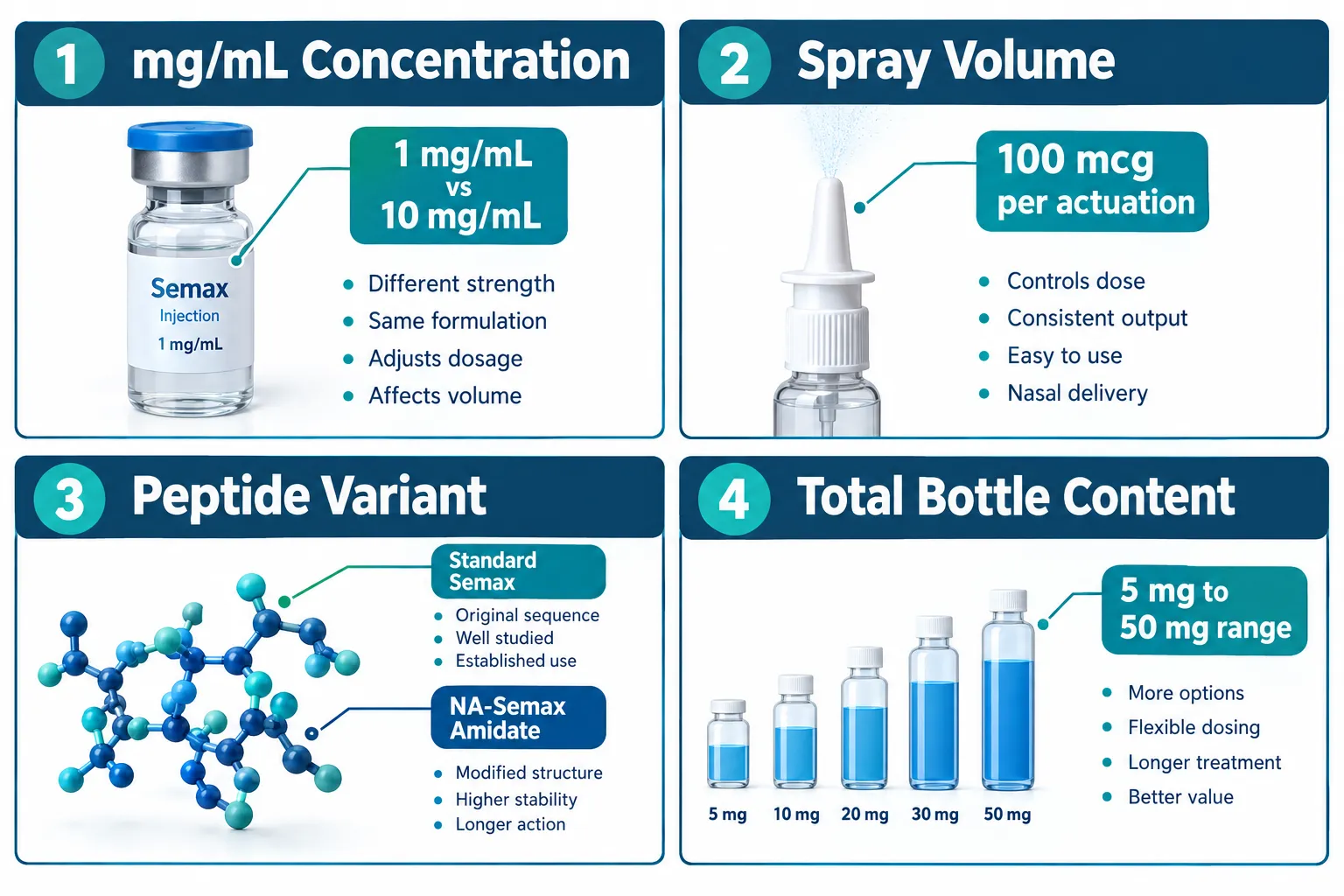
The single most consequential variable when comparing Semax nasal spray research products is concentration, yet it is frequently presented inconsistently across suppliers. Some vendors list total milligrams per bottle, others use percentage notation, and others specify micrograms per actuation. All three refer to the same underlying quantity, but only when converted to mg/mL do they become directly comparable.

A 0.1% Semax nasal spray contains 1 mg/mL of active peptide. A 1% spray contains 10 mg/mL. Russian clinical studies that established the foundational Semax research record typically used 0.1% (1 mg/mL) solutions, delivering 200-400 mcg intranasally per day. A 5 mL bottle at that concentration holds 5 mg total and delivers roughly 50-100 mcg per spray, yielding approximately 25-50 actuations at 100 mcg each.

Some commercial research products now sit at 1 mg/mL with 100 mcg per metered spray across a 10 mL bottle, a total of 10 mg per container. Others label 30 mg in a 10 mL bottle, placing concentration at 3 mg/mL. The table below illustrates how to normalize these figures:

Label Claim Volume Calculated mg/mL Mcg per 100 µL Spray
5 mg bottle 5 mL 1.0 mg/mL 100 mcg
10 mg bottle 10 mL 1.0 mg/mL 100 mcg
30 mg bottle 10 mL 3.0 mg/mL 300 mcg
50 mg bottle 10 mL 5.0 mg/mL 500 mcg

Always verify whether the listed volume is the fill volume or the nominal bottle size. COA-measured net content can exceed the label claim, one batch labeled at 30 mg was independently tested and found to contain 33 mg, which shifts every dose calculation upward. Relying on the label alone introduces systematic error.

Beyond standard Semax, researchers should confirm the peptide variant. N-acetyl Semax amide (NA-Semax Amidate) is a structurally distinct analogue with different pharmacokinetic properties. It may be presented in an identical nasal spray format at 1 mg/mL, but it is not interchangeable with the classical heptapeptide for research comparison purposes. The COA identity section, not just the product name, is the authoritative source for confirming which compound is actually present.


Excipient Disclosure: What the Carrier Composition Reveals
Excipient Disclosure: What the Carrier Composition Reveals

Excipient transparency has emerged as one of the clearest differentiators among Semax nasal spray research products. The carrier solution, the liquid in which the peptide is dissolved, directly influences stability, mucosal tolerability, and the comparability of formulations across studies.

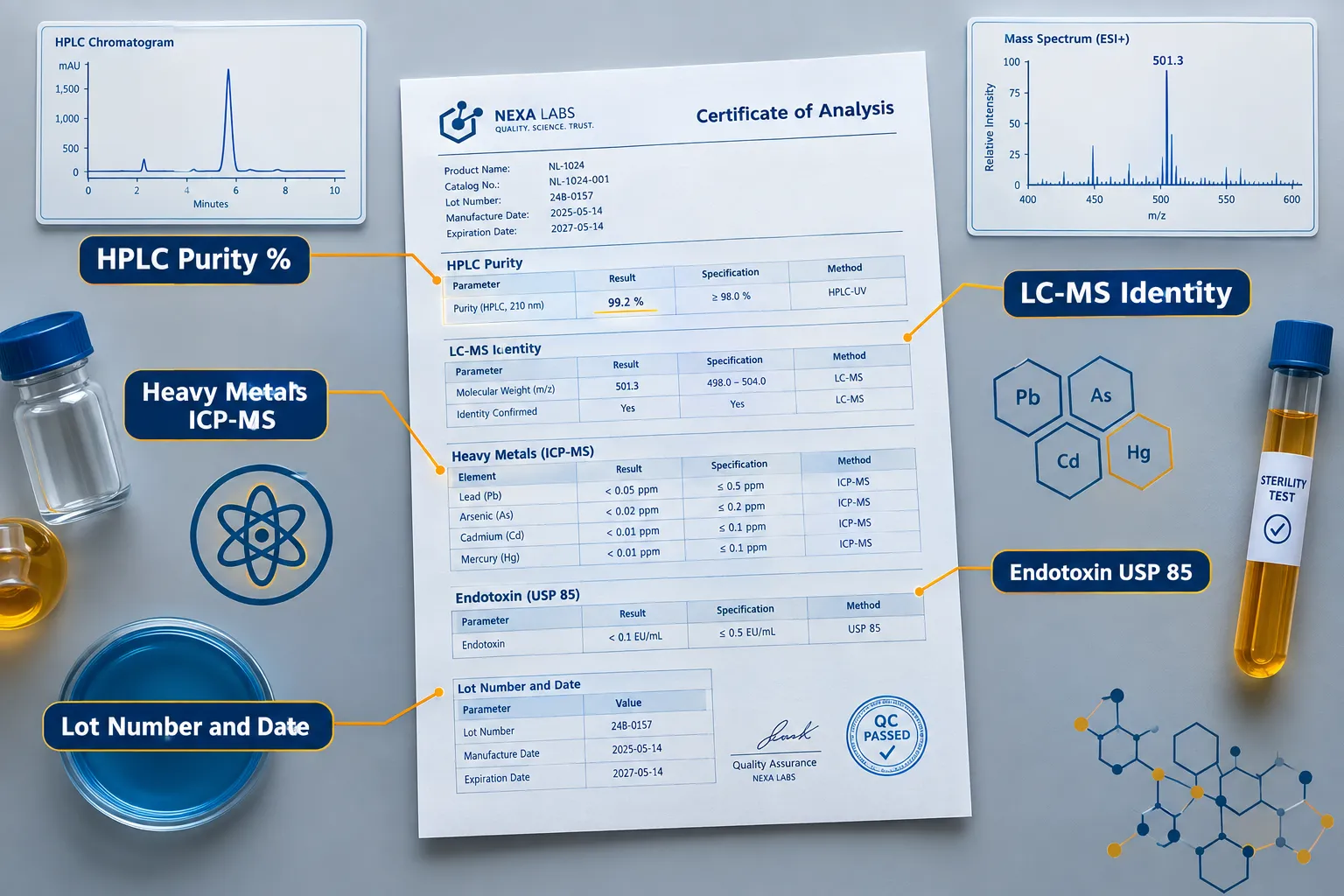
A fully disclosed excipient profile includes:

  • Buffer identity (e.g., normal saline, phosphate-buffered saline)
  • pH value (typically 5.5-7.0 for nasal formulations)
  • Preservative (e.g., benzalkonium chloride at 0.01%)
  • Solvent grade (e.g., lab-grade distilled water, sterile water for injection)

Some suppliers publish this information directly on the product page, specifying normal saline at pH 6.0 with benzalkonium chloride (BKC) at 0.01% as the antimicrobial preservative. This level of detail allows a researcher to assess whether the formulation is isotonic, whether the pH is within a range that preserves peptide integrity, and whether the preservative could interact with any assay being conducted.

Other suppliers focus their public-facing documentation entirely on peptide identity and purity, leaving excipient composition unstated. This is not necessarily a quality failure, the peptide itself may be excellent, but it limits formulation comparability and makes it harder to replicate or cross-reference research conditions.

"The carrier is not inert. pH, ionic strength, and preservative concentration all affect peptide stability and nasal absorption kinetics. Excipient disclosure is a research variable, not just a regulatory formality."

Container closure is a related but often overlooked factor. Metered-dose nasal pumps with defined actuation volumes (typically 100 µL) enable reproducible delivery. Simple dropper-top bottles do not. When comparing products, confirm whether the delivery device is a calibrated pump and what the stated actuation volume is.


Analytical Documentation Standards for Semax Spray Research Products
Analytical Documentation Standards for Semax Spray Research Products

Evaluating Semax nasal spray research products: how to compare concentration, excipient disclosure, and analytical documentation ultimately depends on the depth and accessibility of the certificate of analysis. A single purity percentage is a starting point, not a complete picture.

Purity figures across current research suppliers range from approximately 98.5% to a claimed 100%. However, the more meaningful question is: what method produced that number, and what does the COA document beyond it?

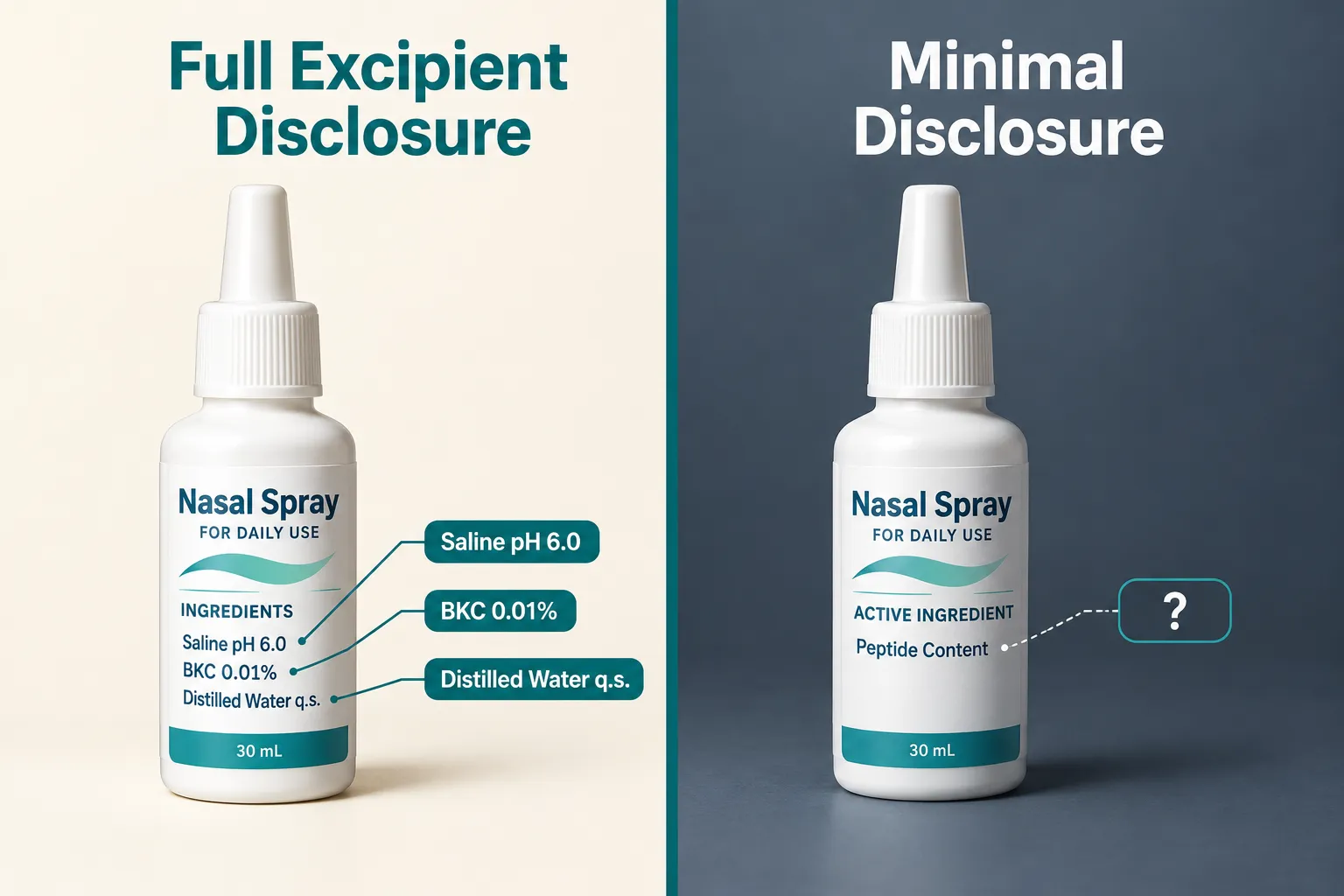
A research-grade COA should include:

  1. HPLC purity, with method details (e.g., RP-HPLC at 214 nm), retention time, and a defined specification threshold (e.g., ≥99.0% peak area)
  2. Mass spectrometry identity, LC-MS or MALDI-MS confirming the expected molecular mass (Semax: approximately 813.9 Da for the full heptapeptide sequence)
  3. Net peptide content, HPLC-quantified actual mass, not just label claim
  4. Heavy metals, ICP-MS screening with a "not detected" or numerical result
  5. Sterility or microbial testing, PCR-based or culture-based, with explicit pass criteria
  6. Endotoxin, tested under USP guidelines with a defined EU/mL limit
  7. Lot number and analysis date, batch-specific, not a generic template
  8. Laboratory accreditation, ISO 17025 certification is the current benchmark

Some suppliers now offer panels that include all eight elements above, including fentanyl screens as an additional safety marker. Others provide identity and purity alone. The gap between these two documentation levels is significant for any serious research context.

COA accessibility also varies. Some vendors maintain downloadable COA libraries organized by batch ID and analysis date, enabling pre-purchase verification. Others issue batch-specific documents only through a support portal on request. Both models can yield legitimate documentation, but downloadable access reduces friction and allows faster cross-batch comparison.

When reviewing identity data, look for explicit mass values rather than generic confirmations. Semax's molecular formula is C₃₇H₅₁N₉O₁₀S (CAS 80714-61-0), with a monoisotopic mass of approximately 813.35 Da. A COA that reports a measured mass matching this value, and notes the absence of Met-sulfoxide oxidation products or truncated sequence variants, demonstrates a higher level of analytical rigor than one that simply states "identity confirmed."

Researchers exploring related peptide research categories, such as SS-31 mitochondrial research or ipamorelin spray products, will recognize that the same COA evaluation framework applies across nasal and injectable peptide formats. The same standards used to assess IPA Sermorelin stack research documentation, HPLC purity, MS identity, and lot traceability, translate directly to Semax nasal spray evaluation. Similarly, researchers reviewing SS-31 kidney health research products or aging support compounds will find that multi-method COA panels are becoming the expected standard across the research peptide sector.


Conclusion

Comparing Semax nasal spray research products: how to compare concentration, excipient disclosure, and analytical documentation requires moving beyond headline purity figures to a structured, multi-variable assessment.

Actionable next steps for researchers:

  • Convert all concentration data to mg/mL before comparing products; do not rely on percentage notation or total bottle content alone.
  • Request or download the batch-specific COA before purchase and confirm it includes HPLC purity with method details, MS identity with a numerical mass value, and a dated lot number.
  • Verify excipient composition, buffer type, pH, and preservative identity, to ensure formulation comparability across research conditions.
  • Confirm the peptide variant (standard Semax vs. NA-Semax Amidate or other analogues) using the identity section of the COA, not the product name alone.
  • Prioritize suppliers using ISO 17025-accredited laboratories and offering multi-parameter panels that include heavy metal, sterility, and endotoxin testing.

As the research peptide market in 2026 continues to mature, suppliers offering transparent, multi-method documentation and full excipient disclosure are setting a higher benchmark. Applying this framework consistently protects research integrity and enables meaningful cross-product comparison.

Tags: analytical testing, coa documentation, excipient disclosure, hplc purity, nasal spray research, peptide concentration, research peptides, semax nasal spray
https://www.puretestedpeptides.com/wp-content/uploads/2026/09/semax-nasal-spray-research-products-how-to-compare-concentration-excipient-discl.webp 1024 1536 https://www.puretestedpeptides.com/wp-content/uploads/2026/01/buy-peptides-online.jpg 2026-09-28 13:04:162026-09-28 13:04:16Semax Nasal Spray Research Products: How to Compare Concentration, Excipient Disclosure, and Analytical Documentation
You might also like
ACE Inhibitors and Research Peptides: Designing Blood-Pressure Controls Around Lisinopril and Growth-Hormone Secretagogues ACE Inhibitors and Research Peptides: Designing Blood-Pressure Controls Around Lisinopril and Growth-Hormone Secretagogues
Enclomiphene vs Enclomiphene Citrate: How Labs Choose Between Research Formulations and Vendors Enclomiphene vs Enclomiphene Citrate: How Labs Choose Between Research Formulations and Vendors
Peptides and Polypeptides in Modern Pharmacology: How Research-Use Peptides Compare With Classic Drugs Like Prednisone and Amlodipine Peptides and Polypeptides in Modern Pharmacology: How Research-Use Peptides Compare With Classic Drugs Like Prednisone and Amlodipine
Selank Peptide: Research Benefits, Dosing Concepts, and Mechanism of Action Selank Peptide: Research Benefits, Dosing Concepts, and Mechanism of Action
The Best Research Peptides for Mitochondrial Function: A Comparative Review of MOTS-c and 5-Amino-1MQ The Best Research Peptides for Mitochondrial Function: A Comparative Review of MOTS-c and 5-Amino-1MQ
5-Amino-1MQ and MOTS-c Synergy in Adiposity Research: How Labs Stack Mitochondrial Peptides 5-Amino-1MQ and MOTS-c Synergy in Adiposity Research: How Labs Stack Mitochondrial Peptides
Peptide Drug Interactions: How Research Peptides Interact With Common Medications Peptide Drug Interactions: How Research Peptides Interact With Common Medications
The Broad Spectrum of Peptides: A Comprehensive Guide to Their Structure, Synthesis, and Diverse Research Applications The Broad Spectrum of Peptides: A Comprehensive Guide to Their Structure, Synthesis, and Diverse Research Applications
0 replies

Leave a Reply

Want to join the discussion?
Feel free to contribute!

Leave a Reply Cancel reply

Your email address will not be published. Required fields are marked *

×

Helpful Links

  • My account
  • Cart
  • Checkout
  • Refund and Returns Policy
  • Privacy Policy
  • SMS Privacy Policy
  • Login
  • My Account
  • Logout

USA Made Lab Tested Peptides

All products are sold for research, laboratory, or analytical purposes only, and are not for human consumption


Pure Tested Peptides is a chemical supplier. Pure Tested Peptides is not a compounding / chemical compounding facility as defined under 503A of the Federal Food, Drug, and Cosmetic act. Pure Tested Peptides is not an outsourcing facility as defined under 503B of the Federal Food, Drug, and Cosmetic act.

The statements made within this website have not been evaluated by the US Food and Drug Administration. The products we offer are not intended to diagnose, treat, cure or prevent any disease.

Human/Animal Consumption Prohibited. Laboratory/In-Vitro Experimental Use Only

Link to: Glow Blend Peptide vs GHK-Cu: What Skin and Tissue Research Models Actually Measure Link to: Glow Blend Peptide vs GHK-Cu: What Skin and Tissue Research Models Actually Measure Glow Blend Peptide vs GHK-Cu: What Skin and Tissue Research Models Actually...Glow Blend Peptide vs GHK-Cu: What Skin and Tissue Research Models Actually Measure Link to: Complement-Dependent Cytotoxicity in GLP-3 and BPC-157 Studies: What New Safety Data Signals Mean for Peptide Researchers in 2026 Link to: Complement-Dependent Cytotoxicity in GLP-3 and BPC-157 Studies: What New Safety Data Signals Mean for Peptide Researchers in 2026 Complement-Dependent Cytotoxicity in GLP-3 and BPC-157 Studies: What New Safety Data Signals Mean for Peptide Researchers in 2026Complement-Dependent Cytotoxicity in GLP-3 and BPC-157 Studies: What New Safety...
Scroll to top Scroll to top Scroll to top