Call or Text 727-513-9780
  • Shopping Cart Shopping Cart
    0Shopping Cart
Pure Tested Peptides | America's most trusted Peptides for sale online
  • Peptides for sale
    • Oral Peptides for sale
      • Peptide Capsules for sale
      • BPC 157 Capsules 1000mcg
      • SLU-PP-332 Capsules | 1000 mcg
      • 5-Amino-1MQ 50mg Capsules
      • Tesofensine 500mcg
    • All Peptides for sale
    • Peptide Sprays
      • BPC 157 Nasal Spray Kit
      • BPC-157 TB500 Nasal Spray Kit
      • Semax Nasal Spray 10mg
      • Selank – Nasal Spray Kit – 10mg
      • Epithalon 50MG Nasal Spray Kit
      • Ipamorelin 10mg Nasal Spray
      • Klow Nasal Spray (BPC-157 + TB-500 + GHK-Cu + KPV) | 80mg
      • Hulk Nasal Spray Tesa / Ipa Blend 6/3 MG
      • Klow Nasal Spray
      • NAD + 500 mg Nasal Spray
      • PT-141 Nasal Spray Kit
    • GHRH Peptides
      • Ipa Peptides
      • CJC-1295 Peptides
        • CJC-1295 with DAC 5 mg
        • CJC-1295 without DAC 5 mg
        • CJC-1295 Ipa 10mg
      • Tesa Peptides
        • Tesa Peptide
        • Tesa 20 mg
    • GHK-Cu Peptides
      • All GHK-Cu Peptides
      • GHK-Cu 100mg
      • KLOW Peptide Blend – Buy KLOW blend online
    • BPC Peptides
      • All BPC Peptides
      • BPC-157
      • BPC-157 TB-500
      • BPC 157 capsules 1000mcg
    • SLU-PP-332 Peptides
      • All SLU-PP-332 Peptides
      • SLU-PP-332 5mg
    • GLP3 Peptides
    • PT-141 Peptides
      • PT-141 Peptides for sale
      • PT-141 10mg
      • PT-141 Nasal Spray
    • CAG Peptides
      • Lipo-C Peptide Blend
      • CAG 5mg
      • CAG 10mg
    • MOTS-C Peptides
      • MOTS-C Peptides for sale
      • MOTS-c peptide
      • MOTS-c 10mg *6 pack*
    • 5 Amino 1MQ Peptides
      • 5 Amino 1MQ Peptides for sale
      • 5-Amino-1MQ 50mg Capsules
      • 5-Amino-1MQ 5mg
    • Epithalon Peptides
      • Epithalon Peptides for sale
      • Epithalon 10mg
      • Epithalon 50mg
  • Shop
    • GLPs
      • 5-Amino-1MQ 50mg Capsules
      • 5-Amino-1MQ 5mg
      • L-Carnitine 500mg/ml
      • Tesofensine 500mcg
      • SLU-PP-332 5mg
      • MOTS-c 10mg *6 pack*
    • Epithalon & BPC Peptides
      • Epithalon 10mg
      • Epithalon 50mg
      • BPC-157
      • BPC 157 capsules 1000mcg
      • BPC-157 TB-500
      • BPC-157 TB500 Nasal Spray Kit
      • BPC 157 Nasal Spray Kit
    • BPC TB-500 & NAD+ Peptides
      • NAD+ 500 mg
      • KLOW Peptide Blend – Buy KLOW blend online
      • GLOW Peptide Blend
      • TB 500 5mg
      • BPC 157 capsules 1000mcg – Supplement
      • BPC 157 Nasal Spray Kit
      • BPC-157
      • BPC-157 TB500 Nasal Spray Kit
      • BPC-157 TB-500
      • BPC 157 capsules 1000mcg
    • LL-37 Peptide
      • LL-37 10 mg
    • MOTS-C & Selank
      • MOTS-c peptide
      • Selank 10mg
    • GHK Peptides
      • GHK-Cu 100mg
      • GLOW Peptide Blend
      • KLOW Peptide Blend – Buy KLOW blend online
  • COAs
  • Wholesale
    • Wholesale Peptides for sale
  • PTP FAQ
  • Affiliates
    • Selank Peptide: Advanced Pharmacological Mechanisms Underlying Its Anxiolytic and Nootropic Effects in Research
      • 5-Amino-1MQ Peptide: Detailed Mechanisms of NNMT Inhibition and Its Impact on Cellular Metabolism Research
        • MOTS-C Peptide: Unraveling Its Role in Mitochondrial Dynamics and Energy Metabolism Research
          • Epithalon Peptide and Telomerase Regulation: Investigating Its Impact on Cellular Senescence and Lifespan Research Models
            • GLP2-T vs GLP2 Tirz Peptide: Understanding the Naming, Mechanistic Nuances, and Research Implications for Gut Health
      • Peptides and Polypeptides in Modern Pharmacology: What Research on Metoprolol, Prednisone, and Amlodipine Reveals
        • Polypeptide Peptides vs NSAIDs: What Naproxen and Diclofenac Teach Tissue-Repair Researchers About BPC‑157 and TB‑500
          • Peptides and Polypeptides in Endocrine Pharmacology: How GLP-1, GLP-2, and GLP-3 Retatrutide Differ From Classic Drugs Like Prednisone and Amlodipine
          • 5‑Amino‑1MQ Peptide and NNMT Inhibition: How It Compares With Statins Like Atorvastatin in Adipose and Lipid Metabolism Research
      • Enclomiphene, Estrogen Receptor Signaling, and Luteinizing Phase Biology: What Hormone Researchers Should Measure
        • Mesenchymal Stem Cells, BPC‑157, and GHK‑Cu: How Tissue Repair Peptides Compare With Classic NSAIDs Like Naproxen in Injury Models
          • Peptide Calculator Use Cases Beyond Growth Hormone: Working Through GLP‑3 Retatrutide, MOTS‑c, and BPC‑157 Research Dosing
        • Polypeptide Peptides in Endocrine and Metabolic Pharmacology: Lessons From Amlodipine, Prednisone, and Metoprolol
        • Peptides Calculator for Advanced Blends: Worked Examples for Tesamorelin, CJC‑1295, and Ipamorelin Stacks
          • Peptides and Polypeptides in Human Physiology: How Molecular Size Shapes Research Applications
            • Selank Peptide: Advanced Pharmacological Mechanisms Underlying Its Anxiolytic and Nootropic Effects in Research
          • 5-Amino-1MQ Peptide: Detailed Mechanisms of NNMT Inhibition and Its Impact on Cellular Metabolism Research
            • MOTS-C Peptide: Unraveling Its Role in Mitochondrial Dynamics and Energy Metabolism Research
              • Epithalon Peptide and Telomerase Regulation: Investigating Its Impact on Cellular Senescence and Lifespan Research Models
                • GLP2-T vs GLP2 Tirz Peptide: Understanding the Naming, Mechanistic Nuances, and Research Implications for Gut Health
                  • Peptides and Polypeptides in Endocrine Pharmacology: How GLP-1, GLP-2, and GLP-3 Retatrutide Differ From Classic Drugs Like Prednisone and Amlodipine
                    • Polypeptide Peptides vs NSAIDs: What Naproxen and Diclofenac Teach Tissue-Repair Researchers About BPC‑157 and TB‑500
                      • Peptides and Polypeptides in Modern Pharmacology: What Research on Metoprolol, Prednisone, and Amlodipine Reveals
                        • 5‑Amino‑1MQ Peptide and NNMT Inhibition: How It Compares With Statins Like Atorvastatin in Adipose and Lipid Metabolism Research
                        • Enclomiphene, Estrogen Receptor Signaling, and Luteinizing Phase Biology: What Hormone Researchers Should Measure
                        • Mesenchymal Stem Cells, BPC‑157, and GHK‑Cu: How Tissue Repair Peptides Compare With Classic NSAIDs Like Naproxen in Injury Models
                        • Peptide Calculator Use Cases Beyond Growth Hormone: Working Through GLP‑3 Retatrutide, MOTS‑c, and BPC‑157 Research Dosing
                        • Polypeptide Peptides in Endocrine and Metabolic Pharmacology: Lessons From Amlodipine, Prednisone, and Metoprolol
                        • Peptides Calculator for Advanced Blends: Worked Examples for Tesamorelin, CJC‑1295, and Ipamorelin Stacks
                        • Peptides and Polypeptides in Human Physiology: How Molecular Size Shapes Research Applications
                        • Selank Peptide: Advanced Pharmacological Mechanisms Underlying Its Anxiolytic and Nootropic Effects in Research
                        • MOTS-C Peptide: Unraveling Its Role in Mitochondrial Dynamics and Energy Metabolism Research
                        • Peptides and Polypeptides in Modern Pharmacology: What Research on Metoprolol, Prednisone, and Amlodipine Reveals
                        • Peptides and Polypeptides in Endocrine Pharmacology: How GLP-1, GLP-2, and GLP-3 Retatrutide Differ From Classic Drugs Like Prednisone and Amlodipine
                        • 5-Amino-1MQ Peptide: Detailed Mechanisms of NNMT Inhibition and Its Impact on Cellular Metabolism Research
                        • Mesenchymal Stem Cells, BPC‑157, and GHK‑Cu: How Tissue Repair Peptides Compare With Classic NSAIDs Like Naproxen in Injury Models
                        • Peptide Calculator Use Cases Beyond Growth Hormone: Working Through GLP‑3 Retatrutide, MOTS‑c, and BPC‑157 Research Dosing
                        • GLP2-T vs GLP2 Tirz Peptide: Understanding the Naming, Mechanistic Nuances, and Research Implications for Gut Health
                        • Polypeptide Peptides in Endocrine and Metabolic Pharmacology: Lessons From Amlodipine, Prednisone, and Metoprolol
                        • Polypeptide Peptides vs NSAIDs: What Naproxen and Diclofenac Teach Tissue-Repair Researchers About BPC‑157 and TB‑500
                        • Peptides and Polypeptides in Human Physiology: How Molecular Size Shapes Research Applications
                        • Peptides Calculator for Advanced Blends: Worked Examples for Tesamorelin, CJC‑1295, and Ipamorelin Stacks
                        • 5‑Amino‑1MQ Peptide and NNMT Inhibition: How It Compares With Statins Like Atorvastatin in Adipose and Lipid Metabolism Research
                        • Enclomiphene, Estrogen Receptor Signaling, and Luteinizing Phase Biology: What Hormone Researchers Should Measure
                        • Epithalon Peptide and Telomerase Regulation: Investigating Its Impact on Cellular Senescence and Lifespan Research Models
                        • Best research protocol Klow blend
                        • best time to take BPC-157
                        • best time to take DSIP (Delta Sleep Inducing Peptide)
                        • best time to take CJC-1295
                        • best time to take AOD-9604
                        • best time to take Follistatin 344
                        • best time to take Ipamorelin
                        • best time to take MK-677 (Ibutamoren)
                        • best time to take Ligandrol (LGD-4033) — research compound
                        • best time to take Ostarine (MK-2866) — research compound
                        • best time to take GHK-CU
                        • best time to take TB-500
                        • best time to take MOTS-c
                        • best time to take Semax
                        • best time to take RAD-140 (Testolone) — research compound
                        • best time to take Thymosin Alpha-1
                        • best time to take PEG-MGF
                        • Biolife Plasma, Octapharma Plasma, and Research Peptides: How Plasma Donation Labs Differ From Peptide Suppliers
                        • best time to take YK-11 — research compound
                        • best time to take PT-141 (Bremelanotide)
                        • Best research protocol Klow blend
                        • 5-Amino-1MQ and MOTS-C Synergy: Metabolic Signaling, Mitochondria, and Research Design
                        • BPC-157 and TB-500: Investigating Their Combined Effects on Angiogenesis and Cellular Migration in Tissue Repair Models
                        • BPC-157 Peptide: Gut Barrier Function, Inflammation, and Tissue-Recovery Research
                        • 5‑Amino‑1MQ and MOTS‑c Synergy in Metabolic Research: Designing NNMT and Mitochondrial Biogenesis Stacks
                        • CJC-1295 with DAC vs. Without DAC: Half-Life, Release Kinetics, and Research Implications
                        • CJC‑1295 with DAC vs. Without DAC: Expanding on Half‑Life Differences Using Tesamorelin and Ipamorelin Blend Case Studies
                        • Collagen Biology and Copper‑Binding Peptides: How GHK‑Cu, Glow Blend, and Klow Blend Interact with Skin and Connective Tissue
                        • Collagen Biology and Regenerative Peptides: How GHK‑Cu, Glow Blend, and Klow Blend Affect Extracellular Matrix Research
                    • DNA, Telomeres, and Longevity Peptides: Positioning Epithalon and MOTS‑c in Genetic Aging Research
                      • Enclomiphene Citrate: serm Mechanism, Testosterone Research, and Stack Compatibility
                        • Enclomiphene vs Enclomiphene Citrate: Formulation, Bioavailability, and Research Distinctions
                        • Epithalon Peptide Research: Telomerase Activation, Aging, and Pineal Gland Function
                        • Estrogen Receptor Signaling and Enclomiphene: How Selective Modulators Compare with Classic Polypeptide Hormones
                        • GHK-Cu Peptide: Advanced Mechanisms in Extracellular Matrix Remodeling and Wound Healing Research
                        • GHK-Cu Peptide: Collagen Synthesis, Wound Repair, and Skin-Barrier Research Models
                        • GLP-1 vs GLP-3 vs GLP-2: Peptide Classification and Research Applications
                        • GLP-2 Peptide Research Guide: Gut Barrier Function, Nutrient Absorption, and Intestinal Recovery Models
                        • GLP-3 Retatrutide vs. GLP-1 Drugs: What Triple-Agonist Biology Changes in Research Models
                        • Ipamorelin and Tesamorelin Combination: Synergistic GH Secretagogue Research and Dosing Protocols
                        • GLP2 Tirz Peptide: What It Is, Why the Name Exists, and How Researchers Should Interpret It
                        • Klow Blend Peptide Nasal Spray: What the Formulation Is Trying to Do in Cognitive Research
                        • Mitochondria, NNMT Inhibition, and Peptide Modulators: Where MOTS‑c and 5‑Amino‑1MQ Fit in Cellular Energy Research
                        • MOTS-c Peptide: Mitochondrial Function, Energy Metabolism, and What Researchers Measure
                        • MOTS-c vs. 5-Amino-1MQ: Which Metabolic Research Questions Each Compound Actually Answers
                        • Nasal Spray Peptides: Bioavailability, Administration, and Semax/Selank Research Applications
                        • PT-141 Peptide Research: Mechanism of Action and Melanocortin Receptor Signaling
                        • Retatrutide for Research: Mechanism, Structure, and GLP-1/GLP-3 Dual Action
                        • Retatrutide for Obesity and Type 2 Diabetes: What the Latest Trial Data Suggest
                        • Tesofensine Peptide Research: Mechanism, Appetite Suppression, and Neuropeptide Y Pathways
  • Contact
    • Contact Customer Service
    • Text Customer Support
  • About US
  • Shop all peptides
  • Affiliate Program
    • Affiliate Signup
  • Login / Register Login / Register Page Link Login / Register Page Link
  • Click to open the search input field Click to open the search input field Search
  • Menu Menu
Meloxicam and Peptide Research: A Practical Guide to COX Inhibition, Pain Scores, and Tissue-Repair Confounding

Meloxicam and Peptide Research: A Practical Guide to COX Inhibition, Pain Scores, and Tissue-Repair Confounding

November 6, 2026/0 Comments/in Uncategorized/by

A single oral dose of meloxicam can suppress prostaglandin E2 levels by roughly 40% within eight hours, a biochemical shift significant enough to reshape the inflammatory environment that repair-focused peptides like BPC-157 and TB-500 are specifically designed to modulate. That overlap is the central problem this guide addresses.

This practical guide to meloxicam and peptide research covers COX inhibition, pain score interpretation, and tissue-repair confounding so that researchers can design cleaner studies and interpret existing data with far greater accuracy.

Key Takeaways

  • Meloxicam preferentially inhibits COX-2 but meaningfully suppresses COX-1 as well, altering the same prostanoid signals that tissue-repair peptides target.
  • Concurrent meloxicam use can reduce pain scores independently of any peptide effect, inflating apparent analgesic efficacy in research endpoints.
  • Timing matters critically: late-phase COX-2 inhibition (days 11-20 post-injury) demonstrably impairs tendon load tolerance and may mask peptide-driven remodeling gains.
  • Bone, tendon, and muscle repair models are all susceptible to meloxicam-induced confounding; each tissue type carries distinct mechanistic risks.
  • Practical mitigation strategies, including analgesic stratification, topical-only NSAID policies, and covariate adjustment, can protect the integrity of peptide trial endpoints.

How COX Inhibition Reshapes the Peptide Research Baseline

Understanding the COX pathway is not optional background knowledge in peptide research, it is the foundation of every pain and repair endpoint used in translational models.
How COX Inhibition Reshapes the Peptide Research Baseline

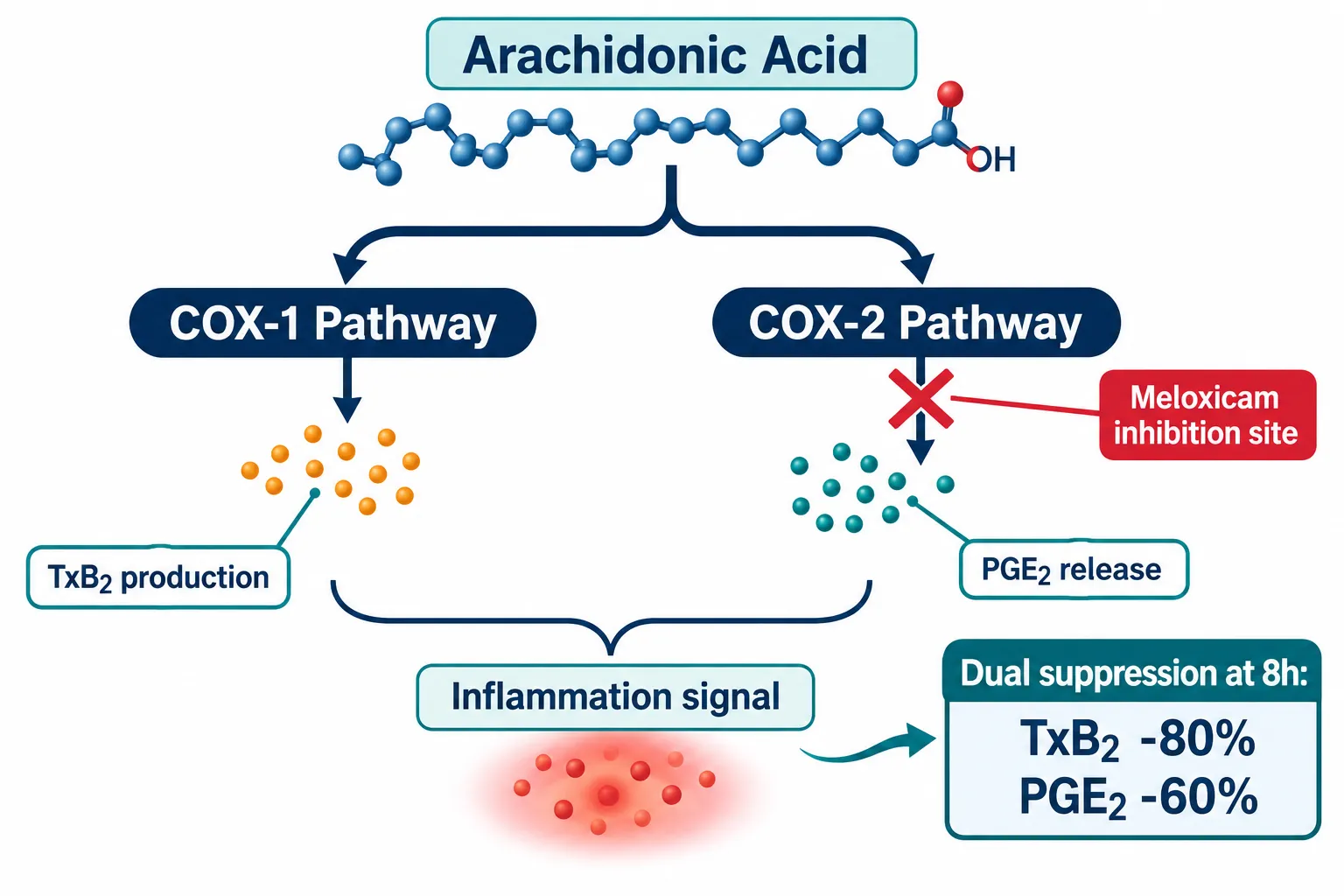
Meloxicam blocks cyclooxygenase enzymes that convert arachidonic acid into prostaglandins and thromboxanes. It has a preference for COX-2 but is not a selective COX-2 inhibitor in the strict pharmacological sense. Pharmacodynamic data from animal models confirm that a standard single dose reduces thromboxane B2 (a COX-1 product) to approximately 80% of baseline and prostaglandin E2 (a COX-2 product) to roughly 60% of baseline, both measured at the eight-hour mark. That dual suppression is consequential because prostaglandins E2 and I2 are not simply pain mediators; they are active regulators of angiogenesis, stem cell recruitment, and matrix remodeling.

Why this directly conflicts with peptide mechanisms:

  • BPC-157 is documented in preclinical models to upregulate growth factor expression partly through prostanoid-sensitive signaling cascades. When meloxicam flattens the PGE2 signal, the upstream environment BPC-157 operates within is fundamentally altered. For a thorough breakdown of that mechanism, see the BPC-157 core peptides documentation and first research guide.
  • TB-500 (thymosin beta-4) promotes actin polymerization and cell migration in a milieu shaped partly by prostanoid gradients.
  • Peptides targeting mitochondrial integrity, such as those reviewed in SS-31 mitochondrial research, operate in an oxidative stress environment that COX-2 activity helps define.

Researchers who fail to account for background NSAID use are, in effect, running peptide trials on a biochemically altered baseline.


Tissue-Repair Confounding Across Bone, Tendon, and Muscle

The confounding risk is not uniform across tissue types. Each repair model carries a distinct mechanistic vulnerability tied to COX-2 biology.
Tissue-Repair Confounding Across Bone, Tendon, and Muscle

Bone Repair

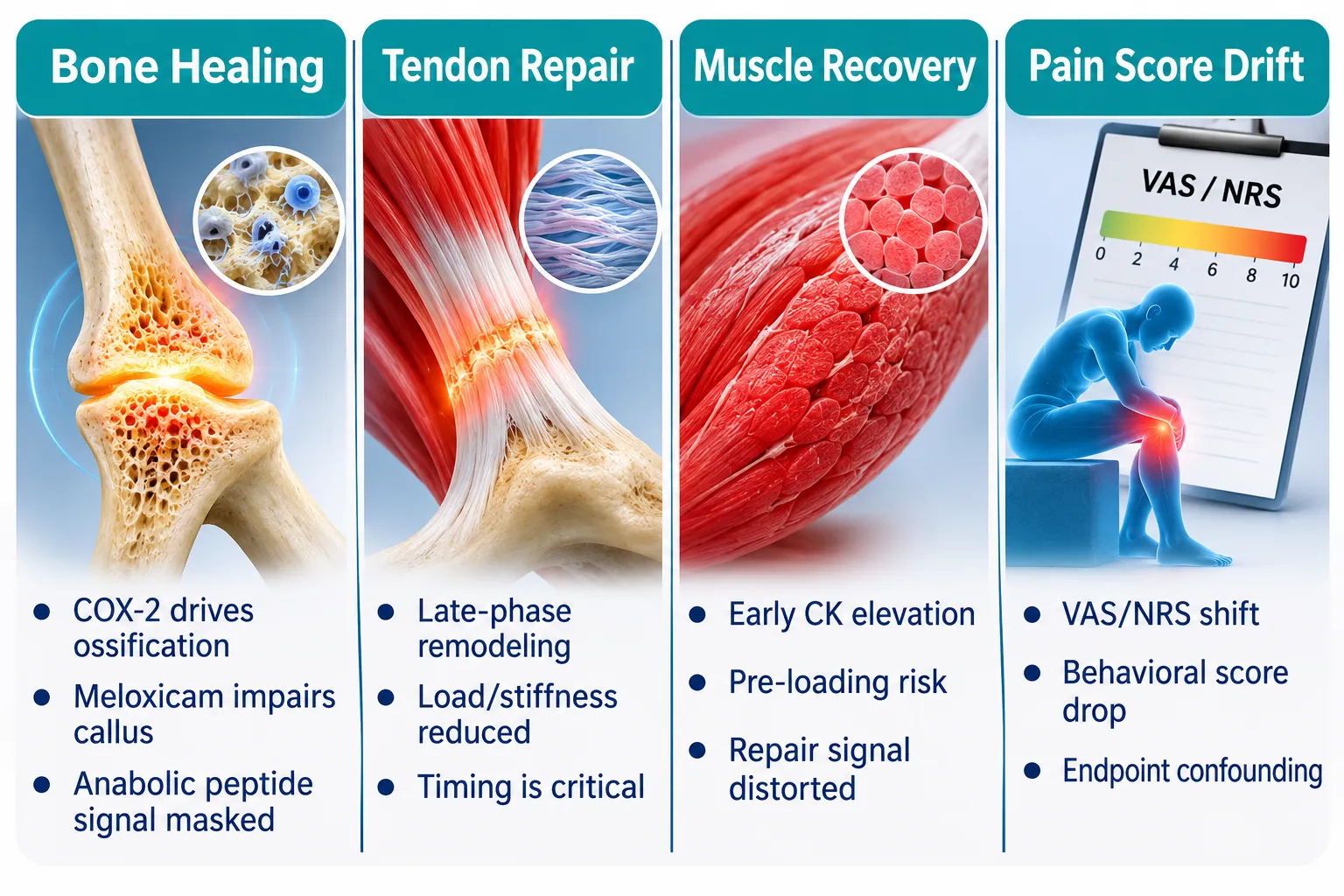
Endochondral ossification, the primary mechanism of fracture healing, depends on COX-2 activity during the cartilaginous callus phase. In rat fracture models, ten days of post-fracture meloxicam significantly impaired healing compared to controls. In vitro work confirms reduced bone nodule formation. For trials testing bone-anabolic peptides or growth factors, concurrent meloxicam use can suppress the very biological machinery the peptide is meant to stimulate, producing false-negative or attenuated efficacy signals.

Tendon and Soft Tissue

A well-characterized rotator cuff repair model found that meloxicam administered during the late proliferative and remodeling phase (days 11 through 20 post-surgery) significantly reduced both maximal load and stiffness at three weeks. Earlier administration was less detrimental. This timing dependency is critical: a peptide trial assessing connective tissue mechanical endpoints must specify exactly when NSAID co-administration occurred, or the biomechanical data are uninterpretable. Broader systematic reviews on soft-tissue healing echo this concern, noting that COX-2-selective agents can reduce tendon and ligament failure loads in controlled models.

Muscle Recovery

An eccentric exercise damage model found that early meloxicam administration, given before the damaging exercise bout, produced higher post-exercise creatine kinase (CK) levels than dosing 48 hours after damage. This suggests that premature COX-2 blockade can amplify the magnitude of muscle injury rather than limit it. For peptide studies targeting muscle repair or hypertrophy, pre-loading subjects with meloxicam before the damage stimulus could substantially inflate CK signals, making a peptide's subsequent effect appear smaller by comparison.

Key point: The mechanism of harm differs by tissue type, but the shared theme is consistent, meloxicam alters the inflammatory signaling environment that repair peptides depend on, in ways that can either mask efficacy or distort biomarker readings.


Pain Scores, Analgesic Confounding, and Practical Protocol Design

Meloxicam's analgesic efficacy is robust. In veterinary trials, meloxicam-treated subjects produced significantly lower pain scores than comparators at days 15, 30, and 60. In behavioral animal models, treated subjects show markedly reduced pain scores versus saline controls within 60 to 180 minutes of dosing. That reliability is exactly what makes it a confounding threat in peptide research.

If a trial uses a visual analogue scale (VAS), numeric rating scale (NRS), or behavioral pain score as a primary endpoint, an uncontrolled meloxicam co-administration can reduce scores by 25% to 60% independently of any peptide effect. Non-NSAID analgesic comparators, such as cetylated fatty acid formulations, have demonstrated VAS reductions of 45% to 64% over eight weeks, confirming that analgesic alternatives exist and can be deployed to avoid COX-2-mediated pain endpoint contamination.

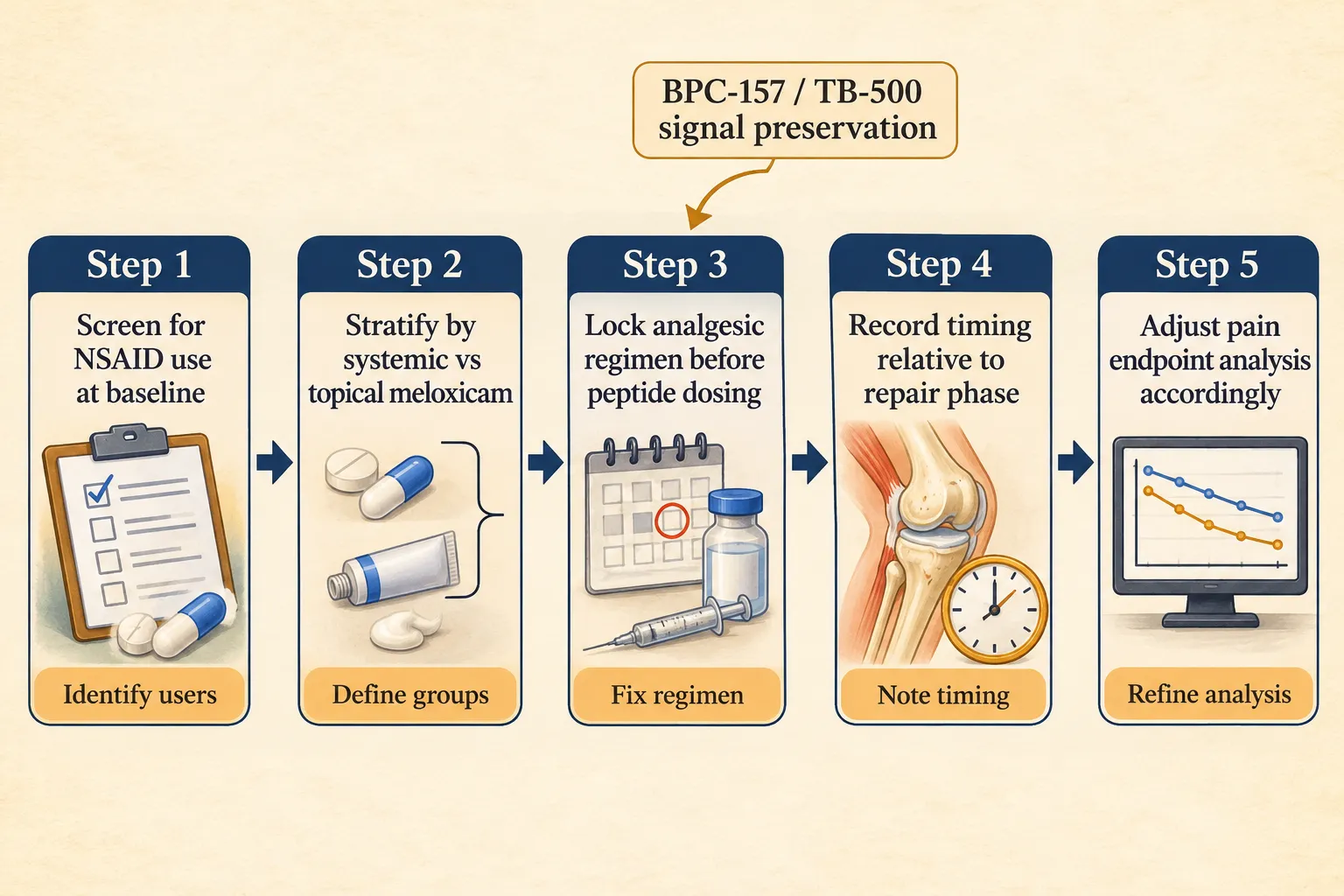
Practical mitigation steps for peptide protocol designers:

  1. Screen all subjects for NSAID use at baseline and during the washout period.
  2. Stratify enrolled subjects by systemic versus topical meloxicam exposure before randomization.
  3. Lock the analgesic rescue regimen before peptide dosing begins, do not allow ad hoc NSAID initiation during the trial.
  4. Document the timing of any meloxicam doses relative to the injury or repair phase.
  5. Pre-specify meloxicam use as a covariate in the statistical analysis plan.

Topical meloxicam formulations, including film-forming sprays and emulgels, deliver meaningful local COX-2 suppression with potentially reduced systemic exposure. However, even localized COX-2 inhibition can alter joint tissue remodeling endpoints in regenerative research, so topical use should be documented and stratified rather than dismissed as inconsequential.

For researchers sourcing compounds for controlled studies, using lab-tested peptides with verified purity documentation is essential when analgesic confounders are already adding variability. Guidance on building robust peptide benchmarks with reference standards is equally relevant to this quality-control conversation.

Clinical practice guidance increasingly recommends topical NSAIDs and multimodal analgesia, combining acetaminophen with topical agents, to minimize systemic COX-2 inhibition while still managing pain. Aligning peptide trial analgesic protocols with these frameworks is now viewed as best practice. Researchers exploring metabolic or mitochondrial peptides in conjunction with pain management should also review the SS-31 mechanism and research context for a parallel example of how co-interventions interact with endpoint selection.
Pain Scores, Analgesic Confounding, and Practical Protocol Design

For newer investigational peptides where the interaction with COX biology has not yet been characterized, supplier-level comparisons and quality documentation become the first line of defense. Resources like peptide supplier comparisons help establish the purity and identity baseline needed before any confounding-variable analysis is meaningful.


Conclusion

Meloxicam is a highly effective analgesic and anti-inflammatory agent, and that effectiveness is precisely what makes it a methodological hazard in peptide and tissue-repair research. Its dual COX-1 and COX-2 suppression reshapes the prostanoid environment that BPC-157, TB-500, and similar compounds are designed to work within. It independently reduces pain scores, potentially inflating apparent peptide analgesic efficacy. And in bone, tendon, and muscle repair models, its timing relative to the injury phase can attenuate the mechanical and cellular outcomes a trial is trying to attribute to the peptide.

Actionable next steps for 2026 and beyond:

  • Treat systemic meloxicam as a primary covariate in any tissue-repair peptide trial, not a nuisance variable.
  • Adopt topical-only analgesic policies during critical repair windows (especially days 10-20 post-injury) when COX-2 activity is mechanistically essential.
  • Use validated non-NSAID analgesic comparators when pain endpoints are primary outcomes.
  • Document analgesic timing with the same rigor applied to peptide dosing schedules.
  • Review study designs against updated systematic evidence on NSAID and soft-tissue interactions, as the human trial literature continues to grow.

Cleaner analgesic protocols do not just protect data integrity, they make the signal from investigational peptides far more interpretable, reproducible, and ultimately useful.

Tags: bpc-157, cox inhibition, meloxicam, nsaid confounding, pain scores, peptide research, prostaglandin e2, tissue repair
https://www.puretestedpeptides.com/wp-content/uploads/2026/11/meloxicam-and-peptide-research-a-practical-guide-to-cox-inhibition-pain-scores-a.webp 1024 1536 https://www.puretestedpeptides.com/wp-content/uploads/2026/01/buy-peptides-online.jpg 2026-11-06 14:06:212026-11-06 14:06:21Meloxicam and Peptide Research: A Practical Guide to COX Inhibition, Pain Scores, and Tissue-Repair Confounding
You might also like
Klow Peptide Nasal Spray: What It Is, How Researchers Evaluate It, and Why Formulation Matters Klow Peptide Nasal Spray: What It Is, How Researchers Evaluate It, and Why Formulation Matters
Prednisone and Peptide Research Models: Separating Glucocorticoid Metabolic Effects From Tissue-Repair Signals Prednisone and Peptide Research Models: Separating Glucocorticoid Metabolic Effects From Tissue-Repair Signals
Spironolactone, Cardiorenal Pathways, and Tissue-Repair Peptides: How BPC-157 and TB-500 Complement Classic Heart and Kidney Drug Models Spironolactone, Cardiorenal Pathways, and Tissue-Repair Peptides: How BPC-157 and TB-500 Complement Classic Heart and Kidney Drug Models
Selank Peptide: Exploring Its Anxiolytic and Nootropic Mechanisms for Cognitive Research Selank Peptide: Exploring Its Anxiolytic and Nootropic Mechanisms for Cognitive Research
What Are Polypeptide Peptides? From Collagen and Hormones to Advanced Research Compounds Like GLP-3 Retatrutide What Are Polypeptide Peptides? From Collagen and Hormones to Advanced Research Compounds Like GLP-3 Retatrutide
Triple Agonist Therapies Beyond GLP‑3: What Retatrutide’s Success Means for Future Multi-Target Peptide Design Triple Agonist Therapies Beyond GLP‑3: What Retatrutide’s Success Means for Future Multi-Target Peptide Design
What Is a Diuretic? HCTZ, Furosemide, and Fluid-Balance Controls in GLP and Growth-Hormone Peptide Research What Is a Diuretic? HCTZ, Furosemide, and Fluid-Balance Controls in GLP and Growth-Hormone Peptide Research
Klow Peptide Nasal Spray vs Single-Agent Semax or Selank: Designing a Formulation-First Comparison Klow Peptide Nasal Spray vs Single-Agent Semax or Selank: Designing a Formulation-First Comparison
0 replies

Leave a Reply

Want to join the discussion?
Feel free to contribute!

Leave a Reply Cancel reply

Your email address will not be published. Required fields are marked *

×

Helpful Links

  • My account
  • Cart
  • Checkout
  • Refund and Returns Policy
  • Privacy Policy
  • SMS Privacy Policy
  • Login
  • My Account
  • Logout

USA Made Lab Tested Peptides

All products are sold for research, laboratory, or analytical purposes only, and are not for human consumption


Pure Tested Peptides is a chemical supplier. Pure Tested Peptides is not a compounding / chemical compounding facility as defined under 503A of the Federal Food, Drug, and Cosmetic act. Pure Tested Peptides is not an outsourcing facility as defined under 503B of the Federal Food, Drug, and Cosmetic act.

The statements made within this website have not been evaluated by the US Food and Drug Administration. The products we offer are not intended to diagnose, treat, cure or prevent any disease.

Human/Animal Consumption Prohibited. Laboratory/In-Vitro Experimental Use Only

Link to: Glow Blend and Klow Blend in 3D Skin Models: Measuring Diffusion, Matrix Remodeling, and Blend Component Attribution Link to: Glow Blend and Klow Blend in 3D Skin Models: Measuring Diffusion, Matrix Remodeling, and Blend Component Attribution Glow Blend and Klow Blend in 3D Skin Models: Measuring Diffusion, Matrix Remodeling,...Glow Blend and Klow Blend in 3D Skin Models: Measuring Diffusion, Matrix Remodeling, and Blend Component Attribution Link to: Retatrutide 2026 Trial Results: What the New Obstructive Sleep Apnea Data Mean for Research Models Link to: Retatrutide 2026 Trial Results: What the New Obstructive Sleep Apnea Data Mean for Research Models Retatrutide 2026 Trial Results: What the New Obstructive Sleep Apnea Data Mean for Research ModelsRetatrutide 2026 Trial Results: What the New Obstructive Sleep Apnea Data Mean...
Scroll to top Scroll to top Scroll to top