Call or Text 727-513-9780
  • Shopping Cart Shopping Cart
    0Shopping Cart
Pure Tested Peptides | America's most trusted Peptides for sale online
  • Peptides for sale
    • Oral Peptides for sale
      • Peptide Capsules for sale
      • BPC 157 Capsules 1000mcg
      • SLU-PP-332 Capsules | 1000 mcg
      • 5-Amino-1MQ 50mg Capsules
      • Tesofensine 500mcg
    • All Peptides for sale
    • Peptide Sprays
      • BPC 157 Nasal Spray Kit
      • BPC-157 TB500 Nasal Spray Kit
      • Semax Nasal Spray 10mg
      • Selank – Nasal Spray Kit – 10mg
      • Epithalon 50MG Nasal Spray Kit
      • Ipamorelin 10mg Nasal Spray
      • Klow Nasal Spray (BPC-157 + TB-500 + GHK-Cu + KPV) | 80mg
      • Hulk Nasal Spray Tesa / Ipa Blend 6/3 MG
      • Klow Nasal Spray
      • NAD + 500 mg Nasal Spray
      • PT-141 Nasal Spray Kit
    • GHRH Peptides
      • Ipa Peptides
      • CJC-1295 Peptides
        • CJC-1295 with DAC 5 mg
        • CJC-1295 without DAC 5 mg
        • CJC-1295 Ipa 10mg
      • Tesa Peptides
        • Tesa Peptide
        • Tesa 20 mg
    • GHK-Cu Peptides
      • All GHK-Cu Peptides
      • GHK-Cu 100mg
      • KLOW Peptide Blend – Buy KLOW blend online
    • BPC Peptides
      • All BPC Peptides
      • BPC-157
      • BPC-157 TB-500
      • BPC 157 capsules 1000mcg
    • SLU-PP-332 Peptides
      • All SLU-PP-332 Peptides
      • SLU-PP-332 5mg
    • GLP3 Peptides
      • GLP3-R
      • GLP3-R CAG 10mg
      • GLP3-R 20mg
    • PT-141 Peptides
      • PT-141 Peptides for sale
      • PT-141 10mg
      • PT-141 Nasal Spray
    • CAG Peptides
      • Lipo-C Peptide Blend
      • CAG 5mg
      • CAG 10mg
    • MOTS-C Peptides
      • MOTS-C Peptides for sale
      • MOTS-c peptide
      • MOTS-c 10mg *6 pack*
    • 5 Amino 1MQ Peptides
      • 5 Amino 1MQ Peptides for sale
      • 5-Amino-1MQ 50mg Capsules
      • 5-Amino-1MQ 5mg
    • Epithalon Peptides
      • Epithalon Peptides for sale
      • Epithalon 10mg
      • Epithalon 50mg
  • Shop
    • GLPs
      • 5-Amino-1MQ 50mg Capsules
      • 5-Amino-1MQ 5mg
      • GLP3-Reta
      • L-Carnitine 500mg/ml
      • Tesofensine 500mcg
      • SLU-PP-332 5mg
      • MOTS-c 10mg *6 pack*
    • Epithalon & BPC Peptides
      • Epithalon 10mg
      • Epithalon 50mg
      • BPC-157
      • BPC 157 capsules 1000mcg
      • BPC-157 TB-500
      • BPC-157 TB500 Nasal Spray Kit
      • BPC 157 Nasal Spray Kit
    • BPC TB-500 & NAD+ Peptides
      • NAD+ 500 mg
      • KLOW Peptide Blend – Buy KLOW blend online
      • GLOW Peptide Blend
      • TB 500 5mg
      • BPC 157 capsules 1000mcg – Supplement
      • BPC 157 Nasal Spray Kit
      • BPC-157
      • BPC-157 TB500 Nasal Spray Kit
      • BPC-157 TB-500
      • BPC 157 capsules 1000mcg
    • LL-37 Peptide
      • LL-37 10 mg
    • MOTS-C & Selank
      • MOTS-c peptide
      • Selank 10mg
    • GHK Peptides
      • GHK-Cu 100mg
      • GLOW Peptide Blend
      • KLOW Peptide Blend – Buy KLOW blend online
  • COAs
  • Wholesale
    • Wholesale Peptides for sale
  • PTP FAQ
  • Affiliates
    • Selank Peptide: Advanced Pharmacological Mechanisms Underlying Its Anxiolytic and Nootropic Effects in Research
      • 5-Amino-1MQ Peptide: Detailed Mechanisms of NNMT Inhibition and Its Impact on Cellular Metabolism Research
        • MOTS-C Peptide: Unraveling Its Role in Mitochondrial Dynamics and Energy Metabolism Research
          • Epithalon Peptide and Telomerase Regulation: Investigating Its Impact on Cellular Senescence and Lifespan Research Models
            • GLP2-T vs GLP2 Tirz Peptide: Understanding the Naming, Mechanistic Nuances, and Research Implications for Gut Health
      • Peptides and Polypeptides in Modern Pharmacology: What Research on Metoprolol, Prednisone, and Amlodipine Reveals
        • Polypeptide Peptides vs NSAIDs: What Naproxen and Diclofenac Teach Tissue-Repair Researchers About BPC‑157 and TB‑500
          • Peptides and Polypeptides in Endocrine Pharmacology: How GLP-1, GLP-2, and GLP-3 Retatrutide Differ From Classic Drugs Like Prednisone and Amlodipine
          • 5‑Amino‑1MQ Peptide and NNMT Inhibition: How It Compares With Statins Like Atorvastatin in Adipose and Lipid Metabolism Research
      • Enclomiphene, Estrogen Receptor Signaling, and Luteinizing Phase Biology: What Hormone Researchers Should Measure
        • Mesenchymal Stem Cells, BPC‑157, and GHK‑Cu: How Tissue Repair Peptides Compare With Classic NSAIDs Like Naproxen in Injury Models
          • Peptide Calculator Use Cases Beyond Growth Hormone: Working Through GLP‑3 Retatrutide, MOTS‑c, and BPC‑157 Research Dosing
        • Polypeptide Peptides in Endocrine and Metabolic Pharmacology: Lessons From Amlodipine, Prednisone, and Metoprolol
        • Peptides Calculator for Advanced Blends: Worked Examples for Tesamorelin, CJC‑1295, and Ipamorelin Stacks
          • Peptides and Polypeptides in Human Physiology: How Molecular Size Shapes Research Applications
            • Selank Peptide: Advanced Pharmacological Mechanisms Underlying Its Anxiolytic and Nootropic Effects in Research
          • 5-Amino-1MQ Peptide: Detailed Mechanisms of NNMT Inhibition and Its Impact on Cellular Metabolism Research
            • MOTS-C Peptide: Unraveling Its Role in Mitochondrial Dynamics and Energy Metabolism Research
              • Epithalon Peptide and Telomerase Regulation: Investigating Its Impact on Cellular Senescence and Lifespan Research Models
                • GLP2-T vs GLP2 Tirz Peptide: Understanding the Naming, Mechanistic Nuances, and Research Implications for Gut Health
                  • Peptides and Polypeptides in Endocrine Pharmacology: How GLP-1, GLP-2, and GLP-3 Retatrutide Differ From Classic Drugs Like Prednisone and Amlodipine
                    • Polypeptide Peptides vs NSAIDs: What Naproxen and Diclofenac Teach Tissue-Repair Researchers About BPC‑157 and TB‑500
                      • Peptides and Polypeptides in Modern Pharmacology: What Research on Metoprolol, Prednisone, and Amlodipine Reveals
                        • 5‑Amino‑1MQ Peptide and NNMT Inhibition: How It Compares With Statins Like Atorvastatin in Adipose and Lipid Metabolism Research
                        • Enclomiphene, Estrogen Receptor Signaling, and Luteinizing Phase Biology: What Hormone Researchers Should Measure
                        • Mesenchymal Stem Cells, BPC‑157, and GHK‑Cu: How Tissue Repair Peptides Compare With Classic NSAIDs Like Naproxen in Injury Models
                        • Peptide Calculator Use Cases Beyond Growth Hormone: Working Through GLP‑3 Retatrutide, MOTS‑c, and BPC‑157 Research Dosing
                        • Polypeptide Peptides in Endocrine and Metabolic Pharmacology: Lessons From Amlodipine, Prednisone, and Metoprolol
                        • Peptides Calculator for Advanced Blends: Worked Examples for Tesamorelin, CJC‑1295, and Ipamorelin Stacks
                        • Peptides and Polypeptides in Human Physiology: How Molecular Size Shapes Research Applications
                        • Selank Peptide: Advanced Pharmacological Mechanisms Underlying Its Anxiolytic and Nootropic Effects in Research
                        • MOTS-C Peptide: Unraveling Its Role in Mitochondrial Dynamics and Energy Metabolism Research
                        • Peptides and Polypeptides in Modern Pharmacology: What Research on Metoprolol, Prednisone, and Amlodipine Reveals
                        • Peptides and Polypeptides in Endocrine Pharmacology: How GLP-1, GLP-2, and GLP-3 Retatrutide Differ From Classic Drugs Like Prednisone and Amlodipine
                        • 5-Amino-1MQ Peptide: Detailed Mechanisms of NNMT Inhibition and Its Impact on Cellular Metabolism Research
                        • Mesenchymal Stem Cells, BPC‑157, and GHK‑Cu: How Tissue Repair Peptides Compare With Classic NSAIDs Like Naproxen in Injury Models
                        • Peptide Calculator Use Cases Beyond Growth Hormone: Working Through GLP‑3 Retatrutide, MOTS‑c, and BPC‑157 Research Dosing
                        • GLP2-T vs GLP2 Tirz Peptide: Understanding the Naming, Mechanistic Nuances, and Research Implications for Gut Health
                        • Polypeptide Peptides in Endocrine and Metabolic Pharmacology: Lessons From Amlodipine, Prednisone, and Metoprolol
                        • Polypeptide Peptides vs NSAIDs: What Naproxen and Diclofenac Teach Tissue-Repair Researchers About BPC‑157 and TB‑500
                        • Peptides and Polypeptides in Human Physiology: How Molecular Size Shapes Research Applications
                        • Peptides Calculator for Advanced Blends: Worked Examples for Tesamorelin, CJC‑1295, and Ipamorelin Stacks
                        • 5‑Amino‑1MQ Peptide and NNMT Inhibition: How It Compares With Statins Like Atorvastatin in Adipose and Lipid Metabolism Research
                        • Enclomiphene, Estrogen Receptor Signaling, and Luteinizing Phase Biology: What Hormone Researchers Should Measure
                        • Epithalon Peptide and Telomerase Regulation: Investigating Its Impact on Cellular Senescence and Lifespan Research Models
                        • Best research protocol Klow blend
                        • best time to take BPC-157
                        • best time to take DSIP (Delta Sleep Inducing Peptide)
                        • best time to take CJC-1295
                        • best time to take AOD-9604
                        • best time to take Follistatin 344
                        • best time to take Ipamorelin
                        • best time to take MK-677 (Ibutamoren)
                        • best time to take Ligandrol (LGD-4033) — research compound
                        • best time to take Ostarine (MK-2866) — research compound
                        • best time to take GHK-CU
                        • best time to take TB-500
                        • best time to take MOTS-c
                        • best time to take Semax
                        • best time to take RAD-140 (Testolone) — research compound
                        • best time to take Thymosin Alpha-1
                        • best time to take PEG-MGF
                        • Biolife Plasma, Octapharma Plasma, and Research Peptides: How Plasma Donation Labs Differ From Peptide Suppliers
                        • best time to take YK-11 — research compound
                        • best time to take PT-141 (Bremelanotide)
                        • Best research protocol Klow blend
                        • 5-Amino-1MQ and MOTS-C Synergy: Metabolic Signaling, Mitochondria, and Research Design
                        • BPC-157 and TB-500: Investigating Their Combined Effects on Angiogenesis and Cellular Migration in Tissue Repair Models
                        • BPC-157 Peptide: Gut Barrier Function, Inflammation, and Tissue-Recovery Research
                        • 5‑Amino‑1MQ and MOTS‑c Synergy in Metabolic Research: Designing NNMT and Mitochondrial Biogenesis Stacks
                        • CJC-1295 with DAC vs. Without DAC: Half-Life, Release Kinetics, and Research Implications
                        • CJC‑1295 with DAC vs. Without DAC: Expanding on Half‑Life Differences Using Tesamorelin and Ipamorelin Blend Case Studies
                        • Collagen Biology and Copper‑Binding Peptides: How GHK‑Cu, Glow Blend, and Klow Blend Interact with Skin and Connective Tissue
                        • Collagen Biology and Regenerative Peptides: How GHK‑Cu, Glow Blend, and Klow Blend Affect Extracellular Matrix Research
                    • DNA, Telomeres, and Longevity Peptides: Positioning Epithalon and MOTS‑c in Genetic Aging Research
                      • Enclomiphene Citrate: serm Mechanism, Testosterone Research, and Stack Compatibility
                        • Enclomiphene vs Enclomiphene Citrate: Formulation, Bioavailability, and Research Distinctions
                        • Epithalon Peptide Research: Telomerase Activation, Aging, and Pineal Gland Function
                        • Estrogen Receptor Signaling and Enclomiphene: How Selective Modulators Compare with Classic Polypeptide Hormones
                        • GHK-Cu Peptide: Advanced Mechanisms in Extracellular Matrix Remodeling and Wound Healing Research
                        • GHK-Cu Peptide: Collagen Synthesis, Wound Repair, and Skin-Barrier Research Models
                        • GLP-1 vs GLP-3 vs GLP-2: Peptide Classification and Research Applications
                        • GLP-2 Peptide Research Guide: Gut Barrier Function, Nutrient Absorption, and Intestinal Recovery Models
                        • GLP-3 Retatrutide vs. GLP-1 Drugs: What Triple-Agonist Biology Changes in Research Models
                        • Ipamorelin and Tesamorelin Combination: Synergistic GH Secretagogue Research and Dosing Protocols
                        • GLP2 Tirz Peptide: What It Is, Why the Name Exists, and How Researchers Should Interpret It
                        • Klow Blend Peptide Nasal Spray: What the Formulation Is Trying to Do in Cognitive Research
                        • Mitochondria, NNMT Inhibition, and Peptide Modulators: Where MOTS‑c and 5‑Amino‑1MQ Fit in Cellular Energy Research
                        • MOTS-c Peptide: Mitochondrial Function, Energy Metabolism, and What Researchers Measure
                        • MOTS-c vs. 5-Amino-1MQ: Which Metabolic Research Questions Each Compound Actually Answers
                        • Nasal Spray Peptides: Bioavailability, Administration, and Semax/Selank Research Applications
                        • PT-141 Peptide Research: Mechanism of Action and Melanocortin Receptor Signaling
                        • Retatrutide for Research: Mechanism, Structure, and GLP-1/GLP-3 Dual Action
                        • Retatrutide for Obesity and Type 2 Diabetes: What the Latest Trial Data Suggest
                        • Tesofensine Peptide Research: Mechanism, Appetite Suppression, and Neuropeptide Y Pathways
  • Contact
    • Contact Customer Service
    • Text Customer Support
  • About US
  • Shop all peptides
  • Affiliate Program
    • Affiliate Signup
  • Login / Register Login / Register Page Link Login / Register Page Link
  • Click to open the search input field Click to open the search input field Search
  • Menu Menu
Tesamorelin and Ipamorelin Peptides: Mechanism, Synergy, and Growth Hormone Research Design

Tesamorelin and Ipamorelin Peptides: Mechanism, Synergy, and Growth Hormone Research Design

August 8, 2026/0 Comments/in Uncategorized/by

Growth hormone secretion declines at roughly 14% per decade after age 30, a biological reality that has driven significant scientific interest in peptides capable of modulating the somatotropic axis. Among the most studied compounds in this space, Tesamorelin and Ipamorelin peptides: mechanism, synergy, and growth hormone research design represent a compelling area of inquiry precisely because these two molecules work through fundamentally different receptor pathways, yet produce overlapping downstream effects on GH pulsatility.

Understanding why researchers pair them requires a clear grasp of each compound's mechanism before any discussion of combined protocols.
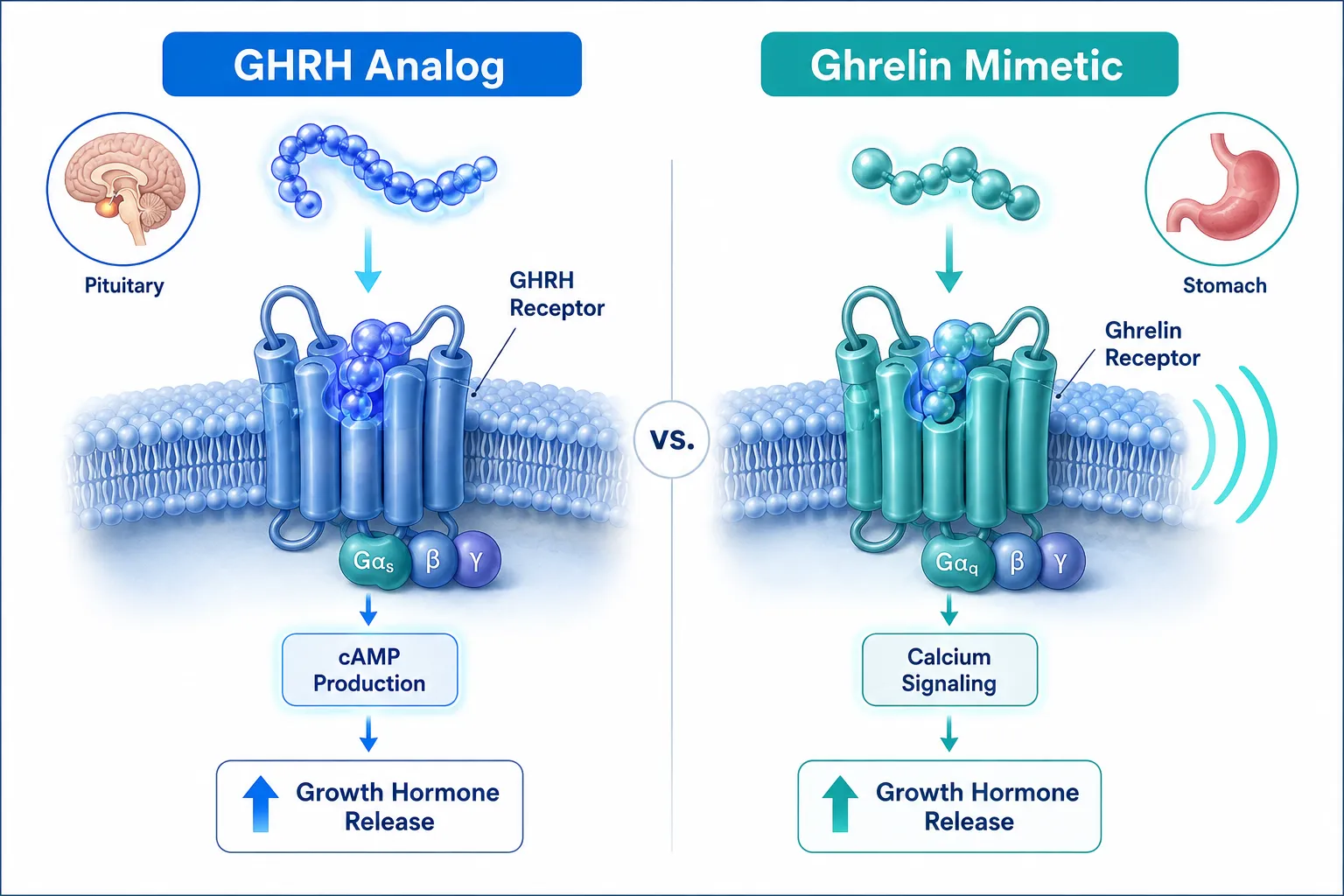
Labeled isometric illustration in bright clinical white and blue tones: two distinct molecular pathway diagrams side by side

Key Takeaways

  • Tesamorelin is a GHRH analog; Ipamorelin is a ghrelin-mimetic, they act on separate receptor classes.
  • Their mechanistic difference is the primary rationale for studying them together in GH research.
  • Tesamorelin carries FDA approval for HIV-associated lipodystrophy, giving it a documented clinical reference point.
  • Ipamorelin is noted for high GH selectivity with minimal cortisol or prolactin stimulation.
  • Rigorous research design requires defined purity standards, controlled dosing schedules, and outcome-specific biomarker tracking.

How Each Peptide Works: Distinct Receptor Pathways

Tesamorelin: A GHRH Analog

Tesamorelin is a synthetic analog of growth hormone-releasing hormone (GHRH), a 44-amino-acid hypothalamic peptide. Its structure mirrors endogenous GHRH but includes a trans-3-hexenoic acid modification at the N-terminus that extends its plasma half-life beyond that of native GHRH.

It binds selectively to the GHRH receptor (GHRHR) on somatotroph cells in the anterior pituitary. This binding triggers adenylyl cyclase activation, raises intracellular cAMP, and stimulates both GH synthesis and pulsatile release. Because it works through the same receptor as endogenous GHRH, the resulting GH secretion retains physiological feedback sensitivity, IGF-1 and somatostatin can still suppress output, which is a meaningful safety consideration in research contexts.

For a deeper look at documented effects, see the overview of Tesamorelin peptide benefits and the comparison resource on Tesamorelin vs Sermorelin to understand how GHRH analogs differ from one another.

Ipamorelin: A Ghrelin-Mimetic GHRP

Ipamorelin belongs to the growth hormone-releasing peptide (GHRP) class. It is a pentapeptide that acts as a selective agonist at the GHS-R1a receptor (ghrelin receptor), which is expressed both in the pituitary and the hypothalamus.

Unlike earlier GHRPs such as GHRP-2 or GHRP-6, Ipamorelin demonstrates high selectivity for GH release with minimal stimulation of cortisol, prolactin, or ACTH, a profile that makes it attractive for clean mechanistic studies. See the comparison of GHRP-2 peptide vs Sermorelin for context on how selectivity profiles vary across this peptide class.

Mechanistic Synergy: Why These Two Pathways Are Studied Together

Mechanistic Synergy: Why These Two Pathways Are Studied Together

The scientific rationale for studying Tesamorelin and Ipamorelin peptides: mechanism, synergy, and growth hormone research design together rests on a well-characterized phenomenon: GHRH and ghrelin-mimetics act synergistically, not additively.

When both receptor pathways are activated simultaneously:

  • GHRH (via Tesamorelin) amplifies the number of somatotrophs ready to release GH.
  • GHS-R1a agonism (via Ipamorelin) suppresses somatostatin tone at the hypothalamic level while directly stimulating pituitary release.
  • The combined signal produces a GH pulse that exceeds the sum of each compound's individual effect.

This synergy has been documented in multiple preclinical models and forms the mechanistic basis for multi-peptide research stacks. Researchers exploring this combination can reference the Ipamorelin vs Tesamorelin breakdown for a side-by-side mechanistic comparison, as well as the safety discussion on combining Tesamorelin with CJC Ipamorelin.

Key mechanistic differences at a glance:

Feature Tesamorelin Ipamorelin
Receptor target GHRHR (pituitary) GHS-R1a (pituitary + hypothalamus)
Peptide class GHRH analog GHRP / ghrelin mimetic
Cortisol stimulation Minimal Very low
Feedback sensitivity Preserved Partially preserved
Half-life ~26 minutes ~2 hours

Growth Hormone Research Design: Structuring a Rigorous Protocol

Growth Hormone Research Design: Structuring a Rigorous Protocol

Sound research design is what separates meaningful data from noise. For studies examining Tesamorelin and Ipamorelin peptides: mechanism, synergy, and growth hormone research design, the following structural elements are non-negotiable.

Purity and Source Verification

Research-grade peptides must arrive with third-party HPLC and mass spectrometry certificates. Impurities at even low concentrations can confound GH assay results. Researchers sourcing multi-peptide blends should review documentation such as the Tesamorelin CJC1295 Ipamorelin 12mg blend for formulation reference, and consult the CJC-1295 Ipamorelin assay planning and sourcing checklist to build a traceable procurement workflow.

Biomarker Selection

Relevant outcome measures include:

  • Serum IGF-1, the most stable surrogate for integrated GH secretion
  • 24-hour GH pulse amplitude and frequency, via frequent sampling
  • Fasting insulin and glucose, given GH's counter-regulatory role
  • Lipid panels, particularly relevant given Tesamorelin's documented effects on visceral adipose tissue

Dosing Schedule Considerations

GH is secreted in pulses, predominantly during sleep. Research protocols typically time administration to align with or amplify natural pulsatility. The Tesamorelin dosage chart provides a structured reference for dose-range planning.

Controls must include a vehicle-only arm, and washout periods should account for the extended IGF-1 half-life (~15 hours) to avoid carryover effects between experimental phases.

Conclusion

The scientific case for studying Tesamorelin and Ipamorelin together is mechanistic, not merely additive. A GHRH analog and a ghrelin-mimetic operate on distinct receptor systems that converge on somatotroph activation, producing synergistic GH output that neither compound achieves alone.

Actionable next steps for researchers:

  1. Confirm peptide purity via independent HPLC documentation before any in vitro or in vivo work.
  2. Select biomarkers (IGF-1, GH pulse profiling) that match the specific research question being asked.
  3. Review the mechanistic literature on GHRH/ghrelin receptor co-activation before designing dosing schedules.
  4. Use validated sourcing checklists and dosage reference charts to maintain traceability across experimental runs.
  5. Compare individual compound profiles rigorously before choosing a combination, using resources like the Ipamorelin vs Tesamorelin analysis.

Mechanism-first thinking, not protocol hype, is what produces reproducible, publication-worthy results in GH peptide research.

Tags: gh pulsatility, ghrelin mimetic, ghrh analog, ghrp, ghs-r1a receptor, growth hormone peptides, igf-1 biomarker, ipamorelin, peptide research design, peptide synergy, somatotropin research, tesa
https://www.puretestedpeptides.com/wp-content/uploads/2026/08/tesa-and-ipamorelin-peptides-mechanism-synergy-and-growth-hormone-researc.webp 1024 1536 https://www.puretestedpeptides.com/wp-content/uploads/2026/01/buy-peptides-online.jpg 2026-08-08 13:04:012026-08-08 13:04:01Tesamorelin and Ipamorelin Peptides: Mechanism, Synergy, and Growth Hormone Research Design
You might also like
CJC‑1295 With and Without DAC in Emerging Recovery and Metabolic Research: What 2026 Protocols Are Starting to Show CJC‑1295 With and Without DAC in Emerging Recovery and Metabolic Research: What 2026 Protocols Are Starting to Show
CJC-1295 With DAC vs Without DAC: Mechanism, Duration, and Research Design Differences CJC-1295 With DAC vs Without DAC: Mechanism, Duration, and Research Design Differences
5-Amino-1MQ and MOTS-c Synergy: How Mitochondrial Peptides Target Adiposity and Insulin Resistance in Experimental Models 5-Amino-1MQ and MOTS-c Synergy: How Mitochondrial Peptides Target Adiposity and Insulin Resistance in Experimental Models
Tesamorelin and Ipamorelin Mechanism: How GH-Releasing Peptides Differ in Research Models Tesamorelin and Ipamorelin Mechanism: How GH-Releasing Peptides Differ in Research Models
Tesamorelin, Ipamorelin, and CJC-1295 With DAC: How Different GHRH Mimetic Profiles Shape Growth Hormone Study Outcomes Tesamorelin, Ipamorelin, and CJC-1295 With DAC: How Different GHRH Mimetic Profiles Shape Growth Hormone Study Outcomes
Tesamorelin and Ipamorelin: A Comparative Analysis of Their Mechanisms in Growth Hormone Secretion Research Tesamorelin and Ipamorelin: A Comparative Analysis of Their Mechanisms in Growth Hormone Secretion Research
Tesofensine, Enclomiphene, and Peptide-Based Approaches: How Small Molecules Fit Alongside GLP-3 and GH Secretagogues in Metabolic Research Tesofensine, Enclomiphene, and Peptide-Based Approaches: How Small Molecules Fit Alongside GLP-3 and GH Secretagogues in Metabolic Research
How Researchers Use Tesamorelin and Ipamorelin Together vs Separately How Researchers Use Tesamorelin and Ipamorelin Together vs Separately
0 replies

Leave a Reply

Want to join the discussion?
Feel free to contribute!

Leave a Reply Cancel reply

Your email address will not be published. Required fields are marked *

×

Helpful Links

  • My account
  • Cart
  • Checkout
  • Refund and Returns Policy
  • Privacy Policy
  • SMS Privacy Policy
  • Login
  • My Account
  • Logout

USA Made Lab Tested Peptides

All products are sold for research, laboratory, or analytical purposes only, and are not for human consumption


Pure Tested Peptides is a chemical supplier. Pure Tested Peptides is not a compounding / chemical compounding facility as defined under 503A of the Federal Food, Drug, and Cosmetic act. Pure Tested Peptides is not an outsourcing facility as defined under 503B of the Federal Food, Drug, and Cosmetic act.

The statements made within this website have not been evaluated by the US Food and Drug Administration. The products we offer are not intended to diagnose, treat, cure or prevent any disease.

Human/Animal Consumption Prohibited. Laboratory/In-Vitro Experimental Use Only

Link to: MOTS-c Peptide: Mitochondrial Signaling, Metabolic Research, and Why Researchers Study It Link to: MOTS-c Peptide: Mitochondrial Signaling, Metabolic Research, and Why Researchers Study It MOTS-c Peptide: Mitochondrial Signaling, Metabolic Research, and Why Researchers...MOTS-c Peptide: Mitochondrial Signaling, Metabolic Research, and Why Researchers Study It Link to: GHK-Cu Peptide: Collagen Synthesis, Tissue Repair, and Longevity Research Applications Link to: GHK-Cu Peptide: Collagen Synthesis, Tissue Repair, and Longevity Research Applications GHK-Cu Peptide: Collagen Synthesis, Tissue Repair, and Longevity Research ApplicationsGHK-Cu Peptide: Collagen Synthesis, Tissue Repair, and Longevity Research A...
Scroll to top Scroll to top Scroll to top