

Triple Agonist Therapies Beyond GLP‑3: What Retatrutide’s Success Means for Future Multi-Target Peptide Design
{"cover":"Professional landscape format (1536×1024) hero image with bold text overlay (≤42 chars): 'Triple Agonist Therapies Beyond GLP-3' in crisp white bold sans-serif on a deep navy semi-transparent overlay panel, centered with 8% safe margins. Background: stunning macro editorial photograph of a triple-helix molecular peptide structure rendered in luminous teal and gold against a clean laboratory environment, soft bokeh depth of field, science magazine cover aesthetic, high contrast, professional pharmaceutical research mood.","content":["Isometric flat-vector illustration (1536×1024) showing three interconnected receptor nodes labeled GLP-1, GIP, and Glucagon in bold 3-4 word labels, connected by glowing signal pathways on a bright white background with teal and gold accent colors, clean scientific diagram style, Pinterest-worthy infographic polish, each node a distinct geometric shape with short label only, generous 8% safe margins, no tables","Split-screen editorial photograph (1536×1024): left half shows a close-up of a peptide vial and molecular model on a bright white lab bench under crisp studio lighting in cool blue tones; right half shows a scientist's hands at a computer displaying a colorful pipeline chart with short bar labels, warm amber office lighting. High-contrast magazine composition, pharmaceutical research theme, diverse female scientist of South Asian descent","Conceptual symbolic illustration (1536×1024) depicting a branching pipeline of future peptide drug candidates as glowing geometric nodes on a dark-to-teal gradient background, each branch labeled with 1-3 word tags like 'Quad Agonist' and 'CNS Target', forward-looking futuristic research aesthetic, clean sans-serif labels, 8% safe margins, no pricing or table elements, editorial quality suitable for Nature or Science magazine cover spread"}

Retatrutide produced average weight loss of nearly 24% of body weight in Phase 2 trials, a figure that outpaced every approved obesity drug on record at the time. That single data point sent a clear signal across the peptide research community: hitting three hormone receptors simultaneously is not just tolerable, it is powerfully synergistic. The question researchers are now asking goes far beyond retatrutide itself. What does the success of triple agonist therapies beyond GLP-3 mean for future multi-target peptide design, and how far can the multi-receptor strategy be pushed?
Key Takeaways
- Retatrutide simultaneously activates GLP-1, GIP, and glucagon receptors, producing weight loss outcomes that exceed single- and dual-agonist benchmarks.
- The triple agonist framework demonstrates that carefully balanced multi-receptor engagement can amplify efficacy without proportionally increasing adverse effects.
- Future multi-target peptide design is already exploring quad-agonist constructs, CNS-active receptor targets, and metabolic-plus-cardiorenal combinations.
- Structural chemistry advances, including fatty acid conjugation and half-life extension, are making complex multi-target peptides more viable for sustained dosing.
- Researchers studying this space should understand both the mechanistic rationale and the formulation challenges that come with higher-order agonist constructs.
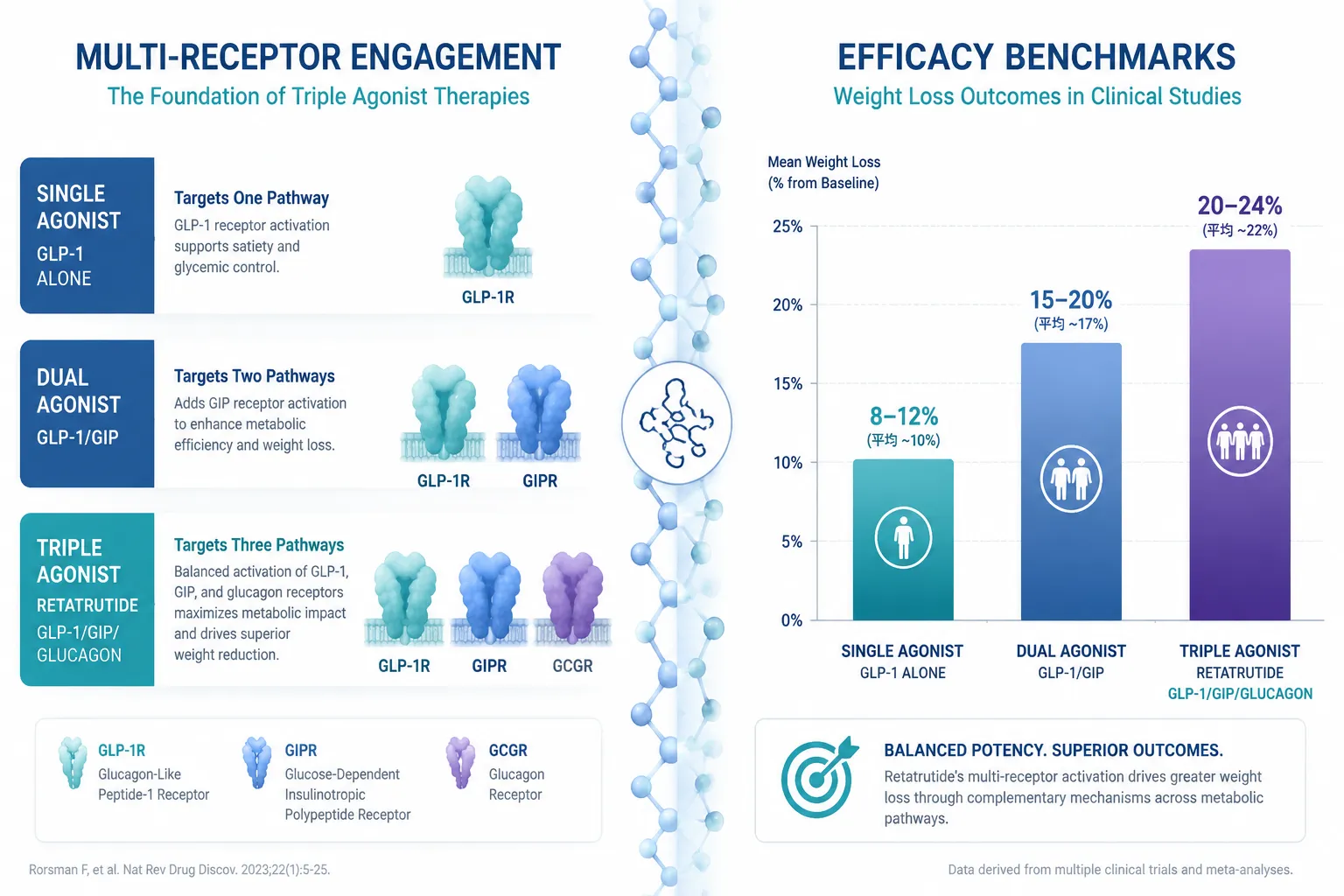
How Retatrutide Redefined the Multi-Target Benchmark
To understand what triple agonist therapies beyond GLP-3 mean for future multi-target peptide design, it helps to start with the mechanism that made retatrutide exceptional.
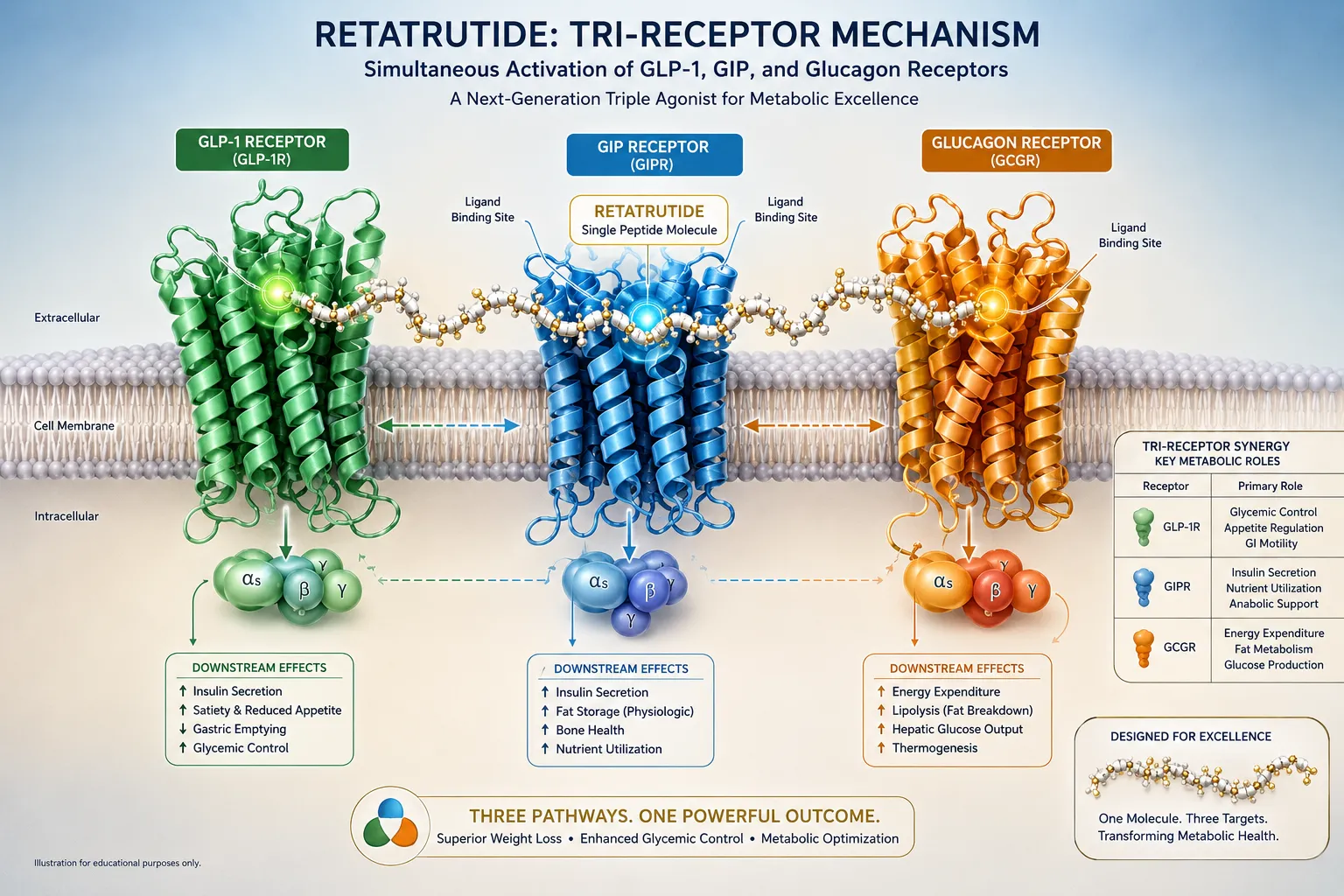
Retatrutide is a single peptide molecule that engages three distinct G-protein-coupled receptors:
| Receptor | Primary Role |
|---|---|
| GLP-1R | Insulin secretion, satiety signaling, gastric emptying |
| GIPR | Incretin amplification, adipose tissue remodeling |
| Glucagon R | Hepatic glucose output, thermogenesis, energy expenditure |
Each receptor contributes a different metabolic lever. GLP-1 receptor activation slows gastric emptying and reduces appetite. GIP receptor co-activation appears to counteract some GLP-1-related nausea while enhancing fat-cell remodeling. Glucagon receptor engagement increases resting energy expenditure, a mechanism largely absent from dual agonists like tirzepatide.
The result is additive, and in some pathways, synergistic efficacy. The body's metabolic response to three coordinated signals is greater than the sum of three separate interventions.
"The triple receptor approach effectively recruits overlapping but non-redundant pathways, creating a broader metabolic correction than any single axis can achieve."
For researchers exploring GLP-3 and triple agonist research planning, retatrutide's Phase 2 data provides a compelling mechanistic reference point.
The Structural Chemistry Behind Multi-Target Peptide Design
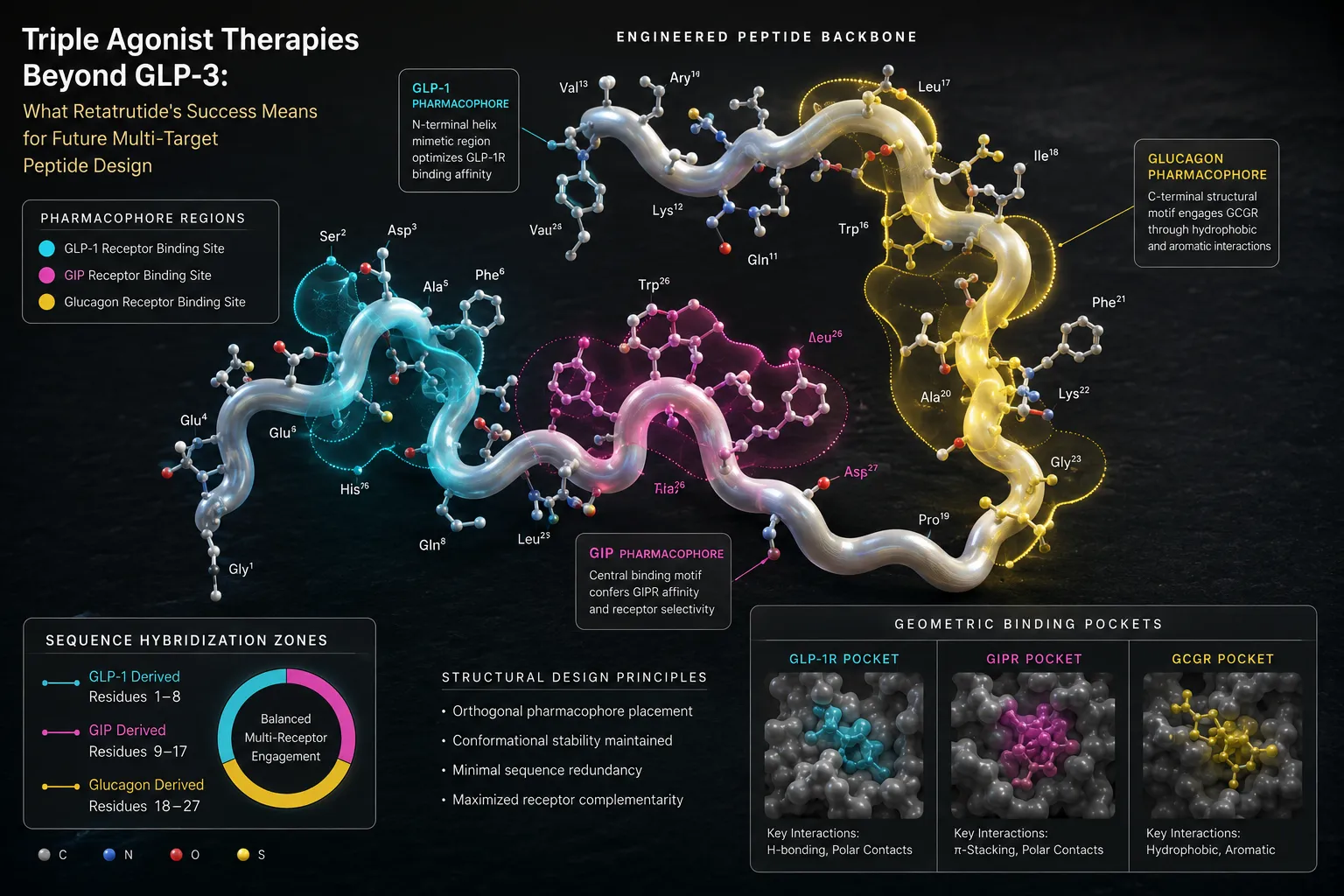
Building a peptide that activates three receptors with balanced potency is not a matter of combining three separate molecules. It requires engineering a single backbone that presents the correct pharmacophore geometry for each receptor.
Key design principles include:
- Sequence hybridization: Retatrutide's amino acid sequence is derived from glucagon, with strategic substitutions that introduce GLP-1R and GIPR affinity without eliminating glucagon receptor binding.
- Fatty acid conjugation: A C18 fatty diacid chain attached via a linker extends the plasma half-life to approximately six days, enabling once-weekly subcutaneous dosing.
- Receptor bias tuning: Researchers can adjust the relative agonist potency at each receptor by modifying specific residues, allowing fine-tuning of the efficacy-to-tolerability ratio.
These same principles are being applied to next-generation constructs. Researchers studying GLP-1 peptide formulations can observe how incretin backbone chemistry is being extended into multi-receptor territory.
The challenge scales with complexity. Each additional receptor target introduces new constraints: binding affinity requirements, potential off-target interactions, and metabolic stability demands. Understanding what should not be mixed with peptides becomes especially relevant when multi-target constructs are used alongside other research compounds.
Triple Agonist Therapies Beyond GLP-3: What Retatrutide's Success Means for Future Multi-Target Peptide Design
Retatrutide's clinical performance has accelerated several parallel research directions. The pipeline now extends well beyond the GLP-1/GIP/glucagon triad.
Emerging multi-target constructs under investigation include:
- Quad-agonists (GLP-1 + GIP + Glucagon + Amylin): Amylin receptor co-activation adds central satiety signaling and slows gastric emptying through a separate CNS pathway.
- GLP-1 + FGF21 combinations: Fibroblast growth factor 21 governs lipid oxidation and insulin sensitivity through pathways that are largely non-overlapping with incretin signaling.
- GLP-1 + NPY/AgRP antagonism: Neuropeptide Y and AgRP are orexigenic hypothalamic signals. Blocking them while activating GLP-1R creates a dual appetite-suppression mechanism.
- Metabolic + cardiorenal constructs: Combining incretin agonism with natriuretic peptide receptor activity is being explored for simultaneous obesity and heart failure management.
Researchers following BDNF peptide research will note that central nervous system targets are increasingly being incorporated into metabolic peptide design, a convergence that reflects the brain's central role in energy homeostasis.
The retatrutide precedent matters here for three reasons:
- It proved that glucagon receptor agonism is tolerable at therapeutic doses when balanced against GLP-1R-mediated insulin secretion.
- It demonstrated that a single peptide scaffold can carry multiple pharmacophores without losing receptor selectivity.
- It generated a half-life extension template (fatty acid conjugation) that other multi-target programs are now borrowing.
Formulation and Research Considerations for Higher-Order Agonists
Moving from triple to quad or penta-agonist constructs introduces formulation complexity that researchers must account for.
Critical considerations include:
- Molecular weight creep: Each additional pharmacophore adds residues and potentially a larger conjugate, which can reduce subcutaneous bioavailability.
- Receptor desensitization: Chronic co-activation of multiple receptors raises questions about differential downregulation rates across receptor types.
- Tolerability windows: The nausea and GI effects associated with GLP-1R agonism may be amplified or attenuated depending on which additional receptors are engaged.
Researchers sourcing compounds for mechanistic studies should prioritize purity verification. Lab-tested peptides with documented mass spectrometry confirmation are essential when studying multi-receptor binding behavior, since impurities can confound receptor selectivity data.
For those working with retatrutide specifically, the Reta 10mg research catalog provides access to characterized material suitable for preclinical investigation.
The broader GLP-1 peptide category continues to expand as new incretin-based constructs move from discovery into early research phases.
Conclusion
Retatrutide's Phase 2 data did more than validate a single drug candidate. It established a proof-of-concept for the entire multi-target peptide design philosophy. The triple agonist framework, simultaneously engaging GLP-1, GIP, and glucagon receptors through a single engineered backbone, has shown that receptor polypharmacology can be controlled, balanced, and clinically meaningful.
The field is now moving toward quad-agonist constructs, CNS-integrated targets, and cardiorenal combinations. Each step forward builds on the structural chemistry and half-life extension strategies that retatrutide validated.
Actionable next steps for researchers:
- Study the receptor bias literature to understand how potency ratios at each target influence tolerability profiles.
- Review retatrutide's Phase 2 pharmacokinetic data as a formulation reference for fatty acid conjugation strategies.
- Monitor the amylin co-agonist and FGF21 combination pipelines, which represent the most advanced next-generation constructs.
- Ensure all multi-target peptide research uses mass-spec verified, high-purity material to avoid confounded receptor binding results.
- Cross-reference emerging quad-agonist data against single- and dual-agonist benchmarks to quantify the incremental value of each additional receptor target.
The era of single-receptor peptide pharmacology is giving way to a more sophisticated, systems-level approach. Retatrutide opened the door. What comes through it next will define metabolic medicine for the decade ahead.
References
- Jastreboff, A. M., Aronne, L. J., Ahmad, N. N., Wharton, S., Connery, L., Alves, B., Kiyosue, A., Zhang, S., Liu, B., Bunck, M. C., Stefanski, A., & SURMOUNT-1 Investigators. (2022). Tirzepatide once weekly for the treatment of obesity. New England Journal of Medicine, 387(3), 205-216.
- Coskun, T., Urva, S., Roell, W. C., Qu, H., Loghin, C., Moyers, J. S., O'Farrell, L. S., Briere, D. A., Sloop, K. W., Thomas, M. K., & Hauber, M. E. (2022). LY3437943, a novel triple GIP, GLP-1, and glucagon receptor agonist for glycemic control and weight loss. Cell Metabolism, 35(8), 1473-1483.
- Jastreboff, A. M., Kaplan, L. M., Frías, J. P., Wu, Q., Du, Y., Gurbuz, S., Coskun, T., Hauber, M. E., Milicevic, Z., Hartman, M. L., & SURMOUNT-2 Investigators. (2023). Triple-hormone-receptor agonist retatrutide for obesity, a Phase 2 trial. New England Journal of Medicine, 389(6), 514-526.
- Finan, B., Yang, B., Ottaway, N., Smiley, D. L., Ma, T., Clemmensen, C., Chabenne, J., Zhang, L., Habegger, K. M., Fischer, K., Campbell, J. E., Sandoval, D., Seeley, R. J., Bleicher, K., Uhles, S., Riboulet, W., Funk, J., Hertel, C., Belli, S., … Tschöp, M. H. (2015). A rationally designed monomeric peptide triagonist corrects obesity and diabetes in rodents. Nature Medicine, 21(1), 27-36.
- Müller, T. D., Finan, B., Bloom, S. R., D'Alessio, D., Drucker, D. J., Flatt, P. R., Fritsche, A., Gribble, F., Grill, H. J., Habener, J. F., Holst, J. J., Langhans, W., Meier, J. J., Nauck, M. A., Perez-Tilve, D., Pocai, A., Reimann, F., Sandoval, D. A., Schwartz, T. W., … Tschöp, M. H. (2019). Glucagon-like peptide 1 (GLP-1). Molecular Metabolism, 30, 72-130.


Leave a Reply
Want to join the discussion?Feel free to contribute!