

Enclomiphene in Male Endocrine Research: LH, FSH, and Testosterone Signaling Without Clomiphene’s Mixed Isomers
Nearly half of all cases of male hypogonadism are classified as secondary, meaning the problem originates not in the testes but in the signaling chain above them. That distinction matters enormously when evaluating research tools, and it is precisely where enclomiphene in male endocrine research has attracted sustained scientific attention. By targeting the hypothalamic-pituitary-gonadal (HPG) axis as a pure trans-isomer selective estrogen receptor modulator (serm), enclomiphene offers a pharmacologically cleaner lens for studying LH, FSH, and testosterone signaling without clomiphene's mixed isomers complicating the data.
Key Takeaways
- Enclomiphene is the pure trans-isomer of clomiphene, stripped of the cis-isomer (zuclomiphene) that contributes to estrogenic side effects and signal suppression.
- It stimulates the HPG axis by blocking hypothalamic estrogen receptors, driving measurable increases in LH, FSH, and downstream testosterone.
- Research data show enclomiphene preserves spermatogenesis, a key advantage over exogenous testosterone replacement therapy (TRT).
- Hormone levels elevated by enclomiphene have demonstrated persistence after discontinuation in several study populations.
- As of 2026, enclomiphene has not received formal regulatory approval for hypogonadism, and its use remains within investigational and research contexts.
The Isomer Problem: Why Clomiphene's Mixed Profile Limits Research Clarity
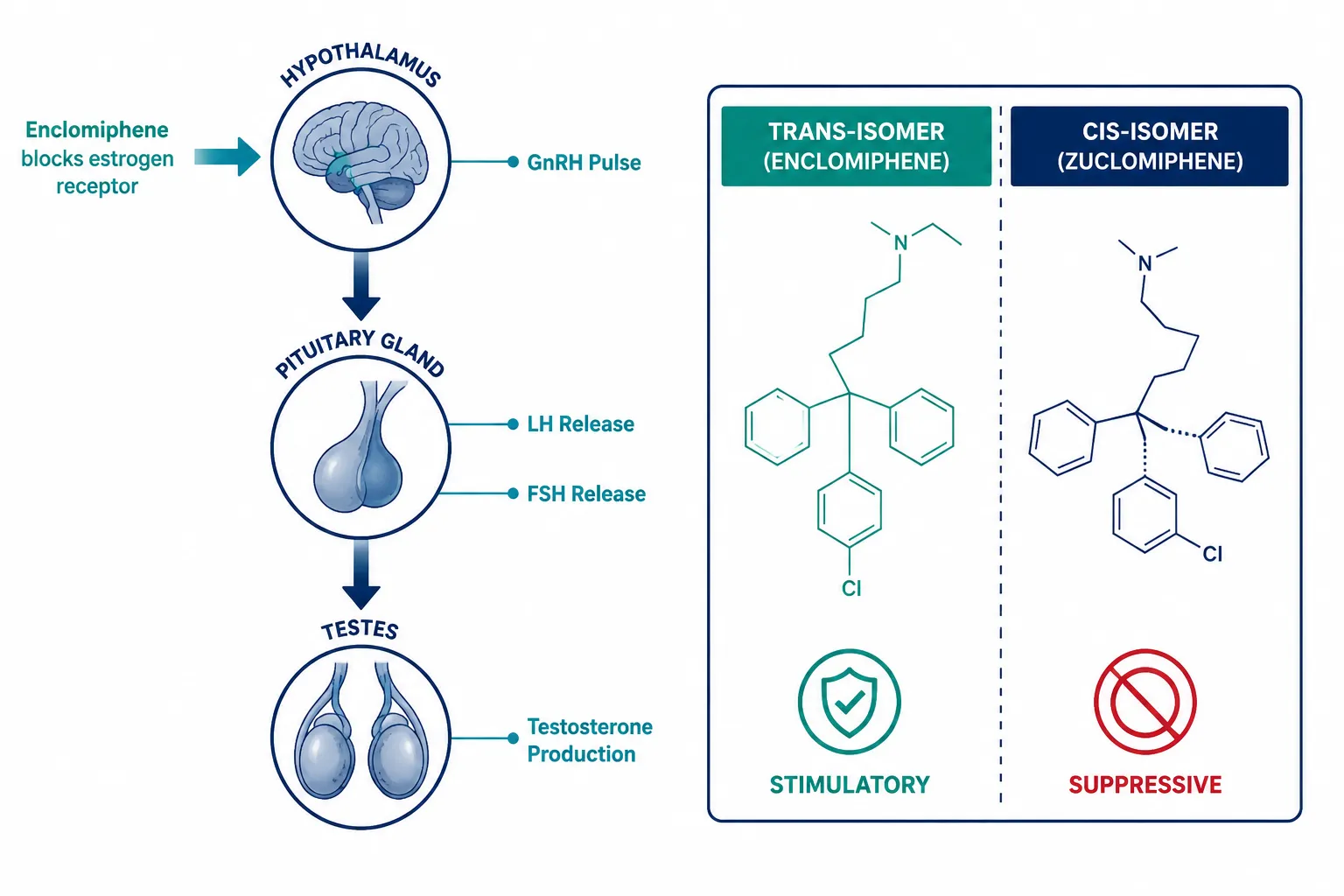
Clomiphene citrate has been used off-label in male endocrine contexts for decades. However, it is a racemic mixture, roughly equal parts trans-clomiphene (enclomiphene) and cis-clomiphene (zuclomiphene). These two isomers behave very differently at estrogen receptors.
Zuclomiphene acts as a partial estrogen agonist and has a much longer half-life, accumulating in tissue over time. This leads to elevated estradiol levels, potential mood disturbances, and visual side effects that have been documented in clinical literature. It also appears to partially suppress the very signaling pathway clomiphene is intended to stimulate.
Enclomiphene, by contrast, functions as a clean estrogen receptor antagonist at the hypothalamus. By occupying estrogen receptors there, it prevents the negative feedback signal that would otherwise suppress gonadotropin-releasing hormone (GnRH) pulsatility. The result is a reliable upstream stimulus for LH and FSH release from the pituitary.
This mechanistic clarity is why researchers exploring hormone research compounds have increasingly distinguished enclomiphene from its parent compound. The mixed-isomer problem in clomiphene is not a minor footnote, it is a confounding variable that makes interpreting hormonal outcomes genuinely difficult.
"Separating the trans-isomer from the cis-isomer is not just a chemistry exercise, it is the difference between a targeted signal and a noisy one."
LH, FSH, and Testosterone Responses in Enclomiphene Research
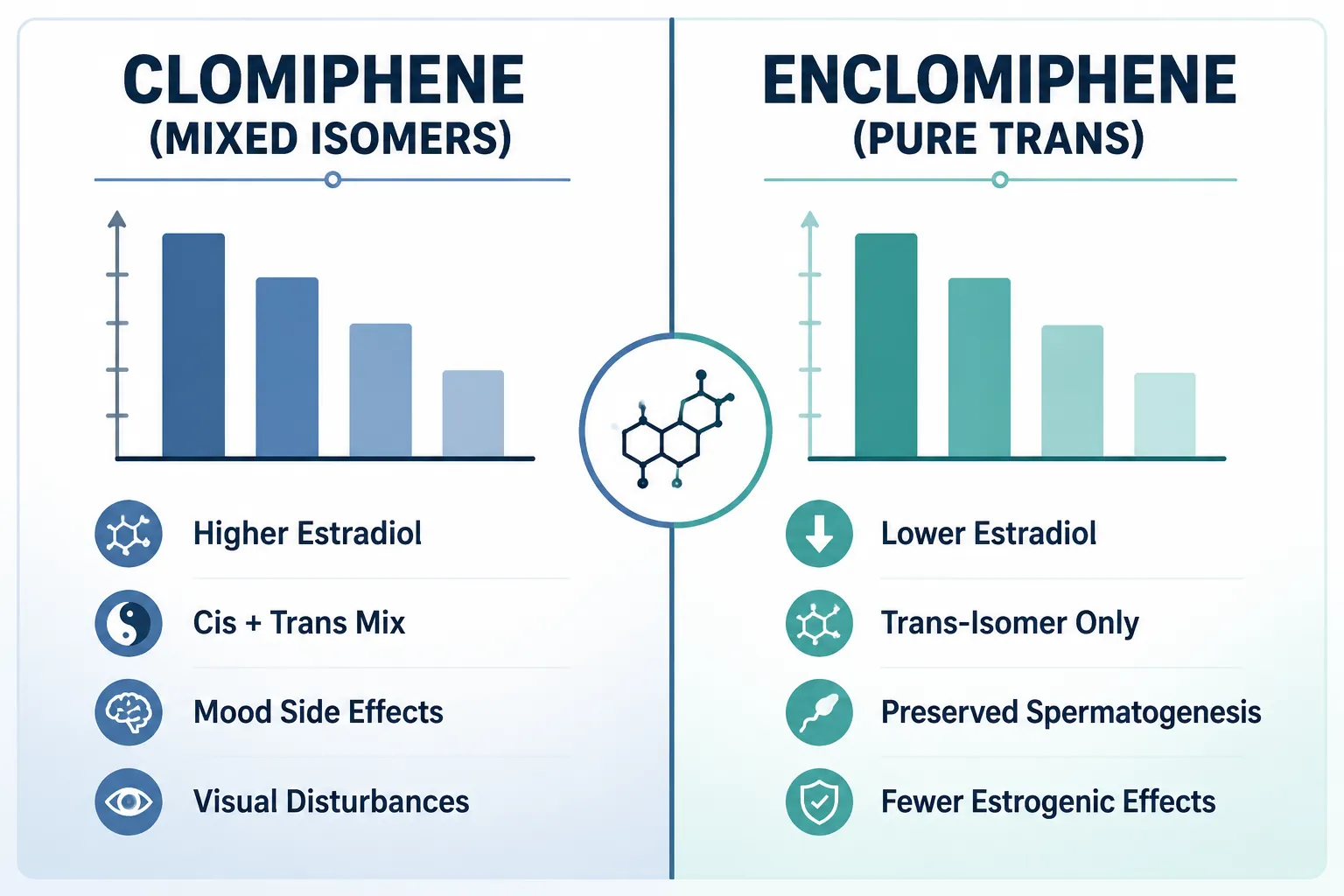
The hormonal data from enclomiphene studies are among the most compelling aspects of its research profile. Across multiple clinical investigations, enclomiphene administration produced robust, dose-dependent increases in:
- Luteinizing hormone (LH): Elevated within days of administration, reflecting rapid hypothalamic receptor blockade
- Follicle-stimulating hormone (FSH): Increased concurrently with LH, supporting both Leydig cell stimulation and spermatogenic signaling
- Total testosterone: Restored toward or into normal physiological ranges in men with secondary hypogonadism
Critically, these hormonal elevations were achieved while keeping estradiol levels lower than those observed with clomiphene. This is a direct consequence of removing the estrogenic zuclomiphene isomer from the equation.
Meta-analytic reviews of serm therapy in male hypogonadism, which include enclomiphene data, consistently show testosterone improvements that are statistically comparable to testosterone gel in some endpoints, while preserving the endogenous production pathway. That preservation has significant downstream implications, particularly for fertility.
Researchers examining hormone research protocols have noted that enclomiphene's hormonal effects also demonstrate a notable persistence after discontinuation. Unlike exogenous testosterone, which suppresses the HPG axis and leads to rapid post-cessation decline, enclomiphene appears to recalibrate the axis rather than override it. This post-treatment persistence is a subject of active investigation.
Spermatogenesis: A Key Differentiator from TRT
Exogenous testosterone replacement therapy reliably suppresses LH and FSH, which in turn suppresses spermatogenesis. For men in whom fertility preservation is a research or clinical consideration, this represents a meaningful limitation of TRT as a comparator.
Enclomiphene, by stimulating FSH rather than replacing testosterone exogenously, supports continued spermatogenic signaling. Multiple studies have documented improvements in sperm concentration, motility, and morphology in men treated with enclomiphene, outcomes that stand in direct contrast to TRT's suppressive effects on semen parameters.
This distinction is central to understanding why enclomiphene in male endocrine research occupies a unique position relative to both clomiphene and testosterone-based interventions. For broader context on how signaling compounds interact with receptor systems, the literature on GPCR signaling provides useful mechanistic background.
Research Context, Regulatory Status, and 2026 Outlook
Enclomiphene's regulatory history is instructive. The compound advanced through FDA Investigational New Drug (IND) processes with a specific focus on secondary hypogonadism, and early Phase II and Phase III data were sufficiently promising to attract significant interest. However, as of 2026, enclomiphene has not received formal approval for hypogonadism or testosterone support from any major regulatory body.
The 2026 British Society of Sexual Medicine (BSSM) position statement acknowledges enclomiphene among emerging options in the male hypogonadism landscape while stopping short of recommending it as a standard-of-care therapy. This reflects the current evidence gap: strong mechanistic rationale and encouraging trial data, but an incomplete formal approval pathway.
In practical research settings, enclomiphene is being studied with the following considerations in mind:
| Research Variable | Enclomiphene Profile |
|---|---|
| Isomer composition | Pure trans-isomer only |
| Primary receptor action | Estrogen receptor antagonist (hypothalamus) |
| LH/FSH effect | Stimulatory |
| Estradiol impact | Lower than clomiphene |
| Spermatogenesis | Preserved or improved |
| Post-discontinuation persistence | Documented in multiple studies |
| Regulatory status (2026) | Investigational; no formal approval |
Analysts tracking the male hormone therapeutics space in 2026 view enclomiphene as a compound with a credible path toward eventual approval, though timelines remain speculative. The compound's clean isomer profile continues to generate interest among researchers working across hormone research domains.
For those studying peptide and hormone interactions more broadly, related work on compounds like the IPA Sermorelin stack and Tesamorelin combined with Ipamorelin illustrates how upstream signaling modulators are being evaluated across multiple endocrine axes simultaneously.
Safety Profile Relative to Clomiphene and TRT
Enclomiphene's safety advantages over clomiphene are largely attributable to the absence of zuclomiphene. Fewer estrogen-related adverse effects, including reduced rates of mood changes and visual disturbances, have been reported in enclomiphene-specific trials compared to racemic clomiphene data.
Compared to TRT, enclomiphene carries a different risk profile rather than a uniformly safer one. It does not suppress the HPG axis, avoids the erythrocytosis risk associated with exogenous androgens, and does not impair fertility. However, it requires a functioning pituitary-gonadal axis to produce its effects, limiting its utility in primary hypogonadism research models.
Conclusion
Enclomiphene in male endocrine research represents a meaningful advance in the precision with which scientists can probe LH, FSH, and testosterone signaling without clomiphene's mixed isomers introducing confounding estrogenic variables. Its mechanism is well-characterized, its hormonal outcomes are reproducible, and its fertility-preserving profile distinguishes it clearly from exogenous testosterone approaches.
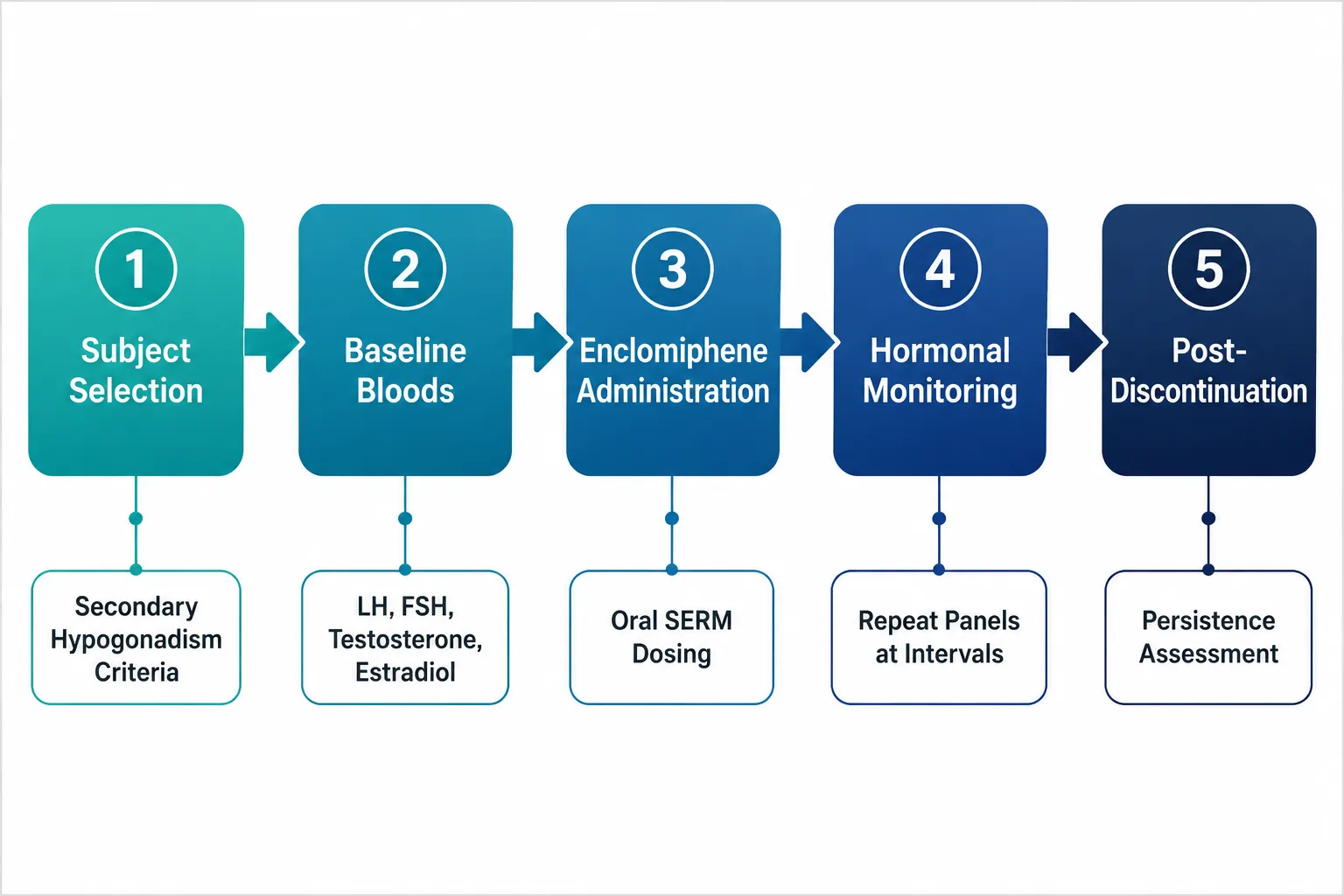
Actionable next steps for researchers and practitioners:
- Differentiate clearly between clomiphene and enclomiphene when reviewing or designing studies, the isomer distinction is not interchangeable.
- Monitor the full hormonal panel, LH, FSH, total testosterone, and estradiol, to capture enclomiphene's selective signaling profile accurately.
- Track post-discontinuation data as a distinct research endpoint, given evidence of HPG axis persistence.
- Follow regulatory developments closely; the 2026 landscape suggests the formal approval question remains open and consequential.
- Contextualize within broader endocrine research by cross-referencing findings with related signaling pathways and compound interactions.
The compound's selective isomer profile is not merely a chemical footnote, it is the foundation of its research value.


Leave a Reply
Want to join the discussion?Feel free to contribute!