

Peptides and Polypeptides in Nervous System Research: Where Semax, Selank, and Nasal Spray Peptides Fit Alongside Classic Drugs
Fewer than 1% of small-molecule drugs successfully cross the blood-brain barrier, a structural reality that has driven decades of interest in alternative delivery strategies and alternative compound classes. That bottleneck sits at the center of why peptides and polypeptides in nervous system research have drawn sustained attention, and why compounds like Semax, Selank, and related nasal spray peptides are studied alongside classic anxiolytics and antidepressants rather than simply replacing them.
Key Takeaways
- Semax and Selank are short synthetic peptides studied for neuroprotective and anxiolytic properties, respectively, with mechanisms that differ fundamentally from classic CNS drugs.
- Intranasal delivery allows peptides to bypass the blood-brain barrier via the olfactory epithelium, making administration route a central variable in research design.
- Semax research in 2026 spans Alzheimer's disease models, Parkinson's neuroprotection, and next-generation analogues such as N-acetyl Semax-amide.
- Selank's evidence base is compared against benzodiazepines and SSRIs primarily through GABAergic and serotonergic pathway studies.
- The broader intranasal neuropeptide landscape, including davunetide, KAFAK, and osteopontin heptamer, frames Semax and Selank as part of a larger research category rather than isolated curiosities.
How Classic CNS Drugs and Neuroactive Peptides Differ in Research Design
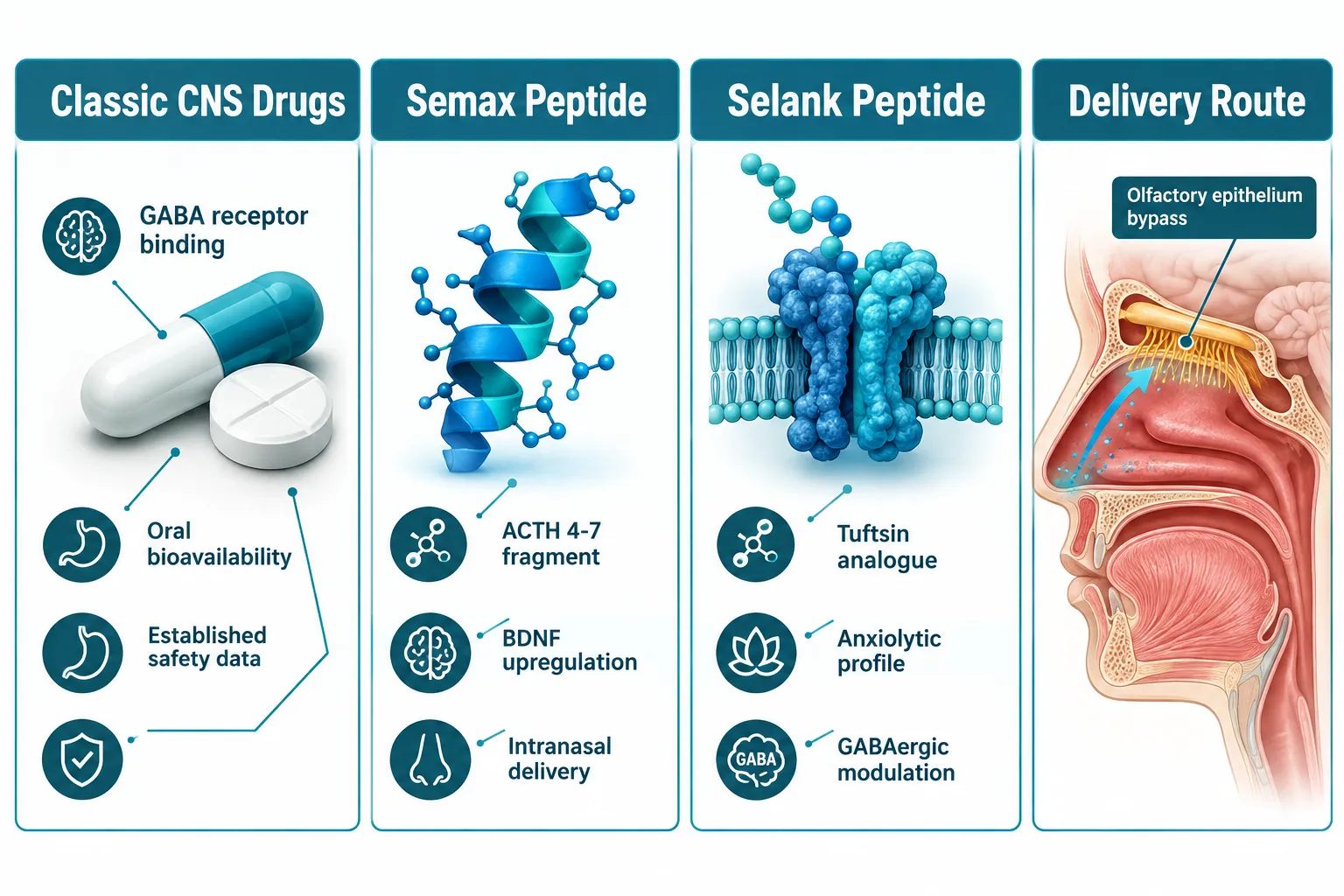
Standard CNS pharmacology has long relied on small molecules, benzodiazepines, selective serotonin reuptake inhibitors (SSRIs), and monoamine oxidase inhibitors, that act on well-mapped receptor systems. These compounds have decades of clinical trial data, defined pharmacokinetic profiles, and regulatory approval in most major markets.
Peptides operate differently. Rather than occupying a single receptor subtype with high affinity, short neuroactive peptides often modulate signaling cascades, influence neurotrophic factor expression, or mimic endogenous regulatory sequences. This mechanistic breadth is both a research advantage and an interpretive challenge: endpoints that work for a benzodiazepine study may not capture what a peptide is doing at the cellular level.
| Feature | Classic CNS Drugs | Research Peptides (e.g., Semax, Selank) |
|---|---|---|
| Molecular size | Small molecule | Short amino acid chain |
| Primary target | Defined receptor (GABA-A, SERT) | Signaling cascade, neurotrophic factors |
| Delivery route | Oral, IV | Intranasal, subcutaneous |
| Regulatory status | Approved (most markets) | Approved in Russia; research-use in West |
| Evidence base | Large RCT datasets | Preclinical + limited human data |
Researchers exploring this space benefit from understanding polypeptide peptides: structure, function, and research applications before designing comparative protocols.
Semax and Selank: Mechanisms and Evidence in the Context of Peptides and Polypeptides in Nervous System Research
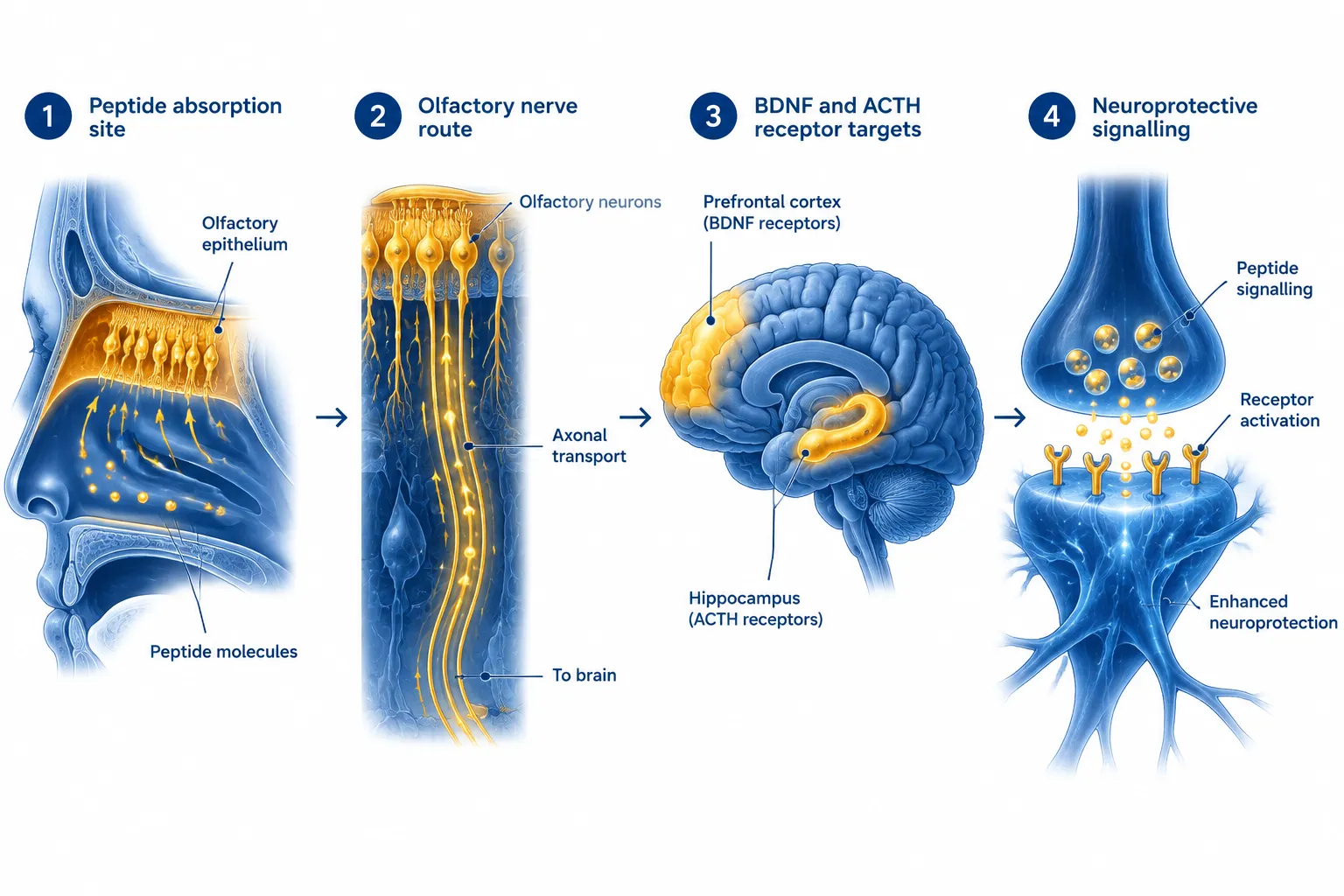
Semax is a heptapeptide derived from the ACTH 4-7 sequence. It does not bind adrenocorticotropic receptors directly; instead, it upregulates brain-derived neurotrophic factor (BDNF), modulates dopaminergic and serotonergic tone, and has shown neuroprotective effects in ischemia models. In Russia, it holds approved status for stroke recovery and cognitive support, a regulatory position that has no equivalent in the United States or European Union, where it remains a research compound.
As of 2026, preclinical Alzheimer's disease data for Semax and its heptapeptide derivative have expanded, with studies examining amyloid-related neurodegeneration endpoints. Parkinson's disease neuroprotection research has also generated academic commentary, focusing on Semax's capacity to reduce oxidative stress in dopaminergic neurons. Next-generation analogues, particularly N-acetyl Semax-amide, are being assessed for improved stability and extended half-life, though human safety data remain limited outside the Russian clinical context.
For researchers comparing these two compounds, the Selank vs Semax nootropic peptide research guide provides a structured breakdown of how each fits different experimental questions.
Selank is a synthetic analogue of the endogenous immunomodulatory peptide tuftsin. Its anxiolytic profile has been studied primarily through GABAergic and serotonergic pathway modulation, positioning it as a mechanistic counterpart, not a replacement, to benzodiazepines. Unlike benzodiazepines, Selank does not appear to produce dependence signals in preclinical models, and it lacks the sedative burden common to GABA-A positive allosteric modulators. A white-paper synthesis circulated in 2026 comparing Selank's evidence base against conventional anxiolytics concluded that while effect size data remain smaller than those for approved drugs, the side-effect profile warrants continued controlled investigation.
"The question in peptide neuroscience research is not whether these compounds replace classic drugs, but what they reveal about pathways that small molecules cannot cleanly isolate."
For detailed mechanistic background on Selank, the Selank peptide research benefits, dosing concepts, and mechanism of action resource offers a thorough foundation.
Intranasal Delivery: Why Administration Route Shapes the Entire Research Framework

The nasal route is not simply a convenience for peptides, it is a mechanistic necessity for many of them. The olfactory epithelium provides a direct anatomical channel to the central nervous system, bypassing hepatic first-pass metabolism and the blood-brain barrier simultaneously. This makes intranasal delivery the dominant administration route in peptides and polypeptides in nervous system research, and it fundamentally changes how bioavailability, dosing intervals, and tissue distribution are measured.
Researchers studying Semax as a Semax nasal spray formulation must account for variables that do not apply to oral CNS drugs: mucosal absorption efficiency, ciliary clearance rates, and peptide stability in aqueous nasal formulations. A broader treatment of these variables is available in the nasal spray peptides bioavailability, administration routes, and research design considerations resource.
Beyond Semax and Selank, the intranasal neuropeptide landscape in 2026 includes several other compounds under active preclinical investigation:
- Davunetide (NAP): an eight-amino-acid peptide derived from activity-dependent neuroprotective protein, studied for tau pathology and microtubule stabilization.
- KAFAK: an anti-inflammatory peptide examined in neuroinflammation models, with intranasal delivery studies showing CNS penetration.
- Osteopontin heptamer: a fragment studied in stroke and traumatic brain injury models for its role in microglial modulation.
These compounds share the intranasal delivery rationale with Semax and Selank but target distinct pathological mechanisms, illustrating how broad the peptides and polypeptides in nervous system research category has become.
For labs working on dosing precision across these compounds, the peptide calculators in research: how labs estimate dosing, concentration, and reconstitution guide addresses a practical gap that affects experimental reproducibility.
Conclusion
The field of peptides and polypeptides in nervous system research is not positioned to displace classic CNS pharmacology, it is positioned to extend it. Semax and Selank occupy a specific niche: mechanistically distinct from benzodiazepines and SSRIs, delivered through a route that bypasses the blood-brain barrier, and studied against endpoints that small molecules cannot cleanly address.
Actionable next steps for researchers in 2026:
- Define experimental endpoints that are appropriate for peptide mechanisms, BDNF expression, GABAergic modulation, and neuroinflammatory markers, rather than borrowing endpoints designed for receptor-occupancy drugs.
- Standardize intranasal delivery protocols using validated bioavailability data before comparing results across studies.
- Treat Semax analogues (including N-acetyl Semax-amide) and Selank as distinct compounds with distinct evidence bases, not interchangeable nootropic tools.
- Monitor the expanding intranasal neuropeptide literature, davunetide, KAFAK, and osteopontin heptamer data, for methodological frameworks transferable to Semax and Selank research.
- Consult Semax research protocols and comparative peptide resources when designing studies that need to position findings within the broader neuroactive peptide literature.
The gap between preclinical promise and clinical evidence remains the central challenge for this entire compound class. Closing that gap requires rigorous, reproducible study design, and a clear understanding of where these peptides sit relative to the drugs that already occupy the clinical landscape.


Leave a Reply
Want to join the discussion?Feel free to contribute!