

What Are Peptides? A Researcher’s Guide to Structure, Synthesis, and How GLP, Growth Hormone, and Mitochondrial Peptides Fit In
Over 100 peptide-based drugs have received regulatory approval worldwide, yet the term "peptide" remains loosely defined across research literature, lab catalogs, and popular science writing. For lab buyers and researchers selecting compounds in 2026, that ambiguity carries real consequences. Misclassifying a peptide class, conflating preclinical data with clinical evidence, or confusing research-grade compounds with approved therapeutics can derail study design before a single experiment begins.
This guide answers the foundational question, what are peptides?, and maps how GLP-class peptides, growth hormone secretagogues, and mitochondrial peptides each occupy a distinct corner of the research landscape.
Key Takeaways
- Peptides are short chains of amino acids (typically 2-49 residues) that act as hormones, signaling molecules, and structural regulators throughout biology.
- Peptide synthesis methods, especially solid-phase peptide synthesis (SPPS), allow researchers to engineer analogs with modified stability and receptor selectivity.
- GLP-class peptides represent the most evidence-rich peptide category, with multiple approved drugs and active phase 3 trials.
- Growth hormone secretagogue peptides show mechanistic promise but lack human randomized controlled trial data and regulatory approval.
- Mitochondrial peptides such as SS-31 (elamipretide) have crossed the clinical threshold, while MOTS-c and humanin remain largely in preclinical development.
Peptide Structure: The Building Blocks Researchers Need to Understand
Amino acids are the alphabet of biology. Peptides are the short words, and proteins are the full sentences. When two or more amino acids link through a peptide bond, a covalent bond formed by condensation between the carboxyl group of one residue and the amino group of the next, the resulting chain is called a peptide.
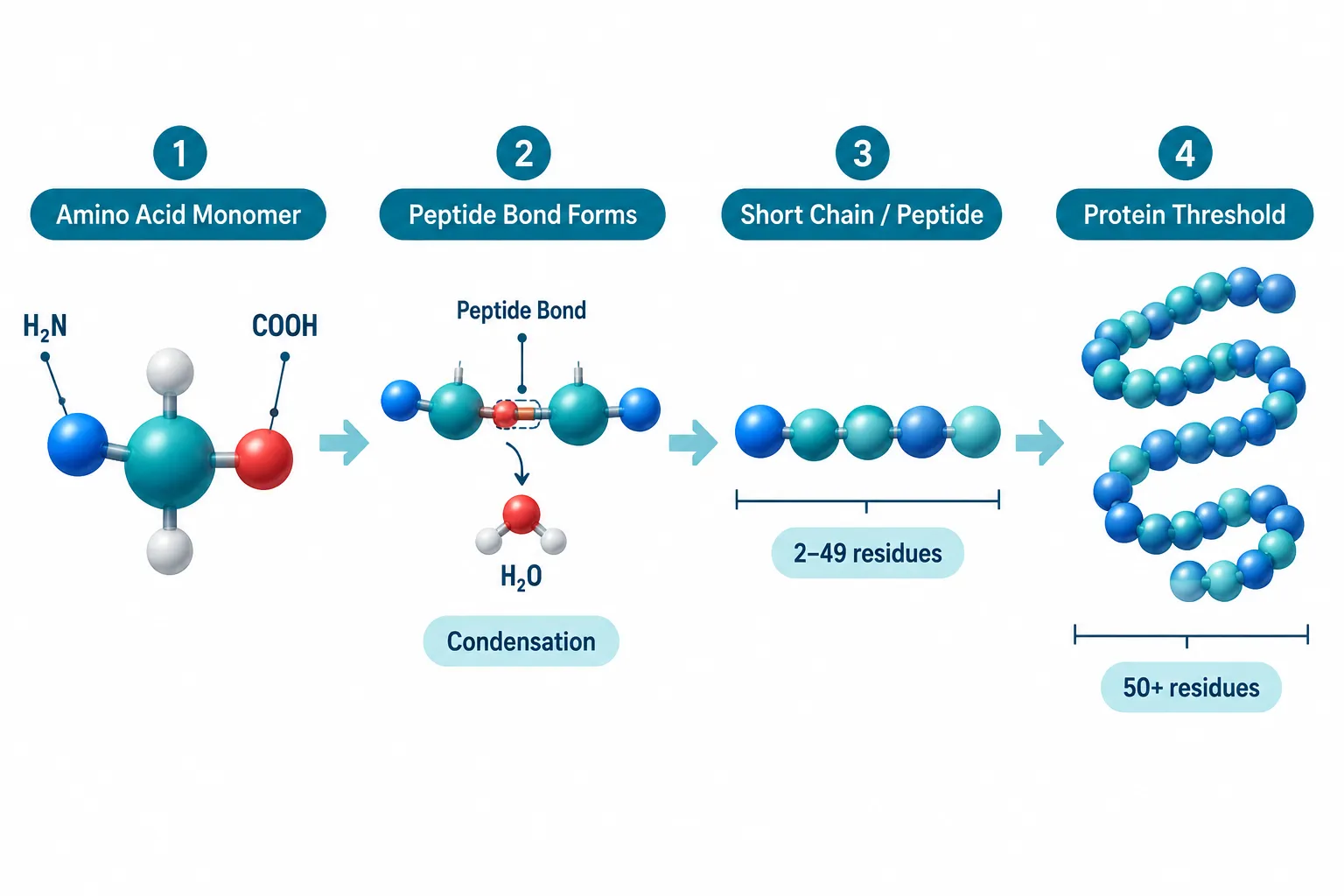
The conventional boundary sits at roughly 50 amino acid residues. Chains below that threshold are peptides; chains above it are proteins. In practice, this line is not perfectly fixed, but it is a useful working definition for research purposes. Molecular weight typically falls below 5,000 daltons for most research peptides.
Why does size matter?
- Smaller chains are easier to synthesize and modify in the lab.
- They are more likely to be absorbed across biological membranes.
- They degrade faster in biological systems, which affects study design.
- Their receptor interactions tend to be more specific and easier to model computationally.
For a deeper look at how structure maps to function across peptide classes, the broad spectrum of peptides guide covering structure, synthesis, and research applications provides a thorough reference.
Synthesis and Engineering: How Research Peptides Are Made
The dominant laboratory method for producing research peptides is solid-phase peptide synthesis (SPPS), pioneered in the 1960s and refined continuously since. In SPPS, amino acids are added sequentially to a resin-bound chain, with protecting groups removed at each step. The final peptide is cleaved from the resin and purified, typically by high-performance liquid chromatography (HPLC).
Key synthesis concepts for lab buyers:
| Term | What It Means for Research |
|---|---|
| Purity (%) | Percentage of the target peptide vs. impurities; 98%+ is standard for most research |
| Lyophilization | Freeze-drying to extend shelf life and improve stability |
| Peptidomimetics | Synthetic analogs designed to mimic peptide function with improved stability |
| Reconstitution | Dissolving lyophilized peptide in bacteriostatic water or acetic acid before use |
Beyond SPPS, researchers increasingly use recombinant biosynthesis for longer peptides and AI-assisted design to predict novel sequences with desired receptor affinity. These tools are accelerating the pace at which new research candidates enter preclinical pipelines.
For practical guidance on reconstitution and dosing calculations, the peptides calculator guide covering accurate dosing and reconstitution methods is a useful companion resource.
GLP, Growth Hormone, and Mitochondrial Peptides: Where Each Class Fits
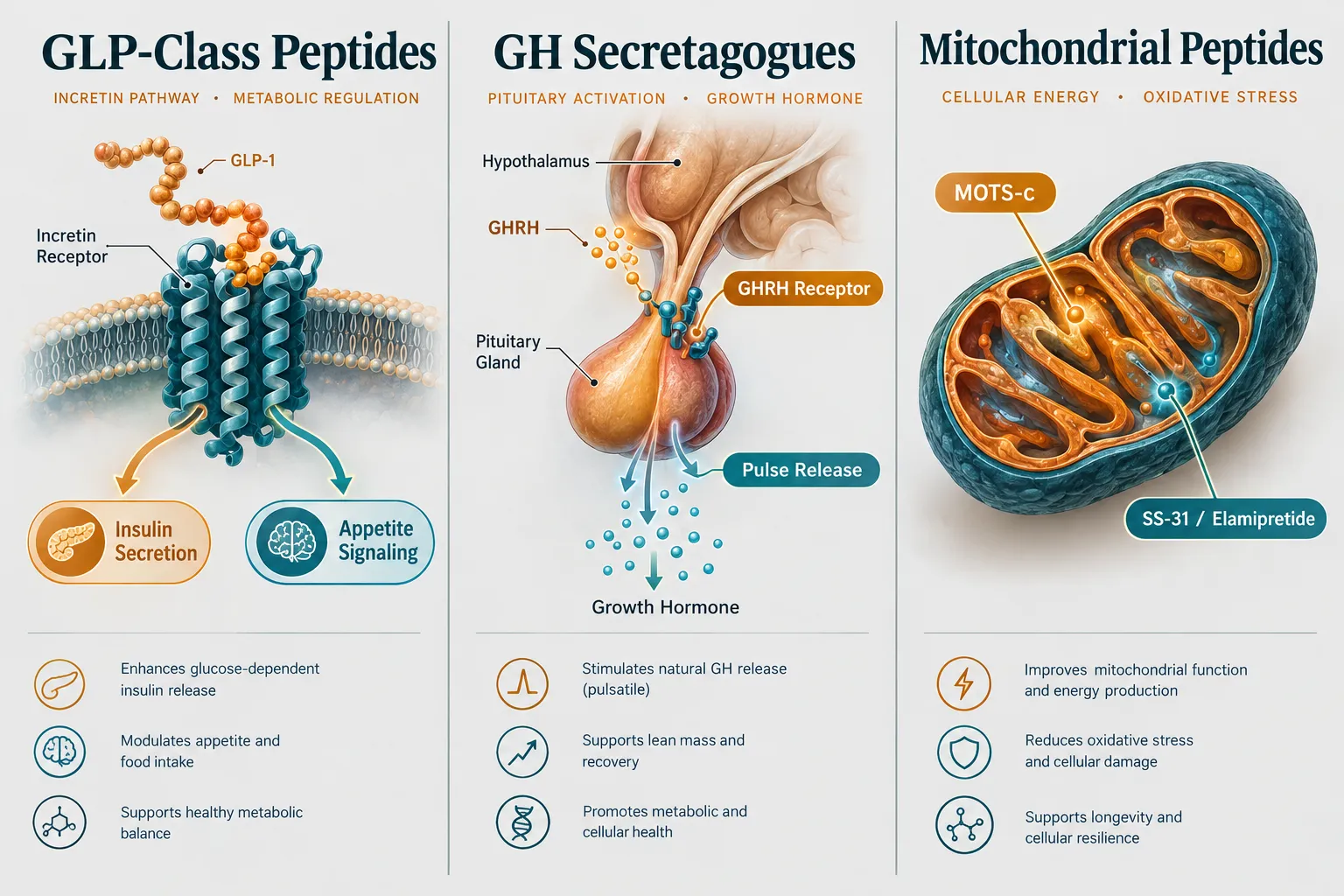
This is where the researcher's guide to peptides becomes most actionable. The three classes below represent the highest research activity in 2026, yet they sit at very different points on the evidence continuum.
GLP-Class Peptides: The Most Evidence-Rich Category
Glucagon-like peptides (GLP-1, GLP-2, and the triple-agonist GLP-3 class) are incretin hormones that regulate insulin secretion, gastric emptying, and appetite signaling. GLP-1 receptor agonists have multiple FDA-approved drugs and represent the strongest clinical evidence base in the peptide field.
Retatrutide, a GLP-1/GIP/glucagon triple agonist, is advancing through phase 3 trials and generating significant research interest around cardiometabolic and liver endpoints. Researchers studying this class should review the current research questions around GLP-3 peptides and what makes retatrutide different from other incretin analogs.
Growth Hormone Secretagogue Peptides: Mechanistic Promise, Evidence Gaps
Growth hormone-releasing peptides (GHRPs) and growth hormone-releasing hormone analogs such as CJC-1295 and ipamorelin stimulate pulsatile GH release through the GHRH receptor and ghrelin receptor pathways. Preclinical data on body composition, recovery, and metabolic parameters are compelling.
However: as of 2026, no GH secretagogue peptide has completed a human randomized controlled trial for the indications most commonly studied in research settings. None holds regulatory approval for those applications. Researchers should treat these compounds strictly as research tools.
For a mechanistic comparison of tesa and ipamorelin, the comparative analysis of tesa and ipamorelin mechanisms in growth hormone secretion research is a strong starting point. CJC-1295 formulation considerations are covered in the CJC-1295 with DAC half-life and dosing frequency research guide.
Mitochondrial Peptides: A Class at an Inflection Point
Mitochondrial-derived peptides (MDPs) are encoded within the mitochondrial genome and play roles in cellular energy regulation, stress response, and metabolic signaling. This class includes:
- SS-31 (elamipretide / Forzinity): The first FDA-approved mitochondrial-targeted therapeutic, approved for Barth syndrome. This is a landmark in the MDP field.
- MOTS-c: A mitochondrial-encoded peptide with strong preclinical signals in metabolic regulation, insulin sensitivity, and exercise response. Clinical development has been slower than early data suggested.
- Humanin: Emerging preclinical data in kidney injury and neurodegeneration, but no clinical approvals.
The distinction between SS-31's approved status and the preclinical stage of MOTS-c matters enormously for research design. For a comparative review, see the best research peptides for mitochondrial function comparing MOTS-c and 5-Amino-1MQ.
Approved Peptide Drugs vs. Research Peptides: A Critical Distinction
Not all peptides in a lab catalog are equivalent in regulatory status. This table clarifies the landscape:
| Category | Examples | Regulatory Status |
|---|---|---|
| Approved peptide drugs | Semaglutide, elamipretide, insulin | FDA/EMA approved for specific indications |
| Investigational peptides (clinical trials) | Retatrutide | Phase 2/3 trials; not yet approved |
| Research-use-only peptides | MOTS-c, CJC-1295, ipamorelin | Preclinical; no human approval |
| Tissue repair and signaling peptides | GHK-Cu, BPC-157 | Research use only |
Research integrity depends on this distinction. Using a research-use-only compound outside a controlled research setting raises both scientific and regulatory concerns.
For tissue repair and skin matrix research, copper-binding peptides like GHK-Cu represent a separate functional class. The collagen signaling and copper peptides research covering GHK-Cu and skin models explores what researchers measure in that space.
Peptides in Oncology and Future Directions
Beyond metabolic and mitochondrial research, peptides are active in oncology as targeted delivery vehicles, receptor antagonists, and immune modulators. AI-driven peptide design is accelerating the identification of novel sequences with improved receptor selectivity and reduced off-target effects. In 2026, computational tools are shortening the gap between sequence design and preclinical validation.

The field is also expanding into nasal delivery formulations for neuropeptides, multi-peptide blends for tissue research, and polypeptide hormone analogs that interface with endocrine pathways. Researchers interested in how peptide signaling intersects with endocrine receptor biology can explore how serms interact with polypeptide hormones in research.
Conclusion
This researcher's guide to peptides, covering structure, synthesis, and how GLP, growth hormone, and mitochondrial peptides fit in, is designed to give lab buyers a reliable framework before selecting compounds. The actionable next steps are straightforward:
- Classify before you order. Identify whether the peptide of interest is approved, investigational, or research-use-only.
- Match synthesis quality to study requirements. Verify purity certificates, HPLC data, and mass spectrometry confirmation from vendors.
- Respect the evidence hierarchy. GLP-class peptides carry the strongest clinical data. GH secretagogues and most mitochondrial peptides do not.
- Design around the biology. Understanding peptide bond chemistry, receptor selectivity, and degradation pathways will produce more reproducible results.
- Stay current. The peptide research landscape in 2026 is moving fast, particularly in GLP-3 triple agonists and mitochondrial-targeted therapeutics.
Researchers who ground their work in structural fundamentals and honest evidence assessment will be best positioned to extract meaningful data from this rapidly evolving field.


Leave a Reply
Want to join the discussion?Feel free to contribute!