

CJC‑1295 With and Without DAC in Emerging Recovery and Metabolic Research: What 2026 Protocols Are Starting to Show
Growth hormone secretagogue research has quietly shifted gears. Where earlier studies focused almost exclusively on peak GH output, the conversation around CJC‑1295 With and Without DAC in Emerging Recovery and Metabolic Research: What 2026 Protocols Are Starting to Show has expanded to include tissue recovery timelines, glucose-handling endpoints, and combination stacking strategies that were barely discussed five years ago. Researchers and clinicians in 2026 are asking more nuanced questions, not just "does IGF-1 rise?" but "what does that rise actually do in a metabolic or recovery context?"
Key Takeaways
- CJC‑1295 with DAC offers a prolonged half-life suited to weekly dosing, while the no-DAC form aligns better with circadian-timed, daily micro-dose protocols.
- Stacking CJC‑1295 with ipamorelin has become the dominant 2026 protocol pattern in both clinical and research settings.
- IGF-1 elevation is well-documented, but hard endpoints for recovery and body composition remain limited in the published evidence base.
- Desensitization risk with the DAC form makes structured washout periods a standard protocol feature in 2026 monographs.
- Combination protocols now extend to Tesamorelin and metabolic peptides, broadening the research scope beyond classic GH modeling.
Understanding the Two Forms: DAC vs. No-DAC
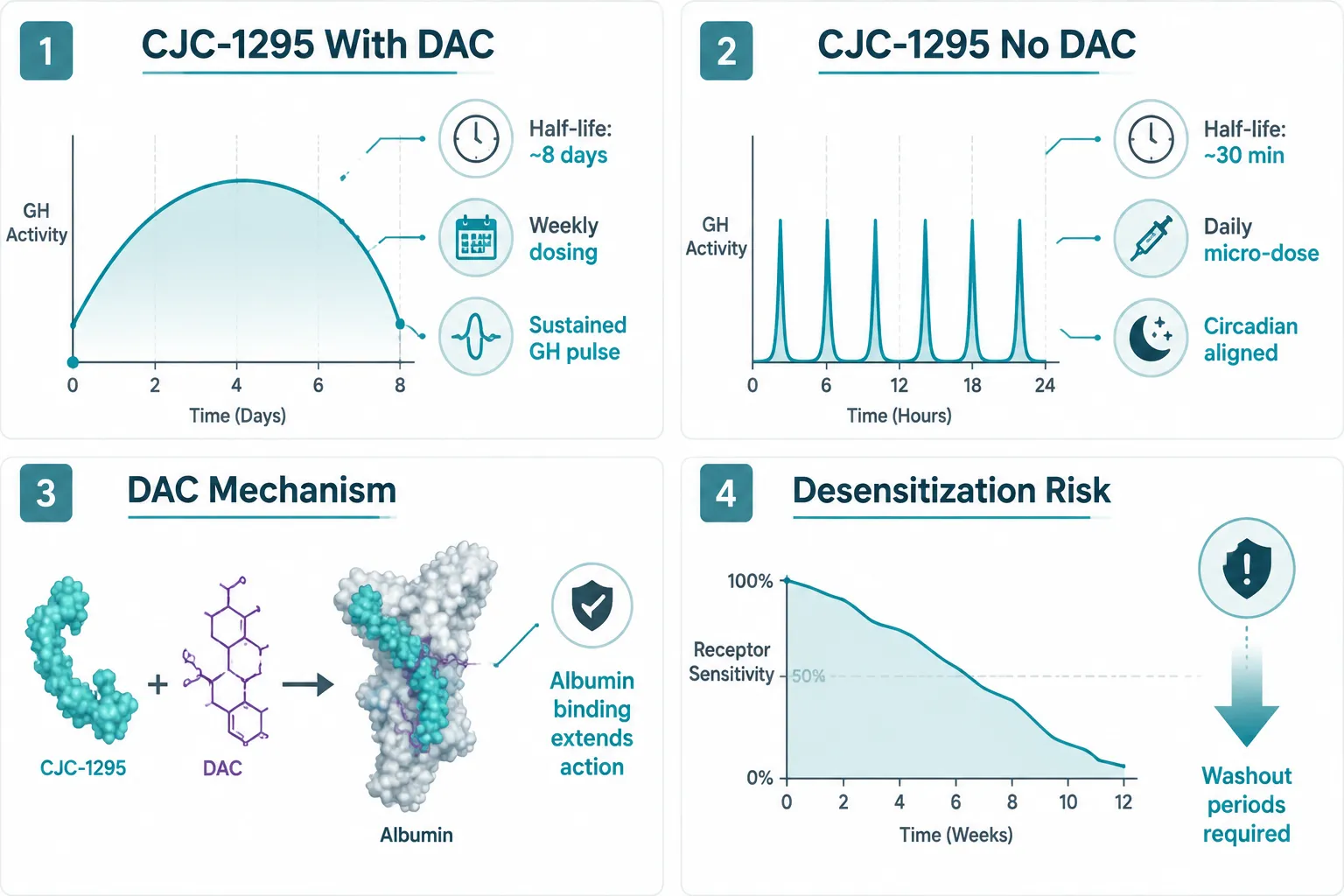
The core structural difference between the two variants drives nearly every protocol decision. CJC‑1295 with DAC (Drug Affinity Complex) binds to albumin in the bloodstream, dramatically extending its half-life to approximately eight days. This makes once-weekly or twice-monthly dosing pharmacologically feasible and reduces injection burden in longer research cycles.
CJC‑1295 without DAC, sometimes called Modified GRF(1-29), has a half-life of roughly 30 minutes. That short window is not a disadvantage in every context. Researchers exploring circadian-aligned dosing argue that brief, timed pulses more closely mimic the body's natural growth hormone release patterns, particularly when administered before sleep or around training windows.
Key pharmacokinetic comparison:
| Feature | With DAC | Without DAC |
|---|---|---|
| Half-life | ~8 days | ~30 minutes |
| Dosing frequency | Weekly or bi-weekly | Daily or twice daily |
| GH pulse pattern | Sustained elevation | Acute, pulsatile |
| Desensitization risk | Higher | Lower |
| Protocol washout need | Yes, structured | Minimal |
Desensitization is a genuine concern with the DAC form. Prolonged receptor stimulation can blunt pituitary responsiveness over time. Current somatotropin research protocols in 2026 address this by building in four-to-six-week washout periods after eight-to-twelve-week active cycles.
CJC‑1295 With and Without DAC in Emerging Recovery and Metabolic Research: What 2026 Protocols Are Starting to Show About Combination Stacking
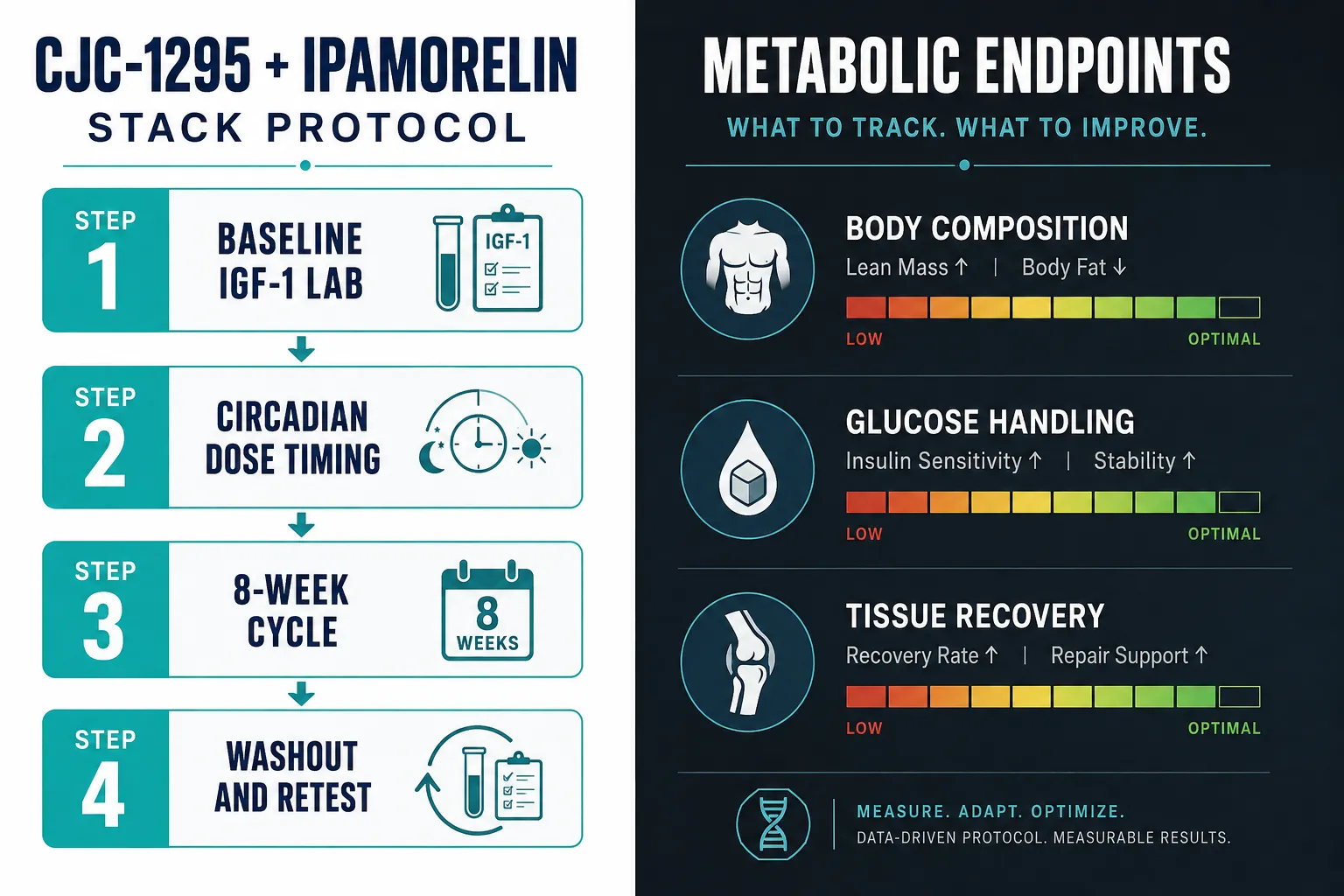
The most significant protocol shift in 2026 is the near-universal pairing of CJC‑1295 with ipamorelin. Ipamorelin is a selective ghrelin receptor agonist that stimulates GH release through a complementary pathway. Together, the two peptides produce a synergistic GH pulse without the cortisol or prolactin elevation associated with older secretagogues.
"The combination of a GHRH analog with a selective ghrelin mimetic has become the reference stack in 2026 protocol literature, it amplifies the GH signal while keeping the hormonal side-effect profile narrow."
For researchers interested in this pairing, resources on sermorelin, ipamorelin, and CJC-1295 dosing provide useful context on how dosing ratios are being structured. A related product reference for lab-grade material is the CJC-1295 IPA 10mg formulation used in current research settings.
Beyond ipamorelin, 2026 protocols are increasingly incorporating Tesamorelin, an FDA-approved GHRH analog with a documented record from HIV lipodystrophy trials. That clinical history provides safety signals that pure research peptides lack. Researchers exploring this avenue can review the Tesamorelin and CJC-1295 combination framework, which positions both analogs within the broader GHRH class. Multi-peptide blends, such as those covered in Tesamorelin, CJC-1295, and ipamorelin 12mg blend protocols, are also appearing in emerging metabolic research designs.
Common 2026 stacking configurations:
- CJC‑1295 (no DAC) + ipamorelin: nightly, circadian-timed
- CJC‑1295 (with DAC) + ipamorelin: weekly CJC, daily ipamorelin
- CJC‑1295 + Tesamorelin + ipamorelin: multi-target metabolic protocols
- CJC‑1295 + AOD-9604 blends: body composition-focused research designs
What the Evidence Actually Shows, and Where It Falls Short
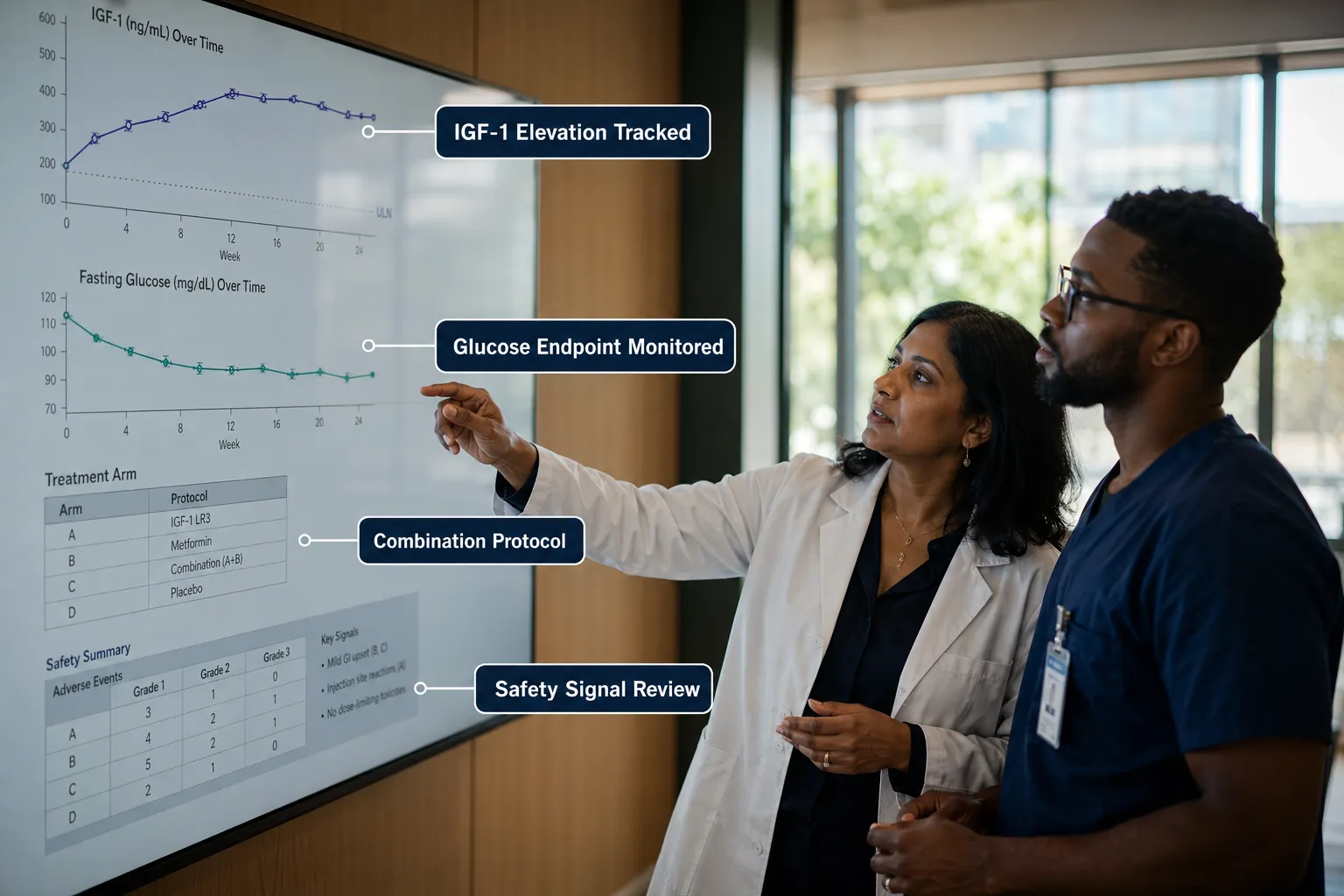
Honest assessment of the evidence base matters here. IGF-1 elevation following CJC‑1295 administration is consistently documented across multiple study designs. That finding is robust. What remains less clear is the translation of that IGF-1 rise into hard clinical endpoints.
What is reasonably supported:
- Dose-dependent increases in IGF-1 and GH
- Improved lean mass markers in some body composition studies
- Potential benefits in tissue recovery research contexts, particularly around collagen synthesis pathways
- Modest improvements in sleep quality linked to nocturnal GH pulsatility
What remains speculative or under-studied:
- Long-term glucose metabolism effects at fixed clinic doses vs. weight-based trial doses
- Durability of body composition changes after cycle cessation
- Comparative efficacy of DAC vs. no-DAC forms on recovery-specific endpoints
- Safety profile in populations beyond healthy adults and HIV lipodystrophy patients
The gap between weight-based dosing used in clinical trials and the fixed doses common in clinic or biohacking settings is a persistent methodological problem. Most trial data comes from weight-adjusted protocols; most real-world use does not follow that model. Researchers tracking tissue repair research outcomes need to account for this discrepancy when interpreting results.
Lab-based monitoring, specifically IGF-1, fasting glucose, and HbA1c panels, is now considered standard practice in responsible 2026 protocol designs, particularly for cycles exceeding eight weeks.
Conclusion
CJC‑1295 With and Without DAC in Emerging Recovery and Metabolic Research: What 2026 Protocols Are Starting to Show points toward a maturing field that is moving beyond simple GH elevation as a goal. The DAC form suits sustained, low-frequency dosing with structured washout; the no-DAC form fits circadian-aligned, pulsatile strategies. Combination stacking with ipamorelin and Tesamorelin is now the research norm rather than the exception.
Actionable next steps for researchers and clinicians:
- Select the CJC‑1295 variant based on dosing frequency needs and desensitization tolerance, not convenience alone.
- Pair with ipamorelin for synergistic GH pulse amplification with a cleaner hormonal side-effect profile.
- Establish baseline IGF-1, fasting glucose, and HbA1c before any cycle begins.
- Build washout periods into DAC-based protocols, typically four to six weeks after an eight-to-twelve-week active phase.
- Interpret body composition and recovery outcomes against trial-dosing literature with appropriate caution given the fixed-dose gap.
The evidence base will sharpen as more combination protocols generate structured outcome data. Until then, disciplined lab monitoring and conservative cycle design remain the most defensible approach.


Leave a Reply
Want to join the discussion?Feel free to contribute!