Call or Text 727-513-9780
  • Shopping Cart Shopping Cart
    0Shopping Cart
Pure Tested Peptides | America's most trusted Peptides for sale online
  • Peptides for sale
    • Oral Peptides for sale
      • Peptide Capsules for sale
      • BPC 157 Capsules 1000mcg
      • SLU-PP-332 Capsules | 1000 mcg
      • 5-Amino-1MQ 50mg Capsules
      • Tesofensine 500mcg
    • All Peptides for sale
    • Peptide Sprays
      • BPC 157 Nasal Spray Kit
      • BPC-157 TB500 Nasal Spray Kit
      • Semax Nasal Spray 10mg
      • Selank – Nasal Spray Kit – 10mg
      • Epithalon 50MG Nasal Spray Kit
      • Ipamorelin 10mg Nasal Spray
      • Klow Nasal Spray (BPC-157 + TB-500 + GHK-Cu + KPV) | 80mg
      • Hulk Nasal Spray Tesa / Ipa Blend 6/3 MG
      • Klow Nasal Spray
      • NAD + 500 mg Nasal Spray
      • PT-141 Nasal Spray Kit
    • GHRH Peptides
      • Ipa Peptides
      • CJC-1295 Peptides
        • CJC-1295 with DAC 5 mg
        • CJC-1295 without DAC 5 mg
        • CJC-1295 Ipa 10mg
      • Tesa Peptides
        • Tesa Peptide
        • Tesa 20 mg
    • GHK-Cu Peptides
      • All GHK-Cu Peptides
      • GHK-Cu 100mg
      • KLOW Peptide Blend – Buy KLOW blend online
    • BPC Peptides
      • All BPC Peptides
      • BPC-157
      • BPC-157 TB-500
      • BPC 157 capsules 1000mcg
    • SLU-PP-332 Peptides
      • All SLU-PP-332 Peptides
      • SLU-PP-332 5mg
    • GLP3 Peptides
    • PT-141 Peptides
      • PT-141 Peptides for sale
      • PT-141 10mg
      • PT-141 Nasal Spray
    • CAG Peptides
      • Lipo-C Peptide Blend
      • CAG 5mg
      • CAG 10mg
    • MOTS-C Peptides
      • MOTS-C Peptides for sale
      • MOTS-c peptide
      • MOTS-c 10mg *6 pack*
    • 5 Amino 1MQ Peptides
      • 5 Amino 1MQ Peptides for sale
      • 5-Amino-1MQ 50mg Capsules
      • 5-Amino-1MQ 5mg
    • Epithalon Peptides
      • Epithalon Peptides for sale
      • Epithalon 10mg
      • Epithalon 50mg
  • Shop
    • GLPs
      • 5-Amino-1MQ 50mg Capsules
      • 5-Amino-1MQ 5mg
      • L-Carnitine 500mg/ml
      • Tesofensine 500mcg
      • SLU-PP-332 5mg
      • MOTS-c 10mg *6 pack*
    • Epithalon & BPC Peptides
      • Epithalon 10mg
      • Epithalon 50mg
      • BPC-157
      • BPC 157 capsules 1000mcg
      • BPC-157 TB-500
      • BPC-157 TB500 Nasal Spray Kit
      • BPC 157 Nasal Spray Kit
    • BPC TB-500 & NAD+ Peptides
      • NAD+ 500 mg
      • KLOW Peptide Blend – Buy KLOW blend online
      • GLOW Peptide Blend
      • TB 500 5mg
      • BPC 157 capsules 1000mcg – Supplement
      • BPC 157 Nasal Spray Kit
      • BPC-157
      • BPC-157 TB500 Nasal Spray Kit
      • BPC-157 TB-500
      • BPC 157 capsules 1000mcg
    • LL-37 Peptide
      • LL-37 10 mg
    • MOTS-C & Selank
      • MOTS-c peptide
      • Selank 10mg
    • GHK Peptides
      • GHK-Cu 100mg
      • GLOW Peptide Blend
      • KLOW Peptide Blend – Buy KLOW blend online
  • COAs
  • Wholesale
    • Wholesale Peptides for sale
  • PTP FAQ
  • Affiliates
    • Selank Peptide: Advanced Pharmacological Mechanisms Underlying Its Anxiolytic and Nootropic Effects in Research
      • 5-Amino-1MQ Peptide: Detailed Mechanisms of NNMT Inhibition and Its Impact on Cellular Metabolism Research
        • MOTS-C Peptide: Unraveling Its Role in Mitochondrial Dynamics and Energy Metabolism Research
          • Epithalon Peptide and Telomerase Regulation: Investigating Its Impact on Cellular Senescence and Lifespan Research Models
            • GLP2-T vs GLP2 Tirz Peptide: Understanding the Naming, Mechanistic Nuances, and Research Implications for Gut Health
      • Peptides and Polypeptides in Modern Pharmacology: What Research on Metoprolol, Prednisone, and Amlodipine Reveals
        • Polypeptide Peptides vs NSAIDs: What Naproxen and Diclofenac Teach Tissue-Repair Researchers About BPC‑157 and TB‑500
          • Peptides and Polypeptides in Endocrine Pharmacology: How GLP-1, GLP-2, and GLP-3 Retatrutide Differ From Classic Drugs Like Prednisone and Amlodipine
          • 5‑Amino‑1MQ Peptide and NNMT Inhibition: How It Compares With Statins Like Atorvastatin in Adipose and Lipid Metabolism Research
      • Enclomiphene, Estrogen Receptor Signaling, and Luteinizing Phase Biology: What Hormone Researchers Should Measure
        • Mesenchymal Stem Cells, BPC‑157, and GHK‑Cu: How Tissue Repair Peptides Compare With Classic NSAIDs Like Naproxen in Injury Models
          • Peptide Calculator Use Cases Beyond Growth Hormone: Working Through GLP‑3 Retatrutide, MOTS‑c, and BPC‑157 Research Dosing
        • Polypeptide Peptides in Endocrine and Metabolic Pharmacology: Lessons From Amlodipine, Prednisone, and Metoprolol
        • Peptides Calculator for Advanced Blends: Worked Examples for Tesamorelin, CJC‑1295, and Ipamorelin Stacks
          • Peptides and Polypeptides in Human Physiology: How Molecular Size Shapes Research Applications
            • Selank Peptide: Advanced Pharmacological Mechanisms Underlying Its Anxiolytic and Nootropic Effects in Research
          • 5-Amino-1MQ Peptide: Detailed Mechanisms of NNMT Inhibition and Its Impact on Cellular Metabolism Research
            • MOTS-C Peptide: Unraveling Its Role in Mitochondrial Dynamics and Energy Metabolism Research
              • Epithalon Peptide and Telomerase Regulation: Investigating Its Impact on Cellular Senescence and Lifespan Research Models
                • GLP2-T vs GLP2 Tirz Peptide: Understanding the Naming, Mechanistic Nuances, and Research Implications for Gut Health
                  • Peptides and Polypeptides in Endocrine Pharmacology: How GLP-1, GLP-2, and GLP-3 Retatrutide Differ From Classic Drugs Like Prednisone and Amlodipine
                    • Polypeptide Peptides vs NSAIDs: What Naproxen and Diclofenac Teach Tissue-Repair Researchers About BPC‑157 and TB‑500
                      • Peptides and Polypeptides in Modern Pharmacology: What Research on Metoprolol, Prednisone, and Amlodipine Reveals
                        • 5‑Amino‑1MQ Peptide and NNMT Inhibition: How It Compares With Statins Like Atorvastatin in Adipose and Lipid Metabolism Research
                        • Enclomiphene, Estrogen Receptor Signaling, and Luteinizing Phase Biology: What Hormone Researchers Should Measure
                        • Mesenchymal Stem Cells, BPC‑157, and GHK‑Cu: How Tissue Repair Peptides Compare With Classic NSAIDs Like Naproxen in Injury Models
                        • Peptide Calculator Use Cases Beyond Growth Hormone: Working Through GLP‑3 Retatrutide, MOTS‑c, and BPC‑157 Research Dosing
                        • Polypeptide Peptides in Endocrine and Metabolic Pharmacology: Lessons From Amlodipine, Prednisone, and Metoprolol
                        • Peptides Calculator for Advanced Blends: Worked Examples for Tesamorelin, CJC‑1295, and Ipamorelin Stacks
                        • Peptides and Polypeptides in Human Physiology: How Molecular Size Shapes Research Applications
                        • Selank Peptide: Advanced Pharmacological Mechanisms Underlying Its Anxiolytic and Nootropic Effects in Research
                        • MOTS-C Peptide: Unraveling Its Role in Mitochondrial Dynamics and Energy Metabolism Research
                        • Peptides and Polypeptides in Modern Pharmacology: What Research on Metoprolol, Prednisone, and Amlodipine Reveals
                        • Peptides and Polypeptides in Endocrine Pharmacology: How GLP-1, GLP-2, and GLP-3 Retatrutide Differ From Classic Drugs Like Prednisone and Amlodipine
                        • 5-Amino-1MQ Peptide: Detailed Mechanisms of NNMT Inhibition and Its Impact on Cellular Metabolism Research
                        • Mesenchymal Stem Cells, BPC‑157, and GHK‑Cu: How Tissue Repair Peptides Compare With Classic NSAIDs Like Naproxen in Injury Models
                        • Peptide Calculator Use Cases Beyond Growth Hormone: Working Through GLP‑3 Retatrutide, MOTS‑c, and BPC‑157 Research Dosing
                        • GLP2-T vs GLP2 Tirz Peptide: Understanding the Naming, Mechanistic Nuances, and Research Implications for Gut Health
                        • Polypeptide Peptides in Endocrine and Metabolic Pharmacology: Lessons From Amlodipine, Prednisone, and Metoprolol
                        • Polypeptide Peptides vs NSAIDs: What Naproxen and Diclofenac Teach Tissue-Repair Researchers About BPC‑157 and TB‑500
                        • Peptides and Polypeptides in Human Physiology: How Molecular Size Shapes Research Applications
                        • Peptides Calculator for Advanced Blends: Worked Examples for Tesamorelin, CJC‑1295, and Ipamorelin Stacks
                        • 5‑Amino‑1MQ Peptide and NNMT Inhibition: How It Compares With Statins Like Atorvastatin in Adipose and Lipid Metabolism Research
                        • Enclomiphene, Estrogen Receptor Signaling, and Luteinizing Phase Biology: What Hormone Researchers Should Measure
                        • Epithalon Peptide and Telomerase Regulation: Investigating Its Impact on Cellular Senescence and Lifespan Research Models
                        • Best research protocol Klow blend
                        • best time to take BPC-157
                        • best time to take DSIP (Delta Sleep Inducing Peptide)
                        • best time to take CJC-1295
                        • best time to take AOD-9604
                        • best time to take Follistatin 344
                        • best time to take Ipamorelin
                        • best time to take MK-677 (Ibutamoren)
                        • best time to take Ligandrol (LGD-4033) — research compound
                        • best time to take Ostarine (MK-2866) — research compound
                        • best time to take GHK-CU
                        • best time to take TB-500
                        • best time to take MOTS-c
                        • best time to take Semax
                        • best time to take RAD-140 (Testolone) — research compound
                        • best time to take Thymosin Alpha-1
                        • best time to take PEG-MGF
                        • Biolife Plasma, Octapharma Plasma, and Research Peptides: How Plasma Donation Labs Differ From Peptide Suppliers
                        • best time to take YK-11 — research compound
                        • best time to take PT-141 (Bremelanotide)
                        • Best research protocol Klow blend
                        • 5-Amino-1MQ and MOTS-C Synergy: Metabolic Signaling, Mitochondria, and Research Design
                        • BPC-157 and TB-500: Investigating Their Combined Effects on Angiogenesis and Cellular Migration in Tissue Repair Models
                        • BPC-157 Peptide: Gut Barrier Function, Inflammation, and Tissue-Recovery Research
                        • 5‑Amino‑1MQ and MOTS‑c Synergy in Metabolic Research: Designing NNMT and Mitochondrial Biogenesis Stacks
                        • CJC-1295 with DAC vs. Without DAC: Half-Life, Release Kinetics, and Research Implications
                        • CJC‑1295 with DAC vs. Without DAC: Expanding on Half‑Life Differences Using Tesamorelin and Ipamorelin Blend Case Studies
                        • Collagen Biology and Copper‑Binding Peptides: How GHK‑Cu, Glow Blend, and Klow Blend Interact with Skin and Connective Tissue
                        • Collagen Biology and Regenerative Peptides: How GHK‑Cu, Glow Blend, and Klow Blend Affect Extracellular Matrix Research
                    • DNA, Telomeres, and Longevity Peptides: Positioning Epithalon and MOTS‑c in Genetic Aging Research
                      • Enclomiphene Citrate: serm Mechanism, Testosterone Research, and Stack Compatibility
                        • Enclomiphene vs Enclomiphene Citrate: Formulation, Bioavailability, and Research Distinctions
                        • Epithalon Peptide Research: Telomerase Activation, Aging, and Pineal Gland Function
                        • Estrogen Receptor Signaling and Enclomiphene: How Selective Modulators Compare with Classic Polypeptide Hormones
                        • GHK-Cu Peptide: Advanced Mechanisms in Extracellular Matrix Remodeling and Wound Healing Research
                        • GHK-Cu Peptide: Collagen Synthesis, Wound Repair, and Skin-Barrier Research Models
                        • GLP-1 vs GLP-3 vs GLP-2: Peptide Classification and Research Applications
                        • GLP-2 Peptide Research Guide: Gut Barrier Function, Nutrient Absorption, and Intestinal Recovery Models
                        • GLP-3 Retatrutide vs. GLP-1 Drugs: What Triple-Agonist Biology Changes in Research Models
                        • Ipamorelin and Tesamorelin Combination: Synergistic GH Secretagogue Research and Dosing Protocols
                        • GLP2 Tirz Peptide: What It Is, Why the Name Exists, and How Researchers Should Interpret It
                        • Klow Blend Peptide Nasal Spray: What the Formulation Is Trying to Do in Cognitive Research
                        • Mitochondria, NNMT Inhibition, and Peptide Modulators: Where MOTS‑c and 5‑Amino‑1MQ Fit in Cellular Energy Research
                        • MOTS-c Peptide: Mitochondrial Function, Energy Metabolism, and What Researchers Measure
                        • MOTS-c vs. 5-Amino-1MQ: Which Metabolic Research Questions Each Compound Actually Answers
                        • Nasal Spray Peptides: Bioavailability, Administration, and Semax/Selank Research Applications
                        • PT-141 Peptide Research: Mechanism of Action and Melanocortin Receptor Signaling
                        • Retatrutide for Research: Mechanism, Structure, and GLP-1/GLP-3 Dual Action
                        • Retatrutide for Obesity and Type 2 Diabetes: What the Latest Trial Data Suggest
                        • Tesofensine Peptide Research: Mechanism, Appetite Suppression, and Neuropeptide Y Pathways
  • Contact
    • Contact Customer Service
    • Text Customer Support
  • About US
  • Shop all peptides
  • Affiliate Program
    • Affiliate Signup
  • Login / Register Login / Register Page Link Login / Register Page Link
  • Click to open the search input field Click to open the search input field Search
  • Menu Menu
What Is a GLP-3 Peptide? Retatrutide Receptor Activity, Terminology, and Research-Model Selection

What Is a GLP-3 Peptide? Retatrutide Receptor Activity, Terminology, and Research-Model Selection

October 10, 2026/0 Comments/in Uncategorized/by

Researchers searching for "GLP-3 peptide" often land in a terminology gap: no officially recognized peptide class carries that name, yet the phrase circulates widely in metabolic research circles and supplement forums alike. Understanding why that gap exists, and what retatrutide actually does at the receptor level, is essential before selecting assay formats or animal models for triple-agonist studies.

Key Takeaways

  • "GLP-3 peptide" is an informal, colloquial label, not an established pharmacological class; retatrutide is formally described as a GLP-1R/GIPR/GCGR triple agonist.
  • Retatrutide engages three distinct G-protein-coupled receptors simultaneously, producing additive metabolic effects that exceed those of GLP-1 monotherapy.
  • Phase 2 clinical data showed average body weight reductions approaching 24% over 48 weeks, among the largest reported for any pharmacological obesity intervention.
  • Naming confusion between GLP-1, GLP-2, and informal "GLP-3" labels can compromise assay design and literature searches if not addressed upfront.
  • Research-model selection for triple agonism requires receptor-specific binding assays and metabolically relevant animal models, not standard GLP-1 protocols.

Where Does the "GLP-3 Peptide" Label Come From?

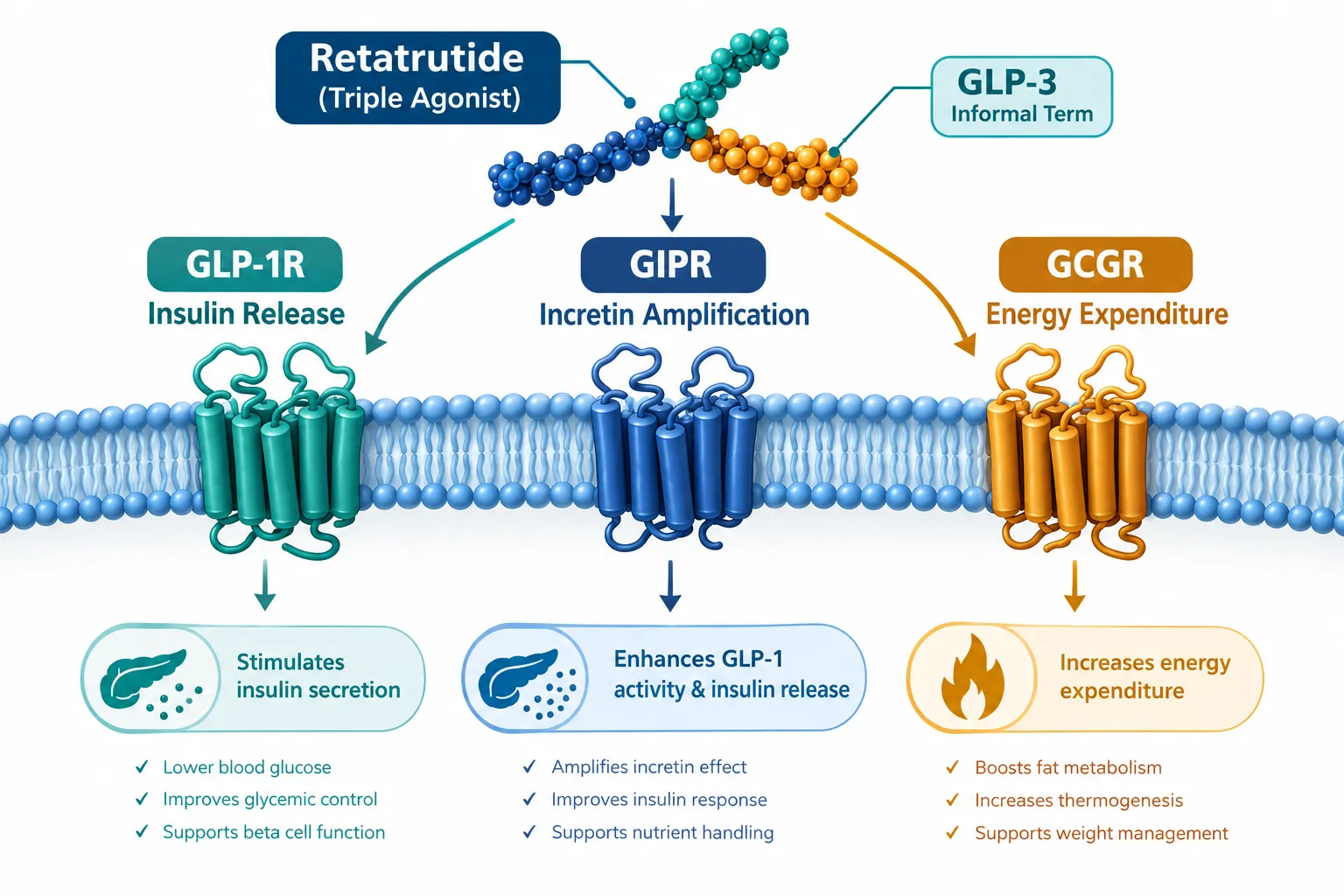
The glucagon-like peptide family is derived from the proglucagon gene. Proglucagon processing yields GLP-1 and GLP-2 as well-characterized peptides with defined receptors. No endogenous peptide named GLP-3 has been isolated or assigned an official receptor in peer-reviewed pharmacology. The informal "GLP-3" label appears to have emerged from two sources: a loose shorthand for third-generation GLP-1-class drugs, and occasional misreading of triple-agonist pipeline terminology.

Retatrutide is the compound most frequently linked to this informal label. Eli Lilly developed it as a single synthetic peptide capable of activating three receptors, GLP-1R, GIPR, and GCGR, in a carefully balanced ratio. Calling it a "GLP-3 peptide" conflates the number of receptors targeted with a nonexistent peptide subfamily. Researchers and procurement teams should note this distinction before designing experiments or sourcing materials.

For those exploring GLP-3 peptide signaling pathway data, understanding this naming context prevents misattribution of results to the wrong mechanistic framework.
Where Does the "GLP-3 Peptide" Label Come From?


Retatrutide Receptor Activity: Triple Agonism Explained

Understanding what is a GLP-3 peptide in practical terms requires a close look at retatrutide's receptor pharmacology.

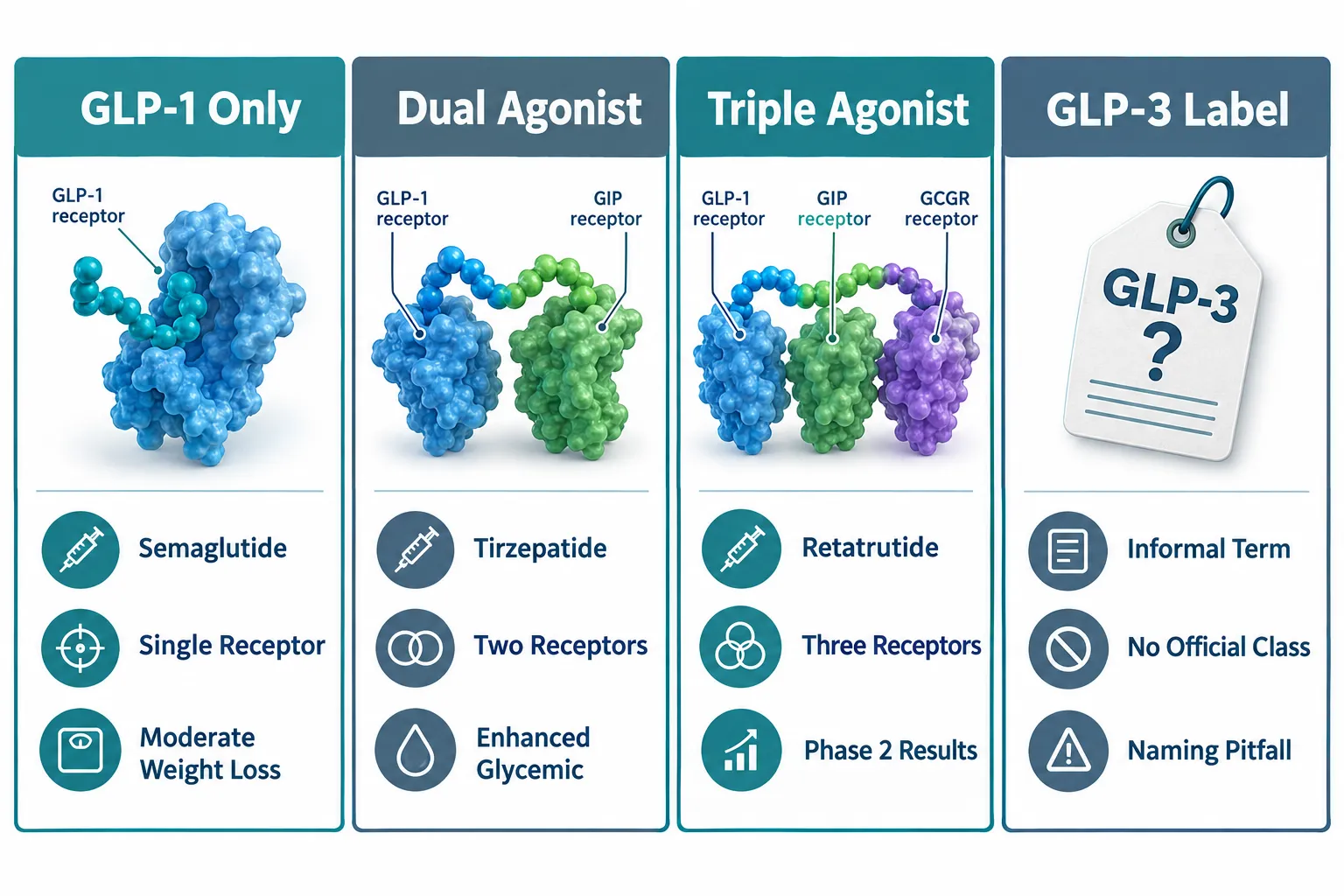
GLP-1R (Glucagon-Like Peptide-1 Receptor)
Activation suppresses appetite, slows gastric emptying, and stimulates glucose-dependent insulin secretion. This is the same receptor targeted by semaglutide and liraglutide.

GIPR (Glucose-Dependent Insulinotropic Polypeptide Receptor)
GIP amplifies the incretin effect and has been shown to enhance GLP-1R-mediated weight loss when combined, as demonstrated by tirzepatide's dual-agonist mechanism.

GCGR (Glucagon Receptor)
Glucagon receptor agonism increases energy expenditure and promotes hepatic fat oxidation. This is the distinguishing feature that separates retatrutide from dual GLP-1/GIP agonists.

"Triple agonism at GLP-1R, GIPR, and GCGR produces a pharmacological synergy that neither receptor alone nor any dual combination fully replicates."

The phase 2 obesity trial published in the New England Journal of Medicine reported mean weight reductions of approximately 17% at the 4 mg dose and up to 24% at the 12 mg dose over 48 weeks, figures that exceeded prior benchmarks for pharmacological interventions. Cardiometabolic markers, including triglycerides, fasting glucose, and blood pressure, also improved across dose cohorts.

Those interested in sourcing research-grade material can buy Retatrutide peptide through verified suppliers, or review available GLP-3 Retatrutide buy online USA options for laboratory use.
Retatrutide Receptor Activity: Triple Agonism Explained


Terminology Pitfalls and How They Affect Research Design

The naming confusion around what is a GLP-3 peptide creates three concrete problems for researchers.

1. Literature Search Errors
Searching databases for "GLP-3" returns inconsistent results. Some papers use it as shorthand for third-generation agents; others use it in the context of proglucagon processing fragments with no receptor activity. Filtering by receptor target (GLP-1R + GIPR + GCGR) yields cleaner, more reproducible literature sets.

2. Assay Misspecification
Standard GLP-1 receptor binding assays measure only GLP-1R affinity. A triple-agonist compound like retatrutide requires three parallel cAMP accumulation assays, one per receptor, to characterize its full pharmacological profile. Using a single-receptor protocol underestimates potency and misrepresents the mechanism.

3. Procurement Confusion
Vendors sometimes list retatrutide under "GLP-3" product codes. Confirming the sequence, purity by HPLC, and receptor-binding data before purchase is non-negotiable. Products such as GLP-3R 30mg peptide and GLP-3R 10mg peptide GA10 use vendor-specific nomenclature that refers to retatrutide-class compounds, not an officially classified GLP-3 receptor ligand.

For broader context on how these compounds compare with other metabolic peptides, the article on polypeptide peptides in cardiometabolic models offers a useful structural comparison.


Research-Model Selection for Retatrutide and Triple-Agonist Studies

Choosing the right model is as important as understanding what is a GLP-3 peptide in the first place. The table below outlines common options.

Model Type Best For Key Limitation
Diet-Induced Obese (DIO) Mouse Weight loss, adiposity, metabolic panels GCGR expression differs from humans
Zucker Diabetic Fatty Rat Glycemic control, insulin sensitivity Limited cardiovascular readouts
Non-Human Primate (NHP) Translational cardiometabolic endpoints High cost, regulatory complexity
In Vitro cAMP Assay (HEK293) Receptor-specific potency ranking No systemic pharmacokinetics

For in vivo work, the DIO mouse model remains the most widely used starting point. Researchers should confirm that their animal colony expresses all three target receptors at physiologically relevant levels before interpreting weight or glucose data as triple-agonist effects.

Ongoing Retatrutide clinical trial data from phase 3 programs (initiated 2024-2025) are expected to clarify dose-response relationships and cardiovascular outcomes through 2026 and beyond. Analysts broadly expect regulatory submissions to follow positive phase 3 readouts, though timelines remain speculative and subject to trial outcomes.
Research-Model Selection for Retatrutide and Triple-Agonist Studies


Conclusion

The question of what is a GLP-3 peptide resolves to a clear answer: it is an informal term, not a recognized pharmacological class. Retatrutide is a GLP-1R/GIPR/GCGR triple agonist whose clinical weight-loss results and cardiometabolic benefits place it among the most closely watched compounds in metabolic medicine in 2026. For researchers, the actionable steps are straightforward:

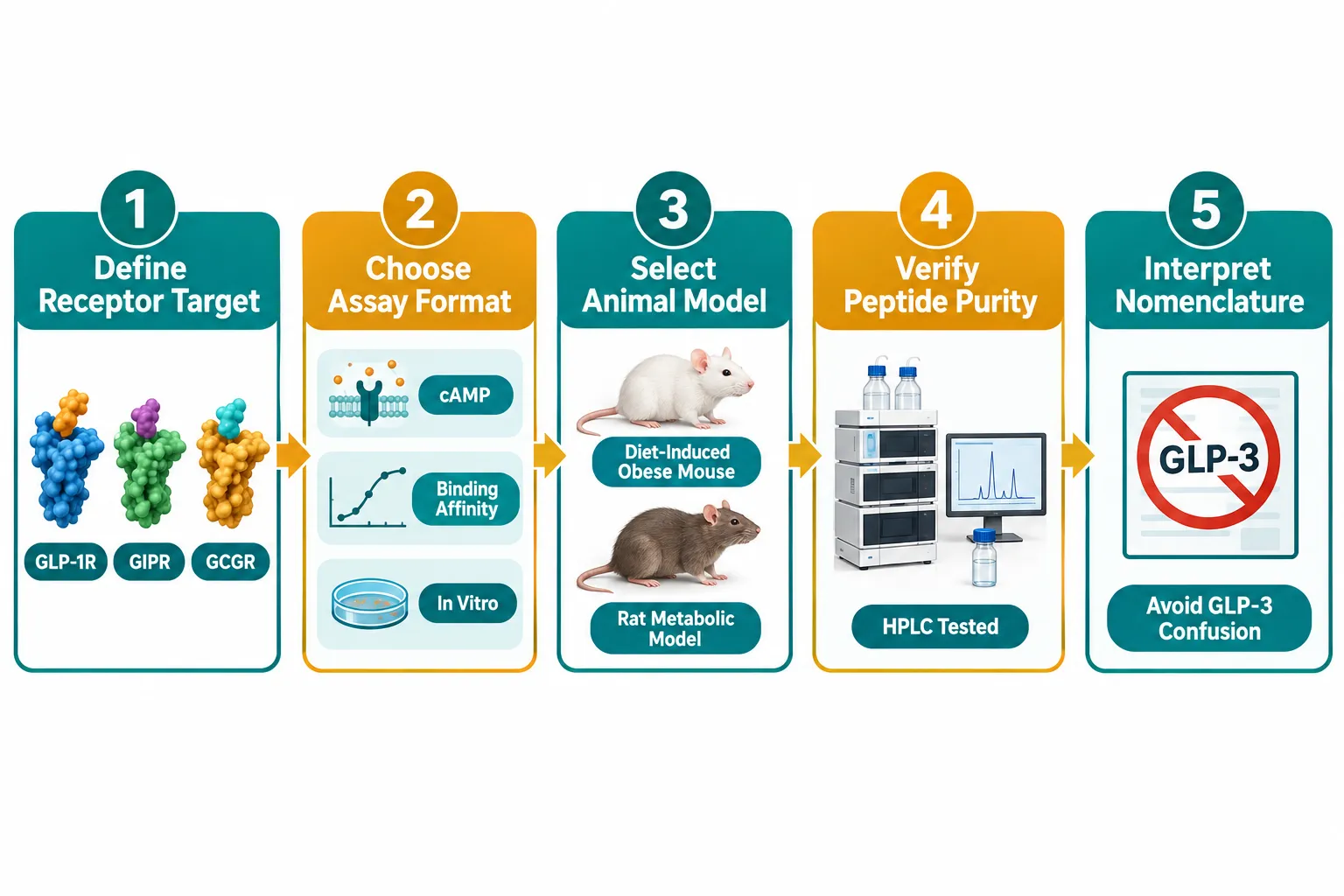
  1. Replace "GLP-3" with "GLP-1R/GIPR/GCGR triple agonist" in all literature searches and assay documentation.
  2. Run three parallel receptor-binding or cAMP assays rather than a single GLP-1R protocol.
  3. Select animal models with confirmed expression of all three target receptors.
  4. Verify peptide purity and sequence data from suppliers before initiating any study.
  5. Monitor phase 3 trial publications for updated dose-response and safety benchmarks.

Those sourcing material for preclinical work can explore options including GLP-3 Reta 30mg for sale and confirm specifications align with their receptor-activity requirements before procurement.

Tags: gcgr, gipr, glp-1r, glp-3 peptide, metabolic research, peptide nomenclature, retatrutide, triple agonist
https://www.puretestedpeptides.com/wp-content/uploads/2026/10/what-is-a-glp-3-peptide-retatrutide-receptor-activity-terminology-and-research-m.webp 1024 1536 https://www.puretestedpeptides.com/wp-content/uploads/2026/01/buy-peptides-online.jpg 2026-10-10 13:04:552026-10-10 13:04:55What Is a GLP-3 Peptide? Retatrutide Receptor Activity, Terminology, and Research-Model Selection
You might also like
Current Research Questions Around GLP-3 Peptides: What Makes Retatrutide Different From Other Incretin Analogs Current Research Questions Around GLP-3 Peptides: What Makes Retatrutide Different From Other Incretin Analogs
GLP‑3 Retatrutide in Phase 3 Trials: How Triple Agonism Is Reshaping Obesity and MASLD Research Endpoints GLP‑3 Retatrutide in Phase 3 Trials: How Triple Agonism Is Reshaping Obesity and MASLD Research Endpoints
Retatrutide Phase 3 Data and the Future of GLP‑3: What TRIUMPH and TRANSCEND Trials Mean for Research-Use Peptide Design Retatrutide Phase 3 Data and the Future of GLP‑3: What TRIUMPH and TRANSCEND Trials Mean for Research-Use Peptide Design
MOTS-c and 5-Amino-1MQ Synergy: Optimizing Mitochondrial Function and Metabolic Research MOTS-c and 5-Amino-1MQ Synergy: Optimizing Mitochondrial Function and Metabolic Research
Tesofensine Mechanism Explained: Noradrenergic Appetite Modulation vs Incretin-Based GLP‑3 and GLP‑1 Pathways Tesofensine Mechanism Explained: Noradrenergic Appetite Modulation vs Incretin-Based GLP‑3 and GLP‑1 Pathways
Prostate Specific Antigen and Hormone-Modulating Compounds: How PSA Monitoring Interfaces With Enclomiphene and GLP-Class Peptide Research Prostate Specific Antigen and Hormone-Modulating Compounds: How PSA Monitoring Interfaces With Enclomiphene and GLP-Class Peptide Research
GLP-1 Peptide Alternatives: How Retatrutide, Tesofensine, and Traditional Weight-Loss Drugs Differ in Research Models GLP-1 Peptide Alternatives: How Retatrutide, Tesofensine, and Traditional Weight-Loss Drugs Differ in Research Models
Tesofensine vs GLP-3 Retatrutide: Which Appetite-Modulating Pathways Each Answer in Metabolic Research Design Tesofensine vs GLP-3 Retatrutide: Which Appetite-Modulating Pathways Each Answer in Metabolic Research Design
0 replies

Leave a Reply

Want to join the discussion?
Feel free to contribute!

Leave a Reply Cancel reply

Your email address will not be published. Required fields are marked *

×

Helpful Links

  • My account
  • Cart
  • Checkout
  • Refund and Returns Policy
  • Privacy Policy
  • SMS Privacy Policy
  • Login
  • My Account
  • Logout

USA Made Lab Tested Peptides

All products are sold for research, laboratory, or analytical purposes only, and are not for human consumption


Pure Tested Peptides is a chemical supplier. Pure Tested Peptides is not a compounding / chemical compounding facility as defined under 503A of the Federal Food, Drug, and Cosmetic act. Pure Tested Peptides is not an outsourcing facility as defined under 503B of the Federal Food, Drug, and Cosmetic act.

The statements made within this website have not been evaluated by the US Food and Drug Administration. The products we offer are not intended to diagnose, treat, cure or prevent any disease.

Human/Animal Consumption Prohibited. Laboratory/In-Vitro Experimental Use Only

Link to: BPC-157 Peptide Research: Separating Angiogenesis, Barrier Repair, and Inflammatory Signaling Link to: BPC-157 Peptide Research: Separating Angiogenesis, Barrier Repair, and Inflammatory Signaling BPC-157 Peptide Research: Separating Angiogenesis, Barrier Repair, and Inflammatory...BPC-157 Peptide Research: Separating Angiogenesis, Barrier Repair, and Inflammatory Signaling Link to: Retatrutide Research vs Conventional Obesity Drugs: A Receptor- and Endpoint-Based Comparison Link to: Retatrutide Research vs Conventional Obesity Drugs: A Receptor- and Endpoint-Based Comparison Retatrutide Research vs Conventional Obesity Drugs: A Receptor- and Endpoint-Based ComparisonRetatrutide Research vs Conventional Obesity Drugs: A Receptor- and Endpoint-Based...
Scroll to top Scroll to top Scroll to top