Call or Text 727-513-9780
  • Shopping Cart Shopping Cart
    0Shopping Cart
Pure Tested Peptides | America's most trusted Peptides for sale online
  • Peptides for sale
    • Oral Peptides for sale
      • Peptide Capsules for sale
      • BPC 157 Capsules 1000mcg
      • SLU-PP-332 Capsules | 1000 mcg
      • 5-Amino-1MQ 50mg Capsules
      • Tesofensine 500mcg
    • All Peptides for sale
    • Peptide Sprays
      • BPC 157 Nasal Spray Kit
      • BPC-157 TB500 Nasal Spray Kit
      • Semax Nasal Spray 10mg
      • Selank – Nasal Spray Kit – 10mg
      • Epithalon 50MG Nasal Spray Kit
      • Ipamorelin 10mg Nasal Spray
      • Klow Nasal Spray (BPC-157 + TB-500 + GHK-Cu + KPV) | 80mg
      • Hulk Nasal Spray Tesa / Ipa Blend 6/3 MG
      • Klow Nasal Spray
      • NAD + 500 mg Nasal Spray
      • PT-141 Nasal Spray Kit
    • GHRH Peptides
      • Ipa Peptides
      • CJC-1295 Peptides
        • CJC-1295 with DAC 5 mg
        • CJC-1295 without DAC 5 mg
        • CJC-1295 Ipa 10mg
      • Tesa Peptides
        • Tesa Peptide
        • Tesa 20 mg
    • GHK-Cu Peptides
      • All GHK-Cu Peptides
      • GHK-Cu 100mg
      • KLOW Peptide Blend – Buy KLOW blend online
    • BPC Peptides
      • All BPC Peptides
      • BPC-157
      • BPC-157 TB-500
      • BPC 157 capsules 1000mcg
    • SLU-PP-332 Peptides
      • All SLU-PP-332 Peptides
      • SLU-PP-332 5mg
    • GLP3 Peptides
    • PT-141 Peptides
      • PT-141 Peptides for sale
      • PT-141 10mg
      • PT-141 Nasal Spray
    • CAG Peptides
      • Lipo-C Peptide Blend
      • CAG 5mg
      • CAG 10mg
    • MOTS-C Peptides
      • MOTS-C Peptides for sale
      • MOTS-c peptide
      • MOTS-c 10mg *6 pack*
    • 5 Amino 1MQ Peptides
      • 5 Amino 1MQ Peptides for sale
      • 5-Amino-1MQ 50mg Capsules
      • 5-Amino-1MQ 5mg
    • Epithalon Peptides
      • Epithalon Peptides for sale
      • Epithalon 10mg
      • Epithalon 50mg
  • Shop
    • GLPs
      • 5-Amino-1MQ 50mg Capsules
      • 5-Amino-1MQ 5mg
      • L-Carnitine 500mg/ml
      • Tesofensine 500mcg
      • SLU-PP-332 5mg
      • MOTS-c 10mg *6 pack*
    • Epithalon & BPC Peptides
      • Epithalon 10mg
      • Epithalon 50mg
      • BPC-157
      • BPC 157 capsules 1000mcg
      • BPC-157 TB-500
      • BPC-157 TB500 Nasal Spray Kit
      • BPC 157 Nasal Spray Kit
    • BPC TB-500 & NAD+ Peptides
      • NAD+ 500 mg
      • KLOW Peptide Blend – Buy KLOW blend online
      • GLOW Peptide Blend
      • TB 500 5mg
      • BPC 157 capsules 1000mcg – Supplement
      • BPC 157 Nasal Spray Kit
      • BPC-157
      • BPC-157 TB500 Nasal Spray Kit
      • BPC-157 TB-500
      • BPC 157 capsules 1000mcg
    • LL-37 Peptide
      • LL-37 10 mg
    • MOTS-C & Selank
      • MOTS-c peptide
      • Selank 10mg
    • GHK Peptides
      • GHK-Cu 100mg
      • GLOW Peptide Blend
      • KLOW Peptide Blend – Buy KLOW blend online
  • COAs
  • Wholesale
    • Wholesale Peptides for sale
  • PTP FAQ
  • Affiliates
    • Selank Peptide: Advanced Pharmacological Mechanisms Underlying Its Anxiolytic and Nootropic Effects in Research
      • 5-Amino-1MQ Peptide: Detailed Mechanisms of NNMT Inhibition and Its Impact on Cellular Metabolism Research
        • MOTS-C Peptide: Unraveling Its Role in Mitochondrial Dynamics and Energy Metabolism Research
          • Epithalon Peptide and Telomerase Regulation: Investigating Its Impact on Cellular Senescence and Lifespan Research Models
            • GLP2-T vs GLP2 Tirz Peptide: Understanding the Naming, Mechanistic Nuances, and Research Implications for Gut Health
      • Peptides and Polypeptides in Modern Pharmacology: What Research on Metoprolol, Prednisone, and Amlodipine Reveals
        • Polypeptide Peptides vs NSAIDs: What Naproxen and Diclofenac Teach Tissue-Repair Researchers About BPC‑157 and TB‑500
          • Peptides and Polypeptides in Endocrine Pharmacology: How GLP-1, GLP-2, and GLP-3 Retatrutide Differ From Classic Drugs Like Prednisone and Amlodipine
          • 5‑Amino‑1MQ Peptide and NNMT Inhibition: How It Compares With Statins Like Atorvastatin in Adipose and Lipid Metabolism Research
      • Enclomiphene, Estrogen Receptor Signaling, and Luteinizing Phase Biology: What Hormone Researchers Should Measure
        • Mesenchymal Stem Cells, BPC‑157, and GHK‑Cu: How Tissue Repair Peptides Compare With Classic NSAIDs Like Naproxen in Injury Models
          • Peptide Calculator Use Cases Beyond Growth Hormone: Working Through GLP‑3 Retatrutide, MOTS‑c, and BPC‑157 Research Dosing
        • Polypeptide Peptides in Endocrine and Metabolic Pharmacology: Lessons From Amlodipine, Prednisone, and Metoprolol
        • Peptides Calculator for Advanced Blends: Worked Examples for Tesamorelin, CJC‑1295, and Ipamorelin Stacks
          • Peptides and Polypeptides in Human Physiology: How Molecular Size Shapes Research Applications
            • Selank Peptide: Advanced Pharmacological Mechanisms Underlying Its Anxiolytic and Nootropic Effects in Research
          • 5-Amino-1MQ Peptide: Detailed Mechanisms of NNMT Inhibition and Its Impact on Cellular Metabolism Research
            • MOTS-C Peptide: Unraveling Its Role in Mitochondrial Dynamics and Energy Metabolism Research
              • Epithalon Peptide and Telomerase Regulation: Investigating Its Impact on Cellular Senescence and Lifespan Research Models
                • GLP2-T vs GLP2 Tirz Peptide: Understanding the Naming, Mechanistic Nuances, and Research Implications for Gut Health
                  • Peptides and Polypeptides in Endocrine Pharmacology: How GLP-1, GLP-2, and GLP-3 Retatrutide Differ From Classic Drugs Like Prednisone and Amlodipine
                    • Polypeptide Peptides vs NSAIDs: What Naproxen and Diclofenac Teach Tissue-Repair Researchers About BPC‑157 and TB‑500
                      • Peptides and Polypeptides in Modern Pharmacology: What Research on Metoprolol, Prednisone, and Amlodipine Reveals
                        • 5‑Amino‑1MQ Peptide and NNMT Inhibition: How It Compares With Statins Like Atorvastatin in Adipose and Lipid Metabolism Research
                        • Enclomiphene, Estrogen Receptor Signaling, and Luteinizing Phase Biology: What Hormone Researchers Should Measure
                        • Mesenchymal Stem Cells, BPC‑157, and GHK‑Cu: How Tissue Repair Peptides Compare With Classic NSAIDs Like Naproxen in Injury Models
                        • Peptide Calculator Use Cases Beyond Growth Hormone: Working Through GLP‑3 Retatrutide, MOTS‑c, and BPC‑157 Research Dosing
                        • Polypeptide Peptides in Endocrine and Metabolic Pharmacology: Lessons From Amlodipine, Prednisone, and Metoprolol
                        • Peptides Calculator for Advanced Blends: Worked Examples for Tesamorelin, CJC‑1295, and Ipamorelin Stacks
                        • Peptides and Polypeptides in Human Physiology: How Molecular Size Shapes Research Applications
                        • Selank Peptide: Advanced Pharmacological Mechanisms Underlying Its Anxiolytic and Nootropic Effects in Research
                        • MOTS-C Peptide: Unraveling Its Role in Mitochondrial Dynamics and Energy Metabolism Research
                        • Peptides and Polypeptides in Modern Pharmacology: What Research on Metoprolol, Prednisone, and Amlodipine Reveals
                        • Peptides and Polypeptides in Endocrine Pharmacology: How GLP-1, GLP-2, and GLP-3 Retatrutide Differ From Classic Drugs Like Prednisone and Amlodipine
                        • 5-Amino-1MQ Peptide: Detailed Mechanisms of NNMT Inhibition and Its Impact on Cellular Metabolism Research
                        • Mesenchymal Stem Cells, BPC‑157, and GHK‑Cu: How Tissue Repair Peptides Compare With Classic NSAIDs Like Naproxen in Injury Models
                        • Peptide Calculator Use Cases Beyond Growth Hormone: Working Through GLP‑3 Retatrutide, MOTS‑c, and BPC‑157 Research Dosing
                        • GLP2-T vs GLP2 Tirz Peptide: Understanding the Naming, Mechanistic Nuances, and Research Implications for Gut Health
                        • Polypeptide Peptides in Endocrine and Metabolic Pharmacology: Lessons From Amlodipine, Prednisone, and Metoprolol
                        • Polypeptide Peptides vs NSAIDs: What Naproxen and Diclofenac Teach Tissue-Repair Researchers About BPC‑157 and TB‑500
                        • Peptides and Polypeptides in Human Physiology: How Molecular Size Shapes Research Applications
                        • Peptides Calculator for Advanced Blends: Worked Examples for Tesamorelin, CJC‑1295, and Ipamorelin Stacks
                        • 5‑Amino‑1MQ Peptide and NNMT Inhibition: How It Compares With Statins Like Atorvastatin in Adipose and Lipid Metabolism Research
                        • Enclomiphene, Estrogen Receptor Signaling, and Luteinizing Phase Biology: What Hormone Researchers Should Measure
                        • Epithalon Peptide and Telomerase Regulation: Investigating Its Impact on Cellular Senescence and Lifespan Research Models
                        • Best research protocol Klow blend
                        • best time to take BPC-157
                        • best time to take DSIP (Delta Sleep Inducing Peptide)
                        • best time to take CJC-1295
                        • best time to take AOD-9604
                        • best time to take Follistatin 344
                        • best time to take Ipamorelin
                        • best time to take MK-677 (Ibutamoren)
                        • best time to take Ligandrol (LGD-4033) — research compound
                        • best time to take Ostarine (MK-2866) — research compound
                        • best time to take GHK-CU
                        • best time to take TB-500
                        • best time to take MOTS-c
                        • best time to take Semax
                        • best time to take RAD-140 (Testolone) — research compound
                        • best time to take Thymosin Alpha-1
                        • best time to take PEG-MGF
                        • Biolife Plasma, Octapharma Plasma, and Research Peptides: How Plasma Donation Labs Differ From Peptide Suppliers
                        • best time to take YK-11 — research compound
                        • best time to take PT-141 (Bremelanotide)
                        • Best research protocol Klow blend
                        • 5-Amino-1MQ and MOTS-C Synergy: Metabolic Signaling, Mitochondria, and Research Design
                        • BPC-157 and TB-500: Investigating Their Combined Effects on Angiogenesis and Cellular Migration in Tissue Repair Models
                        • BPC-157 Peptide: Gut Barrier Function, Inflammation, and Tissue-Recovery Research
                        • 5‑Amino‑1MQ and MOTS‑c Synergy in Metabolic Research: Designing NNMT and Mitochondrial Biogenesis Stacks
                        • CJC-1295 with DAC vs. Without DAC: Half-Life, Release Kinetics, and Research Implications
                        • CJC‑1295 with DAC vs. Without DAC: Expanding on Half‑Life Differences Using Tesamorelin and Ipamorelin Blend Case Studies
                        • Collagen Biology and Copper‑Binding Peptides: How GHK‑Cu, Glow Blend, and Klow Blend Interact with Skin and Connective Tissue
                        • Collagen Biology and Regenerative Peptides: How GHK‑Cu, Glow Blend, and Klow Blend Affect Extracellular Matrix Research
                    • DNA, Telomeres, and Longevity Peptides: Positioning Epithalon and MOTS‑c in Genetic Aging Research
                      • Enclomiphene Citrate: serm Mechanism, Testosterone Research, and Stack Compatibility
                        • Enclomiphene vs Enclomiphene Citrate: Formulation, Bioavailability, and Research Distinctions
                        • Epithalon Peptide Research: Telomerase Activation, Aging, and Pineal Gland Function
                        • Estrogen Receptor Signaling and Enclomiphene: How Selective Modulators Compare with Classic Polypeptide Hormones
                        • GHK-Cu Peptide: Advanced Mechanisms in Extracellular Matrix Remodeling and Wound Healing Research
                        • GHK-Cu Peptide: Collagen Synthesis, Wound Repair, and Skin-Barrier Research Models
                        • GLP-1 vs GLP-3 vs GLP-2: Peptide Classification and Research Applications
                        • GLP-2 Peptide Research Guide: Gut Barrier Function, Nutrient Absorption, and Intestinal Recovery Models
                        • GLP-3 Retatrutide vs. GLP-1 Drugs: What Triple-Agonist Biology Changes in Research Models
                        • Ipamorelin and Tesamorelin Combination: Synergistic GH Secretagogue Research and Dosing Protocols
                        • GLP2 Tirz Peptide: What It Is, Why the Name Exists, and How Researchers Should Interpret It
                        • Klow Blend Peptide Nasal Spray: What the Formulation Is Trying to Do in Cognitive Research
                        • Mitochondria, NNMT Inhibition, and Peptide Modulators: Where MOTS‑c and 5‑Amino‑1MQ Fit in Cellular Energy Research
                        • MOTS-c Peptide: Mitochondrial Function, Energy Metabolism, and What Researchers Measure
                        • MOTS-c vs. 5-Amino-1MQ: Which Metabolic Research Questions Each Compound Actually Answers
                        • Nasal Spray Peptides: Bioavailability, Administration, and Semax/Selank Research Applications
                        • PT-141 Peptide Research: Mechanism of Action and Melanocortin Receptor Signaling
                        • Retatrutide for Research: Mechanism, Structure, and GLP-1/GLP-3 Dual Action
                        • Retatrutide for Obesity and Type 2 Diabetes: What the Latest Trial Data Suggest
                        • Tesofensine Peptide Research: Mechanism, Appetite Suppression, and Neuropeptide Y Pathways
  • Contact
    • Contact Customer Service
    • Text Customer Support
  • About US
  • Shop all peptides
  • Affiliate Program
    • Affiliate Signup
  • Login / Register Login / Register Page Link Login / Register Page Link
  • Click to open the search input field Click to open the search input field Search
  • Menu Menu
GLP-1 Receptor Agonists vs Research Peptides: Where Retatrutide, GLP-3, and GLP-2 Fit Mechanistically

GLP-1 Receptor Agonists vs Research Peptides: Where Retatrutide, GLP-3, and GLP-2 Fit Mechanistically

September 14, 2026/0 Comments/in Uncategorized/by

Fewer than 5% of people with obesity currently have access to the drug class generating the most clinical excitement since statins, yet the peptide research space has expanded far beyond that single drug class, creating genuine confusion about what is approved, what is investigational, and what remains largely theoretical. Understanding GLP-1 Receptor Agonists vs Research Peptides: Where Retatrutide, GLP-3, and GLP-2 Fit Mechanistically is not just an academic exercise. It shapes how clinicians, researchers, and informed readers interpret headlines, evaluate compounds, and distinguish between a regulated medicine and a laboratory tool.

Key Takeaways

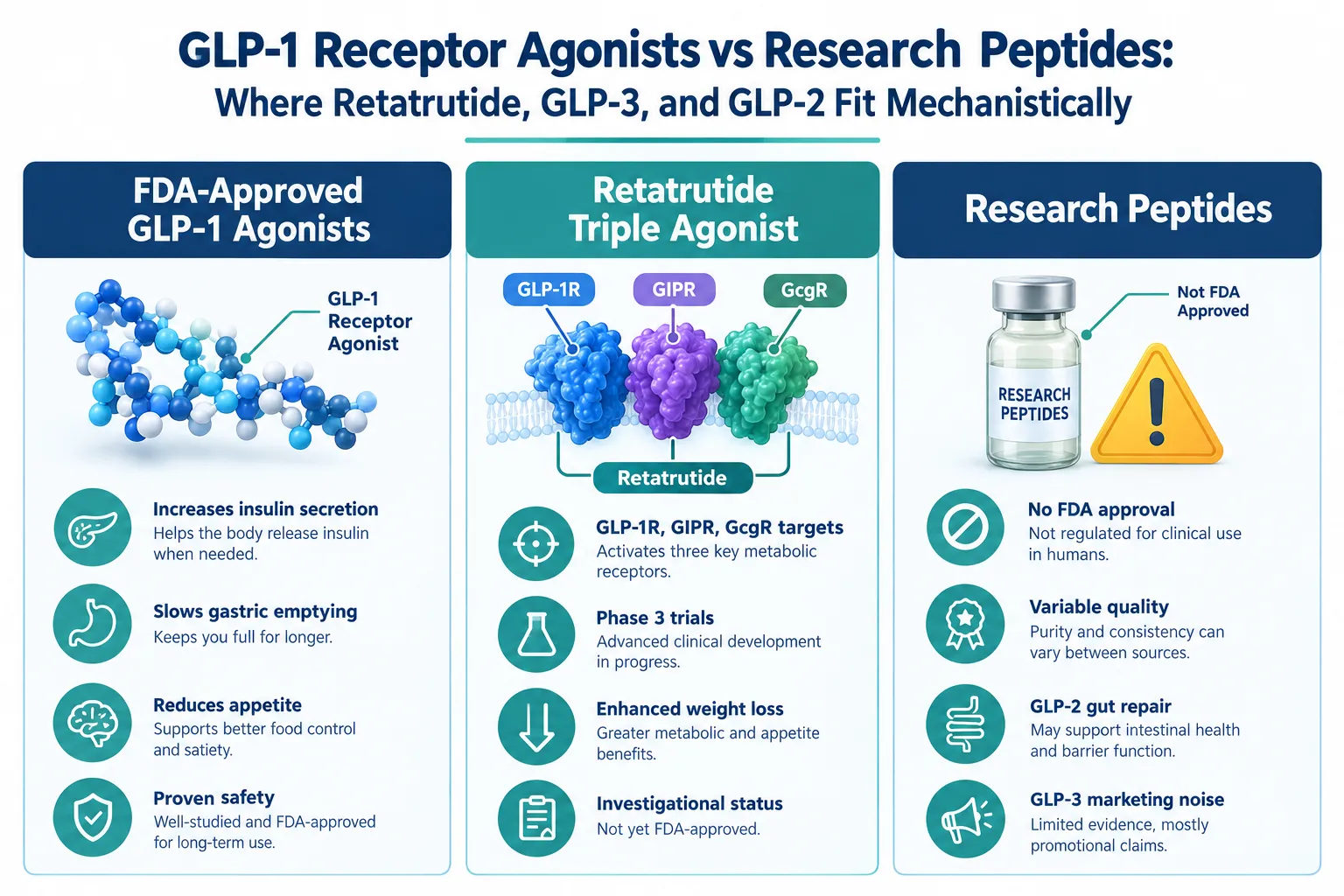
  • GLP-1 receptor agonists are an established, FDA-approved drug class; retatrutide is a next-generation triple agonist still moving through Phase 3 trials as of 2026.
  • Retatrutide targets three receptors (GLP-1R, GIPR, and GcgR simultaneously), producing weight-loss results that significantly exceed standard GLP-1 monotherapy in Phase 2 data.
  • GLP-2 is a structurally related peptide with a distinct, gut-focused mechanism; its agonists are approved for specific intestinal conditions, not obesity.
  • "GLP-3" does not currently represent a validated receptor class; the term is largely used in marketing contexts and should be treated with caution.
  • Research peptides occupy a separate regulatory and mechanistic category from approved GLP-1 drugs, and the distinction matters for both safety and scientific accuracy.

What Defines a GLP-1 Receptor Agonist

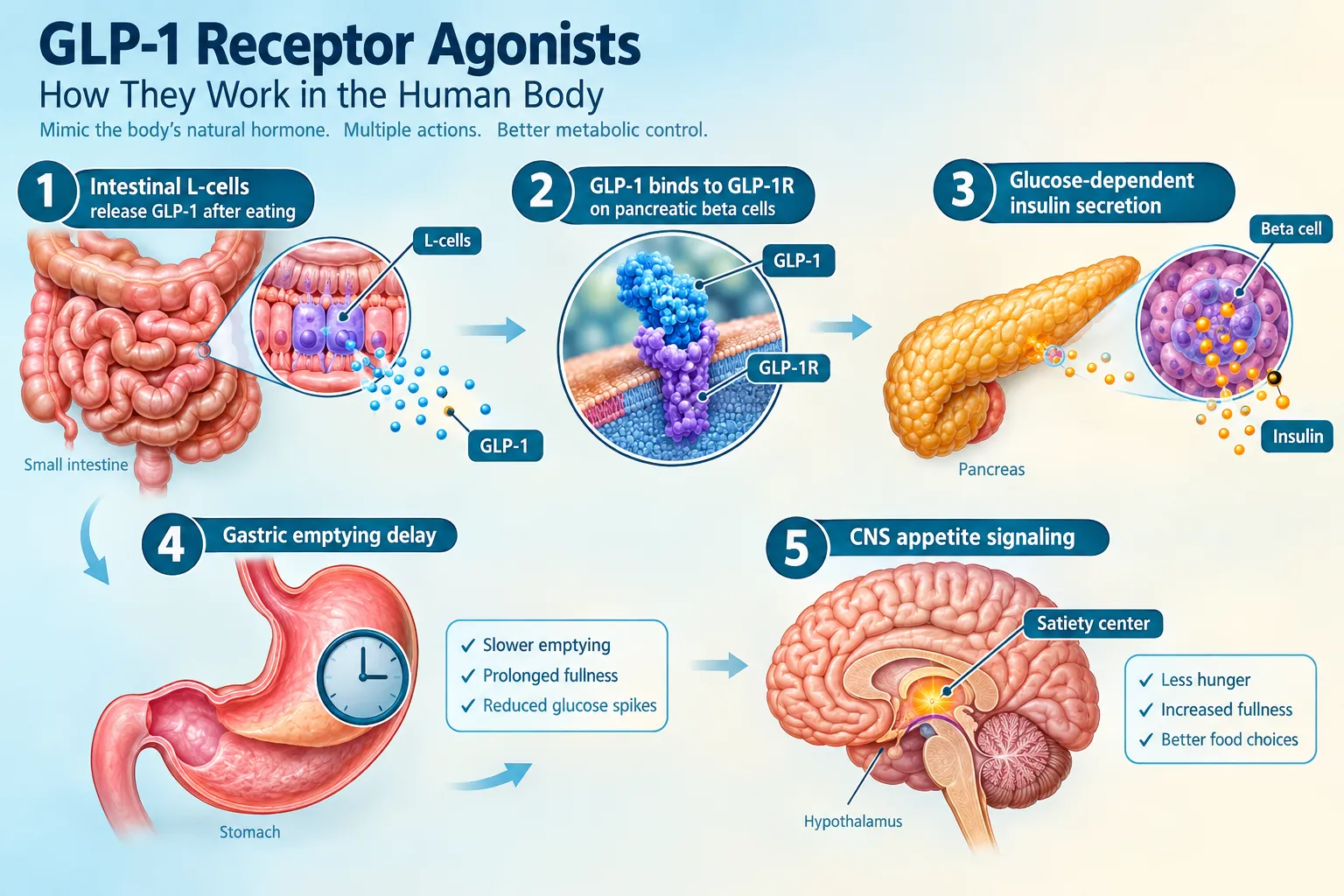
GLP-1 (glucagon-like peptide-1) is an incretin hormone released from intestinal L-cells after eating. It binds the GLP-1 receptor (GLP-1R) to stimulate glucose-dependent insulin secretion, suppress glucagon, slow gastric emptying, and reduce appetite through central nervous system signaling.

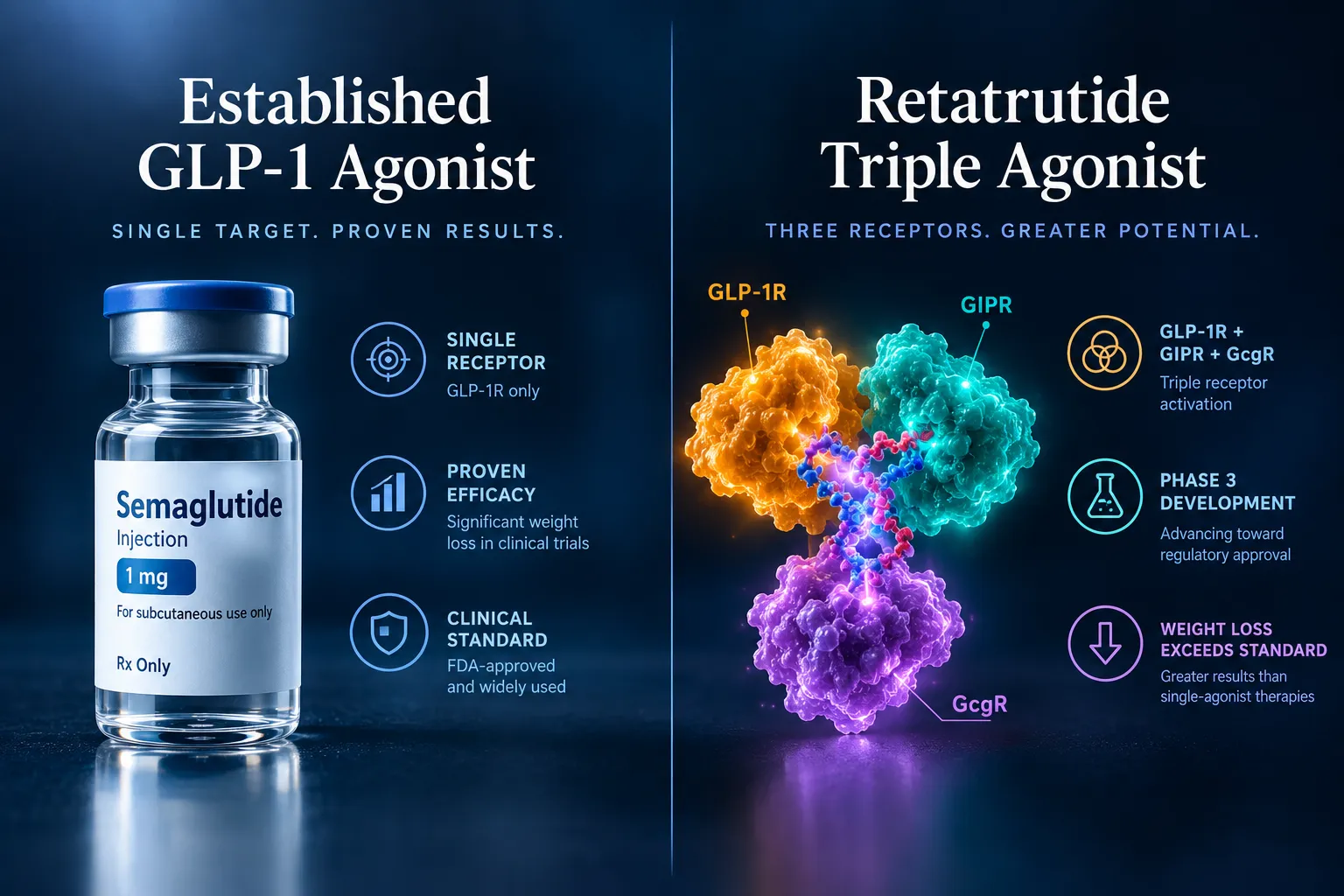
Approved GLP-1 receptor agonists, including semaglutide and liraglutide, are synthetic analogs engineered for extended half-lives. They are regulated medicines with defined dosing, safety profiles, and clinical indications. In obesity trials, semaglutide produces mean body-weight reductions of approximately 15% over 68 weeks, a benchmark that defined the class.
What Defines a GLP-1 Receptor Agonist

The key mechanistic point: these drugs act on a single receptor. Their benefits, glycemic control, modest cardiovascular risk reduction, and weight loss, flow from that one target. This single-receptor architecture is precisely what newer compounds like retatrutide are designed to move beyond.

Retatrutide: Where Triple Agonism Changes the Equation

Retatrutide is the clearest example of why the comparison of GLP-1 Receptor Agonists vs Research Peptides: Where Retatrutide, GLP-3, and GLP-2 Fit Mechanistically demands precision. It is not a research peptide in the informal sense. It is an investigational drug in structured clinical development, and its mechanism is meaningfully different from standard GLP-1 monotherapy.

Retatrutide simultaneously activates three receptors:

Receptor Primary Action
GLP-1R Appetite suppression, insulin secretion, gastric slowing
GIPR (GIP receptor) Enhanced insulin response, adipose tissue signaling
GcgR (Glucagon receptor) Increased energy expenditure, thermogenesis, hepatic fat reduction

This triple agonism produced striking Phase 2 results: participants receiving the highest dose achieved mean weight reductions of approximately 24% over 48 weeks, roughly 60% greater than semaglutide benchmarks in comparable timeframes. Responder analysis showed that a substantial proportion of participants lost more than 20% of body weight, a threshold rarely crossed with single-receptor agents.

Beyond weight, Phase 2 data showed meaningful reductions in fasting glucose, triglycerides, LDL particle counts, and blood pressure. These cardiometabolic improvements suggest the glucagon receptor component contributes effects beyond appetite suppression alone.

As of 2026, retatrutide is in Phase 3 trials covering obesity, type 2 diabetes, and non-alcoholic steatohepatitis (NASH). Regulatory submission timelines remain under active review. Researchers tracking this compound can find relevant context on retatrutide clinical trials and the broader retatrutide clinical trial landscape.

For those looking at investigational compound options, buy Reta online resources and buy Reta peptide listings are available for research purposes, distinct from clinical use.

GLP-2 and GLP-3: Mechanistic Niches and Marketing Noise
GLP-2 and GLP-3: Mechanistic Niches and Marketing Noise

GLP-2: A Real Peptide With a Distinct Gut Role

GLP-2 is co-secreted with GLP-1 from the same intestinal L-cells, but it acts on a completely separate receptor (GLP-2R) with no meaningful overlap in function. Its primary actions are:

  • Intestinal epithelial growth, stimulating mucosal repair and villus elongation
  • Nutrient absorption enhancement, increasing gut surface area
  • Reduced intestinal permeability, supporting barrier integrity

GLP-2 agonists such as teduglutide are approved for short bowel syndrome, a condition where intestinal absorptive surface is critically reduced. Apraglutide is in late-stage development for similar indications. These are not weight-loss drugs. They do not activate GLP-1R, do not suppress appetite centrally, and are not interchangeable with incretin therapies. Placing GLP-2 agonists in the same category as semaglutide or retatrutide reflects a fundamental mechanistic misunderstanding.

For those interested in the gut-focused metabolic research space, tesa peptide benefits and the broader where to buy tesa online resource offer adjacent context on peptides that influence metabolic tissue.

GLP-3: Conceptual Label, Not an Established Class

"GLP-3" appears in product marketing and some preliminary literature, but it does not currently represent a validated receptor class with confirmed pharmacology. The peptide fragment sometimes labeled GLP-3 is a further processing product of proglucagon, but no confirmed GLP-3 receptor has been characterized with reproducible, peer-reviewed receptor binding data.

"GLP-3 as a drug target remains conceptual. Researchers should treat any product marketed under this label with significant skepticism until receptor confirmation and clinical data exist."

This is a critical distinction in the broader discussion of GLP-1 Receptor Agonists vs Research Peptides: Where Retatrutide, GLP-3, and GLP-2 Fit Mechanistically. Mixing a well-validated drug class with a label that lacks receptor confirmation creates confusion that can mislead both researchers and consumers.

For those exploring GLP-3-related research compounds, the GLP-3R 30mg peptide GA9 and GLP-3 Reta 30mg for sale listings provide research-grade options, while GLP3 where to buy resources offer sourcing guidance for laboratory investigation contexts.

Regulatory Status and the Research Peptide Distinction
Regulatory Status and the Research Peptide Distinction

The regulatory gap between approved GLP-1 receptor agonists and research peptides is substantial and consequential.

Approved GLP-1 RAs:

  • Manufactured under GMP (Good Manufacturing Practice) standards
  • Carry defined pharmacokinetic and safety profiles from large-scale trials
  • Prescribed by licensed clinicians for specific indications
  • Subject to post-market surveillance

Research peptides (including investigational GLP-related compounds):

  • Intended for laboratory and preclinical research use only
  • Not approved for human therapeutic use outside clinical trials
  • Purity and characterization depend entirely on supplier quality
  • Regulatory oversight varies significantly by jurisdiction

Retatrutide occupies a middle position: it is investigational, not approved, but it is studied under strict IND (Investigational New Drug) frameworks with rigorous safety monitoring, a very different context from informal research peptide use.

The safety profile of retatrutide in Phase 2 and early Phase 3 data mirrors the GLP-1 class in its most common adverse events: nausea, vomiting, and gastrointestinal discomfort, predominantly dose-dependent and transient. No novel safety signals have emerged that are categorically distinct from the established GLP-1 agonist class, though the glucagon agonism component warrants continued monitoring for effects on bone density and hepatic function.

For researchers sourcing lab tested peptides and evaluating supplier quality, purity documentation is non-negotiable. The visceral fat research tag provides additional context on metabolic endpoints relevant to GLP-related compound investigation.

Conclusion

The landscape of GLP-1 Receptor Agonists vs Research Peptides: Where Retatrutide, GLP-3, and GLP-2 Fit Mechanistically is not as complicated as the terminology suggests, but it does require precision. Three actionable principles apply:

  1. Distinguish by receptor and regulatory status. GLP-1 RAs are approved, single-receptor drugs. Retatrutide is a triple agonist in Phase 3 development. GLP-2 agonists address gut integrity, not obesity. GLP-3 lacks confirmed receptor biology.

  2. Evaluate mechanistic claims critically. Any compound marketed as a "GLP-3 agonist" without peer-reviewed receptor confirmation deserves scrutiny. Receptor identity is the foundation of pharmacological classification.

  3. Apply the research-peptide standard. For laboratory investigation, source purity-verified, lab-tested compounds from documented suppliers. Never conflate research use with clinical therapy.

As Phase 3 retatrutide data matures through 2026 and beyond, the gap between triple agonism and standard GLP-1 monotherapy will become clearer. Staying grounded in mechanism, not marketing, is the most reliable guide through this rapidly evolving field.

Tags: glp-1 receptor agonists, glp-2, glp-3, incretin therapy, investigational peptides, research peptides, retatrutide, triple agonist
https://www.puretestedpeptides.com/wp-content/uploads/2026/09/glp-1-receptor-agonists-vs-research-peptides-where-retatrutide-glp-3-and-glp-2-f.webp 1024 1536 https://www.puretestedpeptides.com/wp-content/uploads/2026/01/buy-peptides-online.jpg 2026-09-14 13:07:022026-09-14 13:07:02GLP-1 Receptor Agonists vs Research Peptides: Where Retatrutide, GLP-3, and GLP-2 Fit Mechanistically
You might also like
Prostate Specific Antigen and Peptide Hormones: How PSA Is Used to Monitor Enclomiphene and GLP-Class Research Studies Prostate Specific Antigen and Peptide Hormones: How PSA Is Used to Monitor Enclomiphene and GLP-Class Research Studies
Peptides and Polypeptides in Modern Research: How Molecular Size Shapes Function, Stability, and Experimental Design Peptides and Polypeptides in Modern Research: How Molecular Size Shapes Function, Stability, and Experimental Design
Peptides vs Classic Small‑Molecule Drugs: How GLP-3 Retatrutide, MOTS-c, and 5-Amino-1MQ Change Lab Design Compared With Prednisone and Atorvastatin Peptides vs Classic Small‑Molecule Drugs: How GLP-3 Retatrutide, MOTS-c, and 5-Amino-1MQ Change Lab Design Compared With Prednisone and Atorvastatin
Peptide Research and Omeprazole: What Acid-Suppressing Drugs Mean for GLP-2 and Gut-Focused Studies Peptide Research and Omeprazole: What Acid-Suppressing Drugs Mean for GLP-2 and Gut-Focused Studies
Nasal Spray Peptides: Delivery Methods, Bioavailability, and Research Advantages Nasal Spray Peptides: Delivery Methods, Bioavailability, and Research Advantages
Tesofensine and Metabolic Research: How a Noradrenergic Appetite Modulator Compares With GLP‑3 Peptides in Study Design Tesofensine and Metabolic Research: How a Noradrenergic Appetite Modulator Compares With GLP‑3 Peptides in Study Design
Retatrutide Phase 3 Data and the Future of GLP‑3: What TRIUMPH and TRANSCEND Trials Mean for Research-Use Peptide Design Retatrutide Phase 3 Data and the Future of GLP‑3: What TRIUMPH and TRANSCEND Trials Mean for Research-Use Peptide Design
Complete Guide to Peptide Mechanisms: How GLP-1, GLP-3, and Growth Hormone Peptides Work at the Molecular Level Complete Guide to Peptide Mechanisms: How GLP-1, GLP-3, and Growth Hormone Peptides Work at the Molecular Level
0 replies

Leave a Reply

Want to join the discussion?
Feel free to contribute!

Leave a Reply Cancel reply

Your email address will not be published. Required fields are marked *

×

Helpful Links

  • My account
  • Cart
  • Checkout
  • Refund and Returns Policy
  • Privacy Policy
  • SMS Privacy Policy
  • Login
  • My Account
  • Logout

USA Made Lab Tested Peptides

All products are sold for research, laboratory, or analytical purposes only, and are not for human consumption


Pure Tested Peptides is a chemical supplier. Pure Tested Peptides is not a compounding / chemical compounding facility as defined under 503A of the Federal Food, Drug, and Cosmetic act. Pure Tested Peptides is not an outsourcing facility as defined under 503B of the Federal Food, Drug, and Cosmetic act.

The statements made within this website have not been evaluated by the US Food and Drug Administration. The products we offer are not intended to diagnose, treat, cure or prevent any disease.

Human/Animal Consumption Prohibited. Laboratory/In-Vitro Experimental Use Only

Link to: Peptide Drug Interactions: How Research Peptides Interact With Common Medications Link to: Peptide Drug Interactions: How Research Peptides Interact With Common Medications Peptide Drug Interactions: How Research Peptides Interact With Common Medic...Peptide Drug Interactions: How Research Peptides Interact With Common Medications Link to: Enclomiphene Citrate vs Enclomiphene: Stability, Storage, and Research Handling Link to: Enclomiphene Citrate vs Enclomiphene: Stability, Storage, and Research Handling Enclomiphene Citrate vs Enclomiphene: Stability, Storage, and Research HandlingEnclomiphene Citrate vs Enclomiphene: Stability, Storage, and Research Hand...
Scroll to top Scroll to top Scroll to top