

Mitochondria, Adenosine Triphosphate, and Peptide Signaling: Where MOTS-c and 5-Amino-1MQ Fit in Cellular Energy Research
Every cell in the human body runs on a single rechargeable currency: adenosine triphosphate. Mitochondria produce the vast majority of it, yet these organelles do far more than generate fuel. They broadcast molecular signals that tell the rest of the cell how to respond to stress, exercise, and metabolic demand. Understanding mitochondria, adenosine triphosphate, and peptide signaling, and where MOTS-c and 5-Amino-1MQ fit in cellular energy research, has become one of the most active areas in metabolic biology heading into 2026.
Key Takeaways
- Mitochondria produce ATP through oxidative phosphorylation and also act as signaling hubs that communicate cellular energy status.
- MOTS-c is a 16-amino-acid peptide encoded in mitochondrial DNA that regulates metabolism via AMPK activation and nuclear gene expression.
- 5-Amino-1MQ inhibits the enzyme NNMT, helping preserve NAD+ pools that feed directly into mitochondrial ATP production.
- As of 2026, MOTS-c remains unapproved by the FDA, is banned by WADA in competitive sport, and has no completed human clinical trials with published outcomes.
- Together, MOTS-c and 5-Amino-1MQ represent two complementary strategies, peptide signaling and small-molecule enzymatic control, for probing cellular energy systems.
Mitochondria and ATP: The Foundation of Cellular Energy
Mitochondria are double-membraned organelles found in nearly every eukaryotic cell. Their inner membrane is folded into structures called cristae, which dramatically increase surface area for the electron transport chain (ETC). As electrons move through ETC complexes, protons are pumped across the inner membrane, creating an electrochemical gradient. ATP synthase harnesses this gradient to phosphorylate ADP into ATP, a process called oxidative phosphorylation.
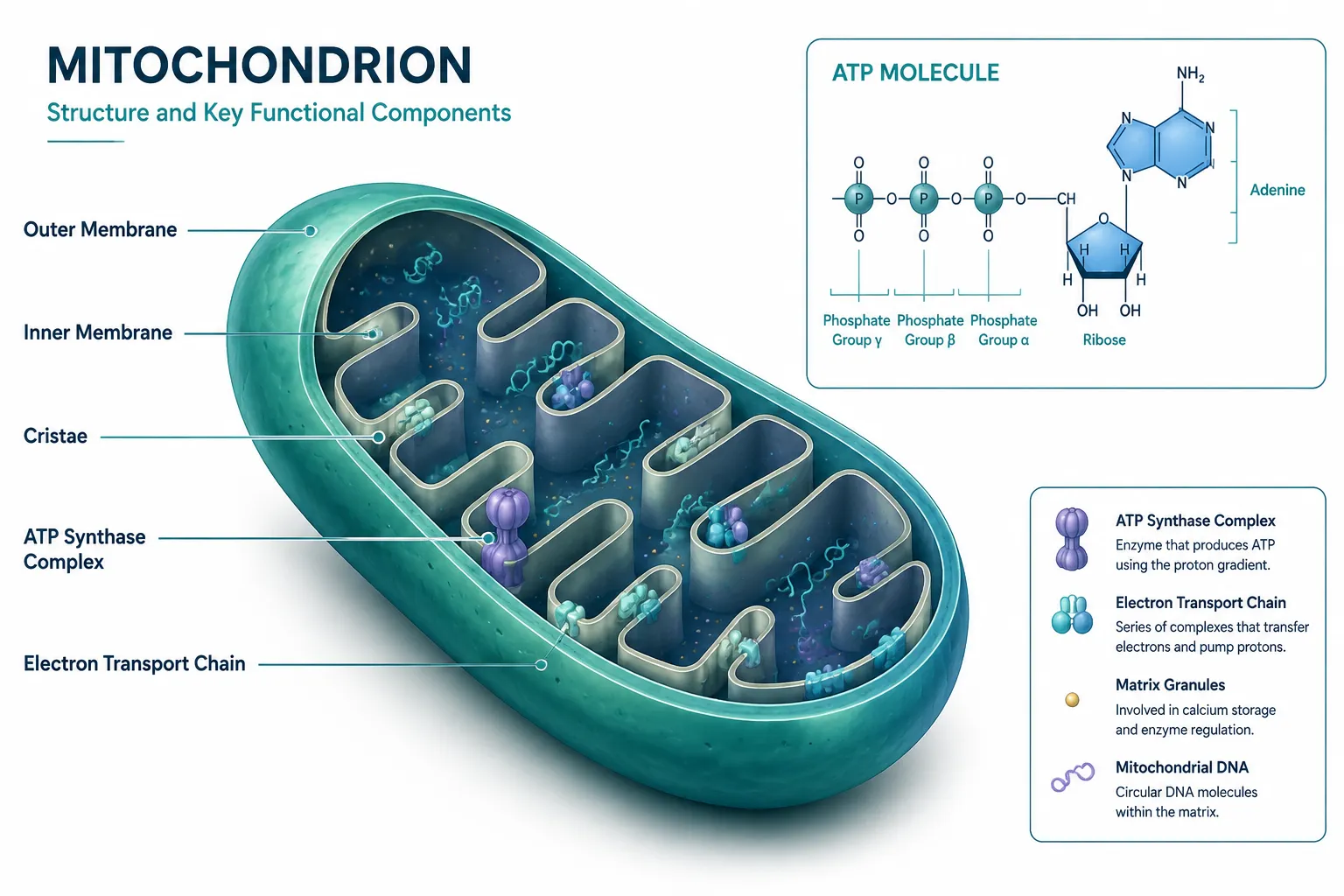
This process is remarkably efficient but sensitive to disruption. Oxidative stress, nutrient excess, and aging can all impair mitochondrial membrane integrity and reduce ATP output. When ATP levels fall, the cell detects the drop through sensors like AMP-activated protein kinase (AMPK), which then triggers compensatory responses, increasing glucose uptake, stimulating fatty acid oxidation, and suppressing energy-expensive anabolic processes.
Key mitochondrial functions beyond ATP production:
- Regulation of calcium signaling
- Control of apoptosis (programmed cell death)
- Production of reactive oxygen species (ROS) as signaling molecules
- Encoding and secreting mitochondrial-derived peptides (MDPs)
That last function is where the field of mitochondria, adenosine triphosphate, and peptide signaling becomes especially relevant to current research.
MOTS-c: A Mitochondrial Peptide That Speaks to the Nucleus
MOTS-c (mitochondrial open reading frame of the 12S rRNA-c) is a 16-amino-acid peptide with the sequence MRWQEMGYIFYPRKLR. It is encoded not in nuclear DNA but within the 12S rRNA region of mitochondrial DNA (MT-RNR1), making it one of the best-characterized mitochondrial-derived peptides identified to date.
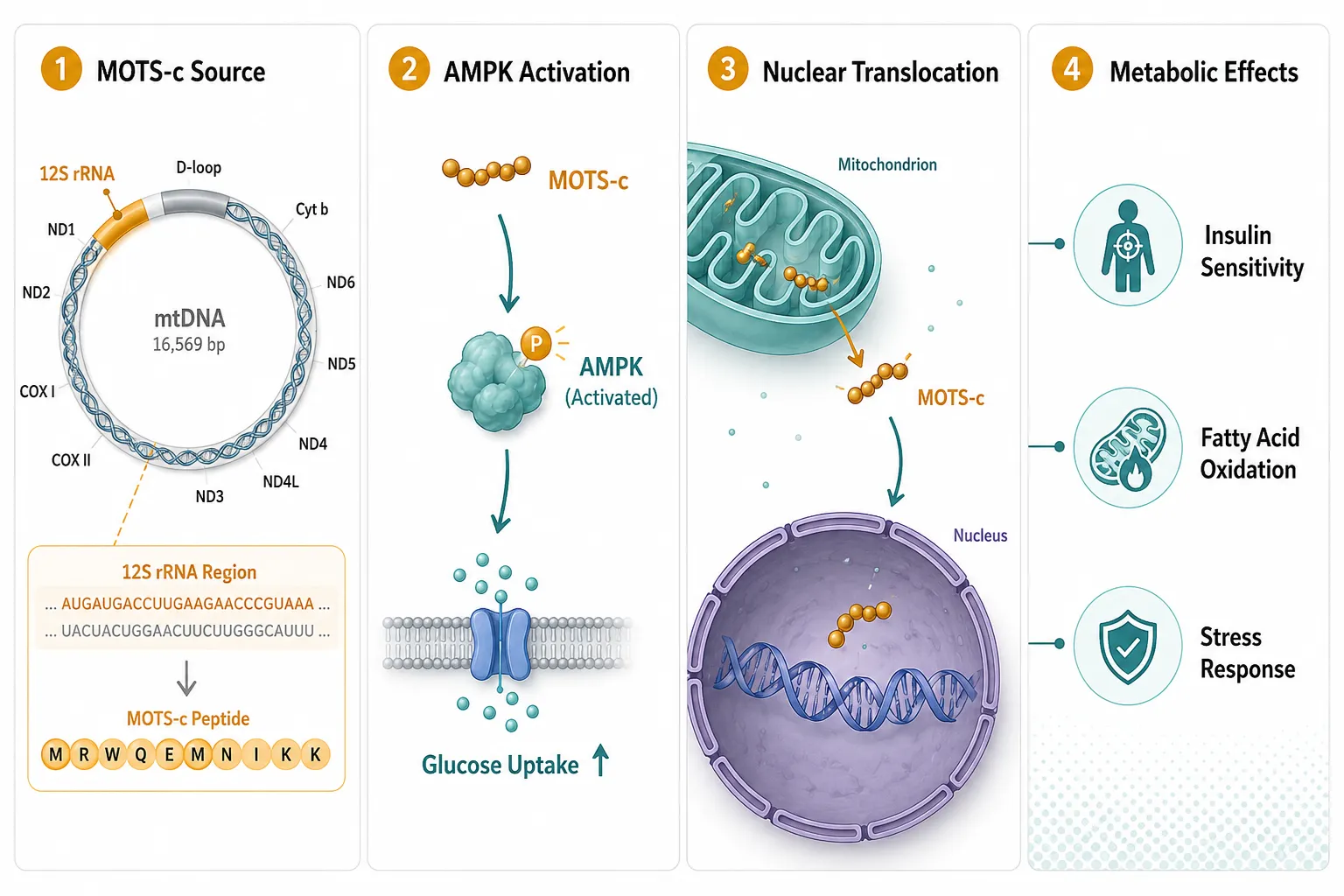
What makes MOTS-c scientifically compelling is its dual role: it functions both as a metabolic regulator and as a direct communicator between mitochondria and the cell nucleus. Under conditions of energetic stress, MOTS-c translocates to the nucleus, where it directly influences gene expression. This mitochondria-to-nucleus communication pathway is a concrete molecular example of how organelles coordinate whole-cell responses to energy challenges.
How MOTS-c Influences Energy Metabolism
MOTS-c activates AMPK, the master energy-sensing kinase, which cascades into several downstream effects:
| Metabolic Effect | Mechanism |
|---|---|
| Improved insulin sensitivity | Enhanced glucose transporter activity in skeletal muscle |
| Increased fatty acid oxidation | AMPK-driven shift toward lipid catabolism |
| Reduced mTOR activity | Suppression of energy-expensive biosynthesis |
| Stress response modulation | Nuclear gene regulation under metabolic stress |
A 2025 study published in Nature reported that MOTS-c helps prevent pancreatic islet dysfunction by modulating both AMPK and mTOR pathways, supporting metabolic homeostasis in disease models. Separate 2025 research described MOTS-c as capable of restoring mitochondrial structure and function in metabolically stressed tissues, reinforcing its role as a bioenergetic modulator rather than a direct ATP booster.
Important distinction: MOTS-c does not directly synthesize ATP. Instead, it adjusts upstream signaling pathways that govern how efficiently cells produce and use energy.
Regulatory and Safety Status in 2026
Researchers and clinicians reviewing MOTS-c in 2026 must navigate a clear regulatory picture:
- FDA status: Not approved for human use; removed from the FDA's Section 503A Category 2 compounding list as of April 2026
- WADA status: Explicitly banned at all times under Section 4.4 (Metabolic Modulators, AMPK activators) of the Prohibited List
- Clinical trials: A Phase 2a randomized, double-blind, placebo-controlled trial (NCT07505745) launched in 2026 is testing MOTS-c in adults with prediabetes and overweight/obesity over 12 weeks, the first mid-stage human trial of its kind, with no results posted yet
- Safety profile: Unknown long-term toxicity, no established dosing, and no completed human trials with published outcomes
Researchers sourcing material for preclinical work can buy MOTS-c peptide through research-grade suppliers, though all use remains strictly experimental. For broader context on the current landscape of experimental compounds, the research peptides 2026 resource provides useful orientation.
5-Amino-1MQ and NAD+: A Complementary Strategy for Cellular Energy
Where MOTS-c operates through peptide signaling, 5-Amino-1MQ takes a different approach. It is a small-molecule inhibitor of nicotinamide N-methyltransferase (NNMT), an enzyme that methylates and consumes nicotinamide, a direct precursor to NAD+.
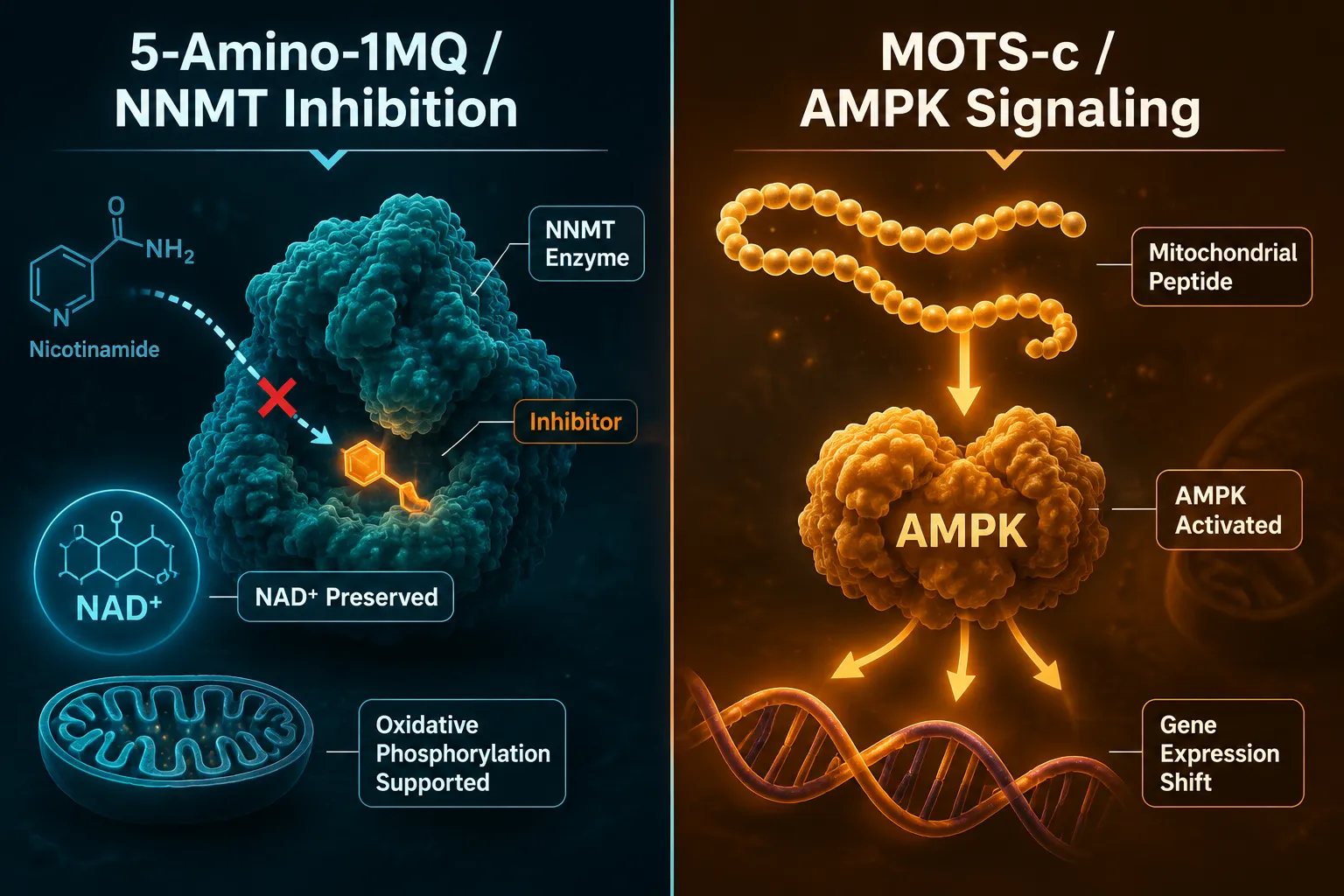
NAD+ is indispensable for mitochondrial function. It serves as the primary electron carrier feeding into the electron transport chain, and its availability directly affects the rate of oxidative phosphorylation and ATP output. When NNMT is overactive, as is common in obesity and metabolic disease, nicotinamide is diverted away from NAD+ synthesis, effectively starving the mitochondria of a key substrate.
By inhibiting NNMT, 5-Amino-1MQ helps preserve nicotinamide availability, supporting NAD+ pools and, by extension, the efficiency of ATP-generating pathways. Preclinical models suggest this mechanism can improve metabolic profiles in obesity-related conditions. Researchers interested in this compound can explore 5-Amino-1MQ peptides available for laboratory investigation.
MOTS-c and 5-Amino-1MQ: Two Layers of the Same System
These two compounds illustrate how cellular energy regulation operates on multiple levels simultaneously:
- MOTS-c adjusts the signaling layer, telling cells how to prioritize energy use via AMPK and nuclear gene regulation
- 5-Amino-1MQ adjusts the substrate layer, ensuring the raw materials (NAD+) needed for ATP synthesis remain available
Neither approach is redundant. Together, they represent a multi-layered research strategy for understanding and potentially correcting metabolic dysfunction at both the signaling and biochemical levels.
For researchers building rigorous experimental frameworks, understanding peptide classification helps distinguish between mitochondrial-derived peptides like MOTS-c and small-molecule enzyme inhibitors like 5-Amino-1MQ. Similarly, reviewing Bachem and reference standards for peptide benchmarks is essential when designing reproducible assays. For neurological comparisons involving other signaling peptides, the work on Semax and Selank in neurogenesis and synaptic plasticity offers useful methodological parallels.
Conclusion
The intersection of mitochondria, adenosine triphosphate, and peptide signaling, and where MOTS-c and 5-Amino-1MQ fit in cellular energy research, represents one of the most promising frontiers in metabolic biology. Mitochondria are not passive ATP factories; they are active signal broadcasters. MOTS-c exemplifies this by using a mitochondrially encoded peptide to communicate energy status to the nucleus and activate AMPK-driven metabolic reprogramming. 5-Amino-1MQ complements this by protecting the NAD+ substrate supply that powers oxidative phosphorylation directly.
Actionable next steps for researchers and science communicators in 2026:
- Monitor the Phase 2a MOTS-c clinical trial (NCT07505745) for the first standardized human safety and efficacy data.
- Treat all current MOTS-c and 5-Amino-1MQ applications as strictly preclinical and research-grade, no validated therapeutic use exists.
- Design experiments that evaluate both signaling (AMPK, mTOR) and substrate (NAD+, ATP yield) endpoints to capture the full picture of cellular energy modulation.
- Ensure any research-grade material is sourced from suppliers with verifiable purity standards and third-party testing.
The 2026 launch of the first mid-stage human MOTS-c trial marks a genuine inflection point. Until those results are published, the science remains compelling but incomplete, exactly the kind of open question that drives rigorous cellular energy research forward.


Leave a Reply
Want to join the discussion?Feel free to contribute!